All regions Ancestral voices across the old continent
Sahul Australia, New Guinea and the islands between them
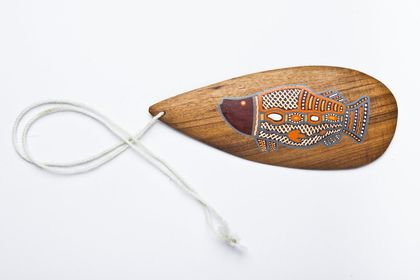
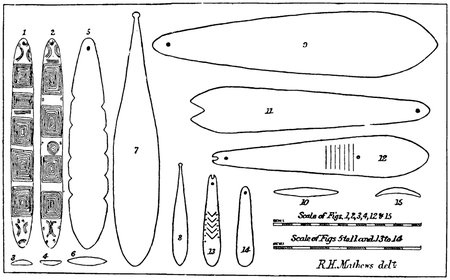
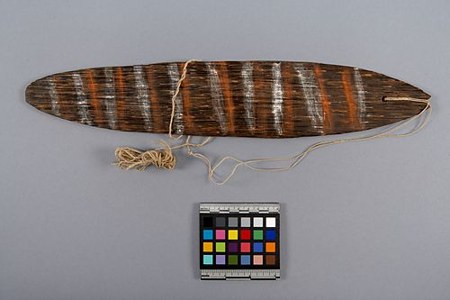
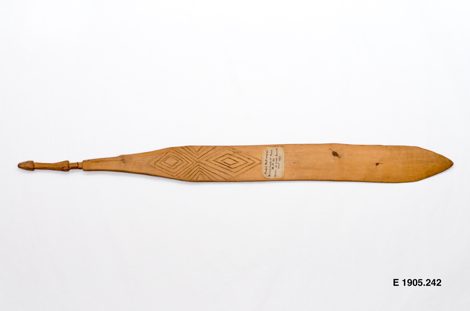
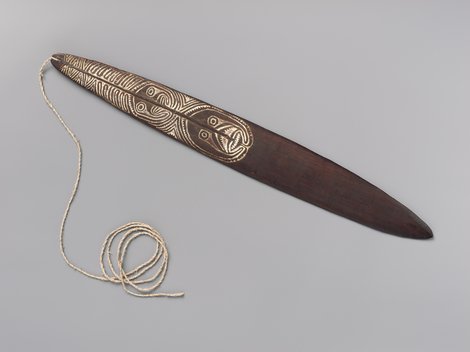
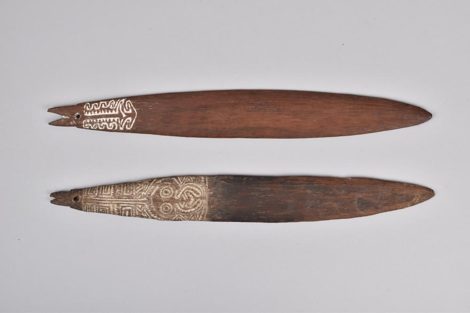
Across Australia and New Guinea, a whirled blade can make an ancestor present, turn a novice into an initiate and embody a right inherited from the first owners. Sahul brings these traditions into one view: voices with names, guarded revelations, and instruments whose stories explain who may hold them.
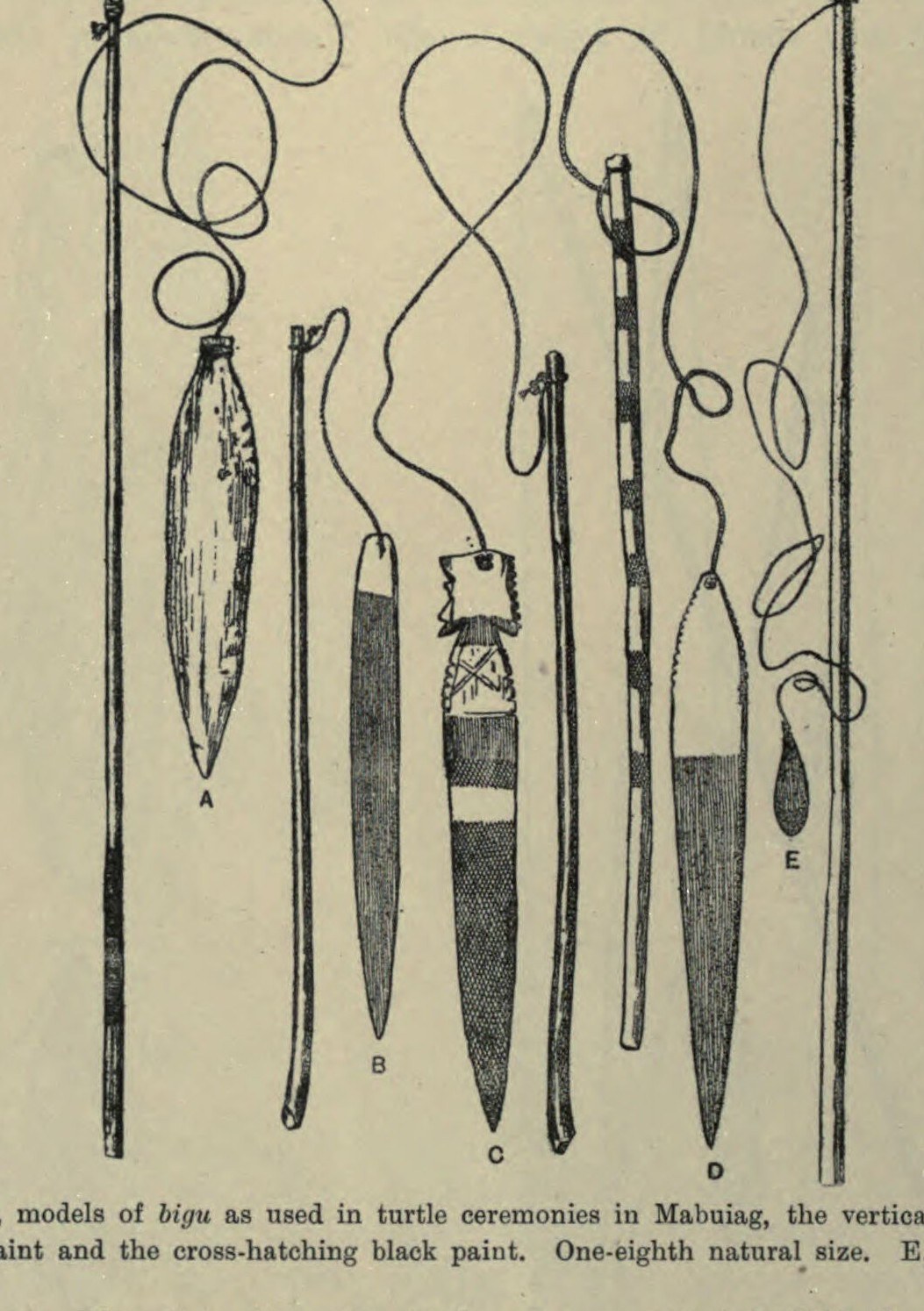
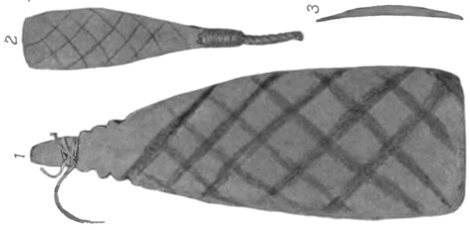
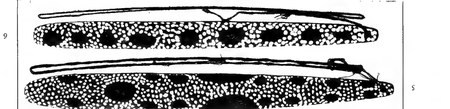
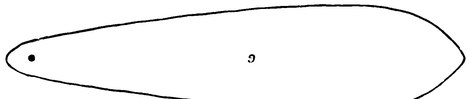
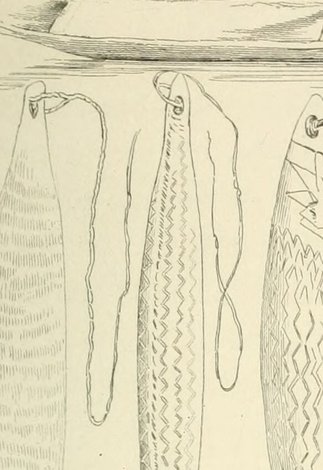
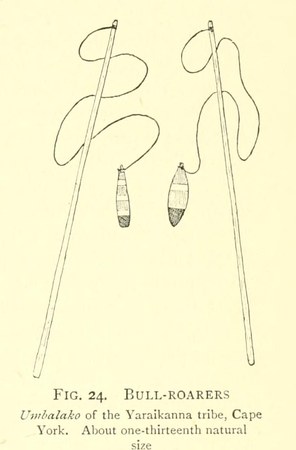
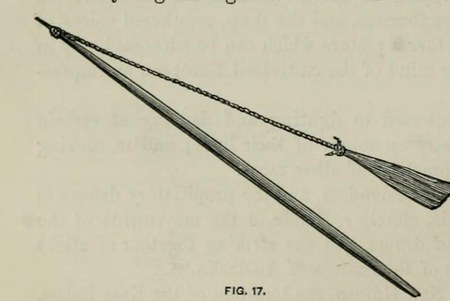
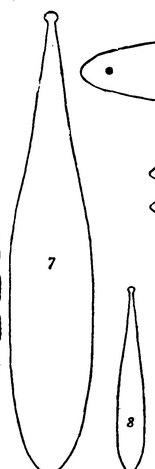
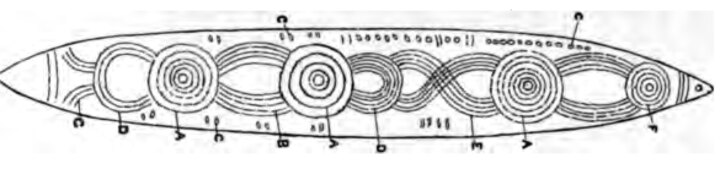
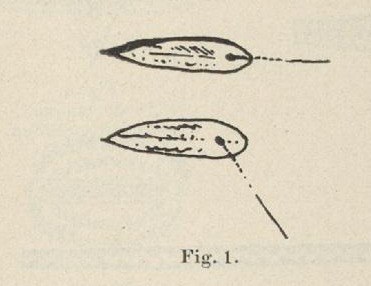
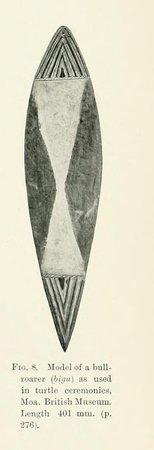
Mabuiag, Torres Strait Haddon's fig. 237: five models (A–E) of the bigu bull-roarers swung. Haddon (ed.), Reports Cambridge Anthrop. Exped. Torres Straits IV (1912), Fig. 237 A-D · Public domain
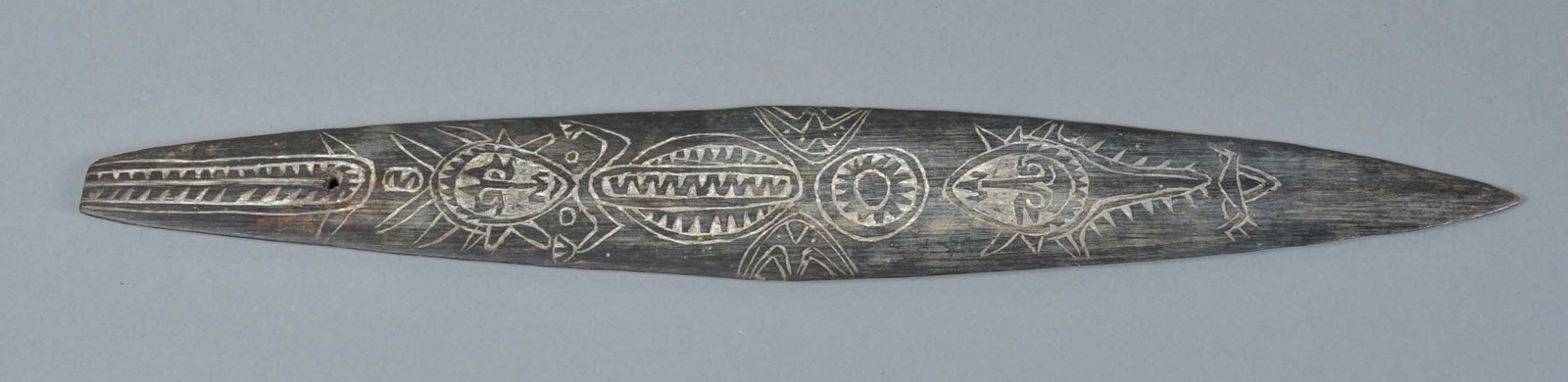
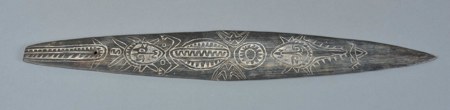
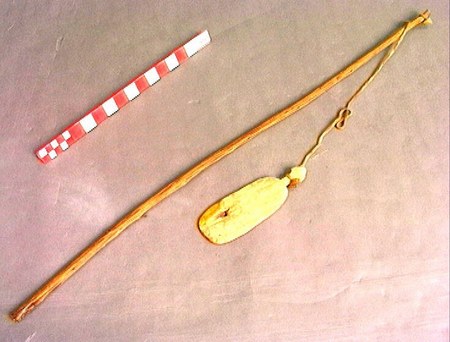
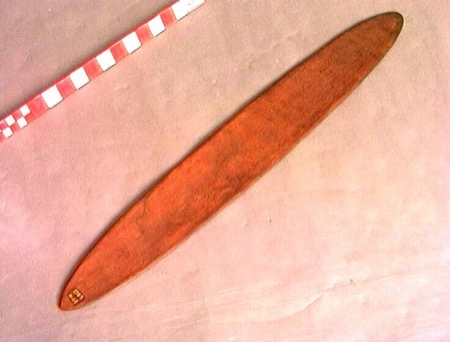
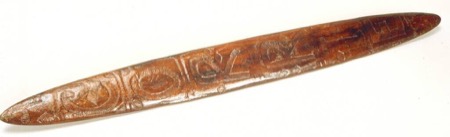
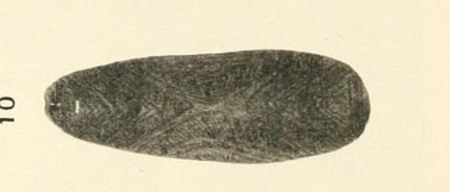
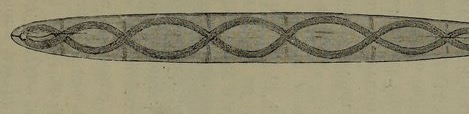
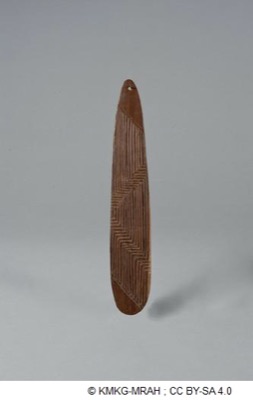
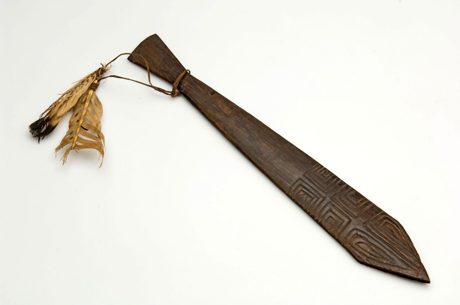
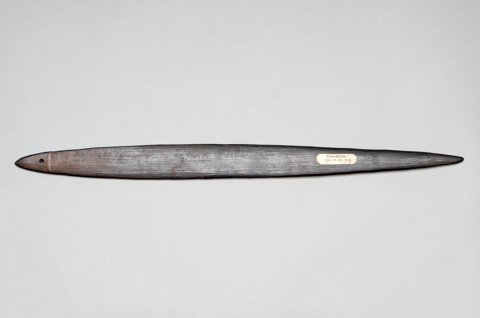
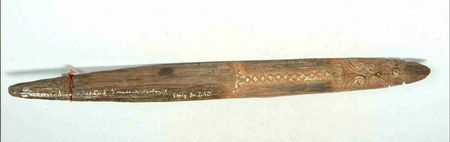
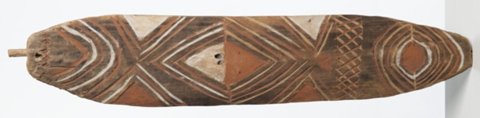
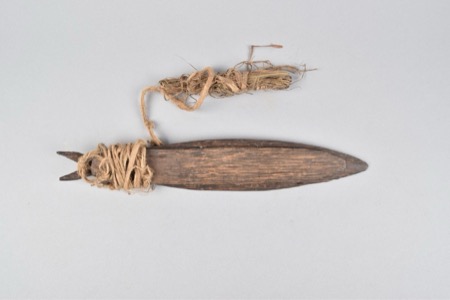
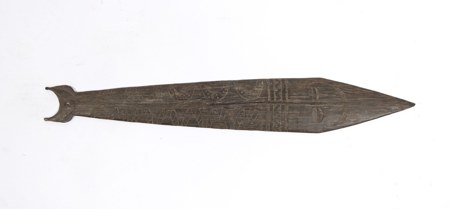
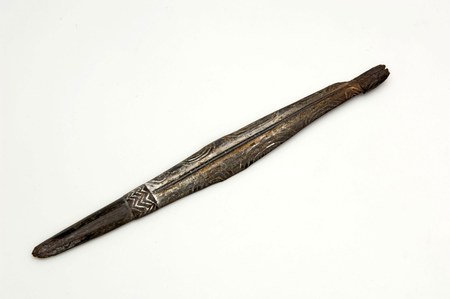
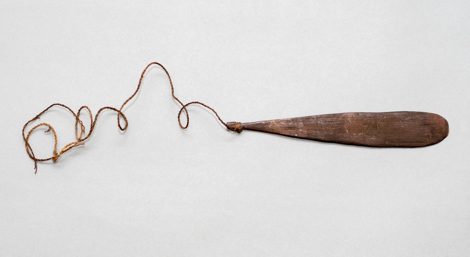
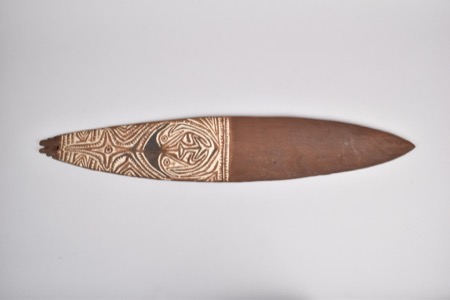
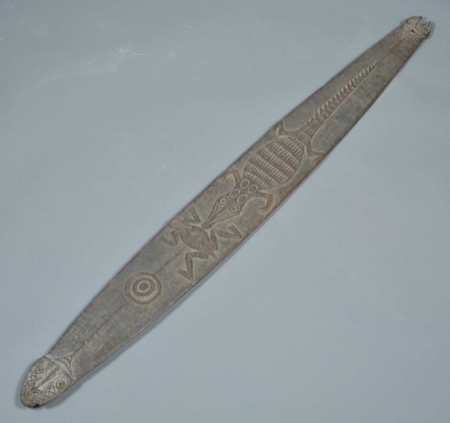
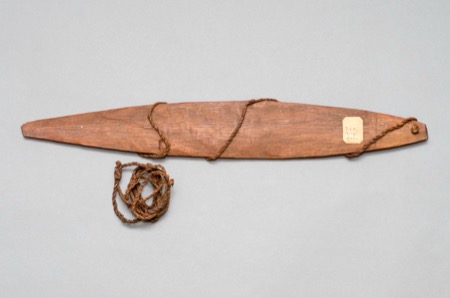
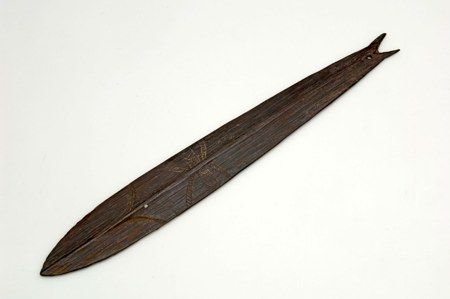
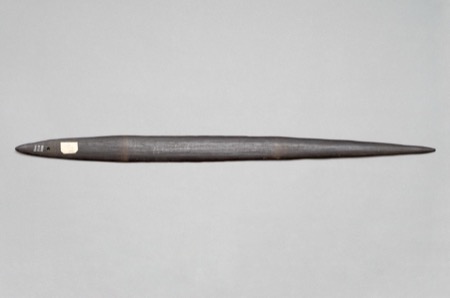
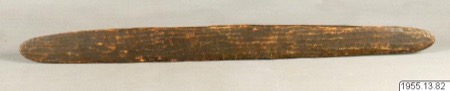
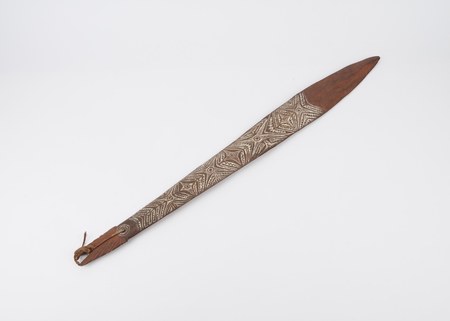
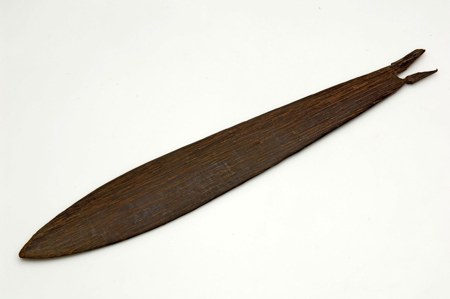
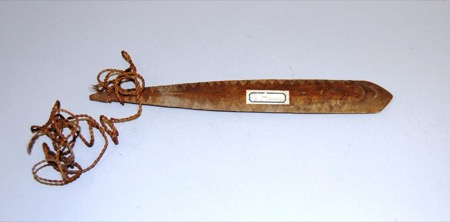
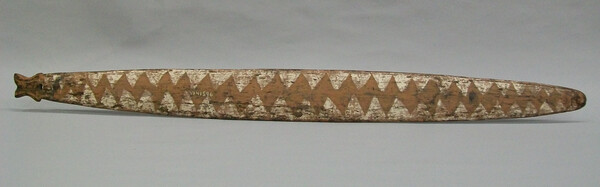
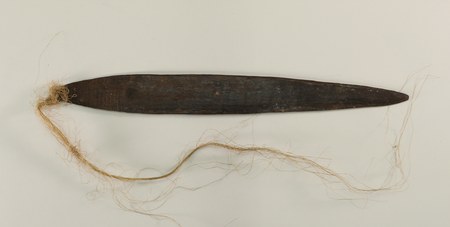
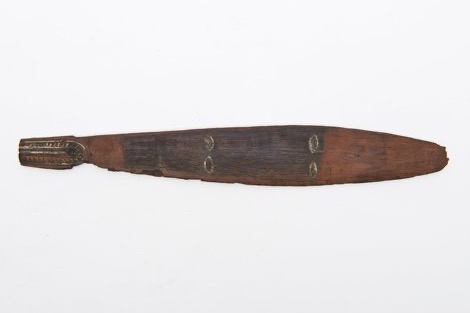
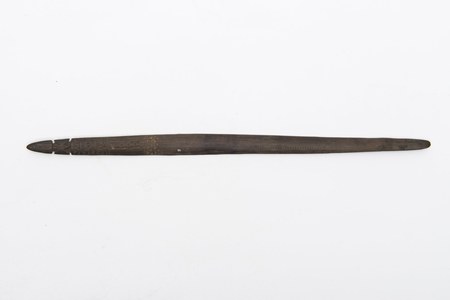
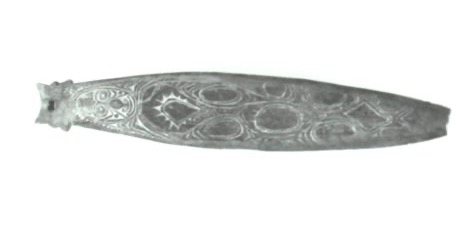
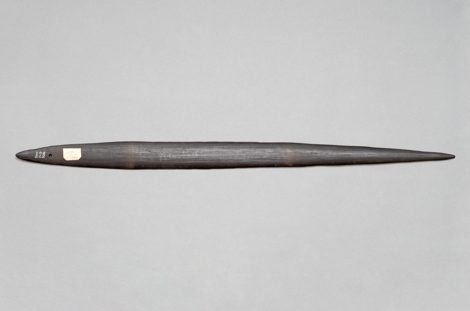
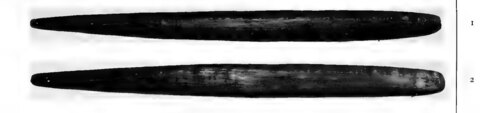
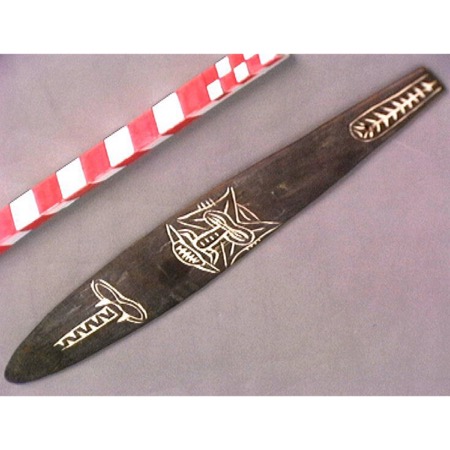
Bukaua (Bukawa), Huon Gulf A long, dark, finely tapered wooden blade incised along its length. Ethnologisches Museum, Staatliche Museen zu Berlin (VI 29955); photo Anika Niemeck · CC BY-NC-SA 4.0
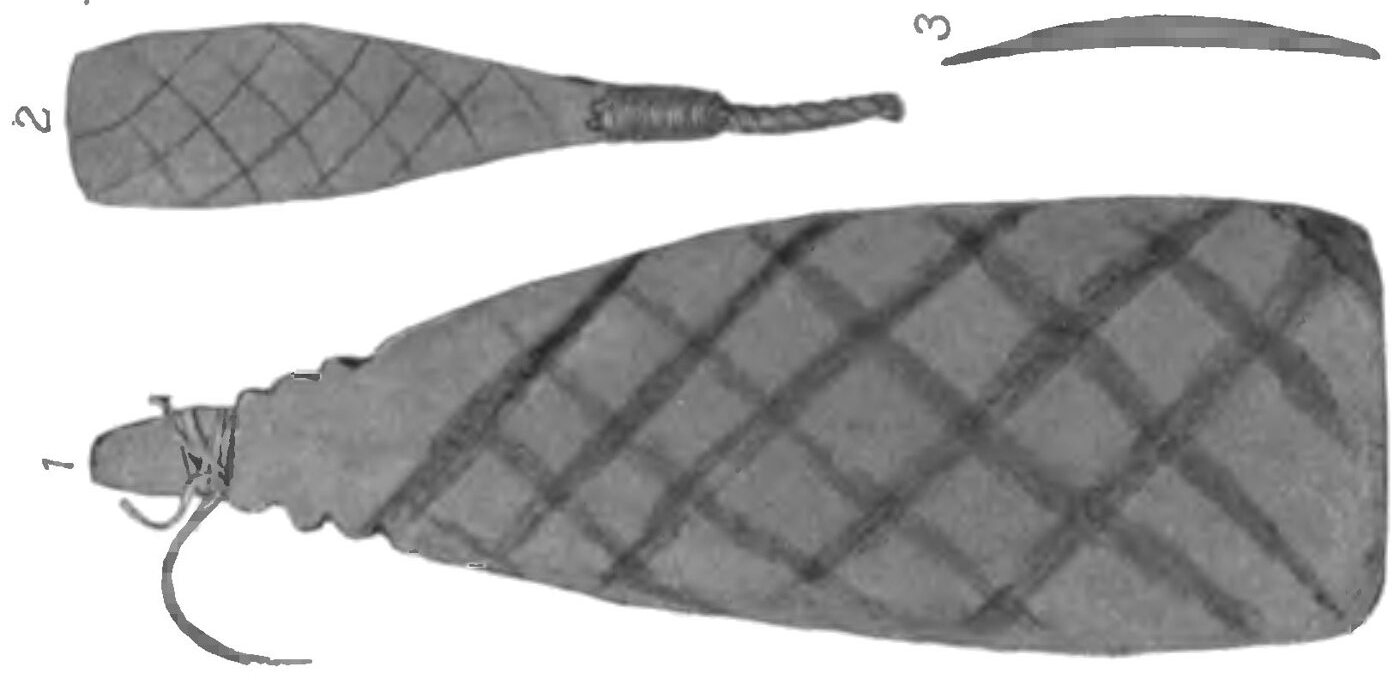
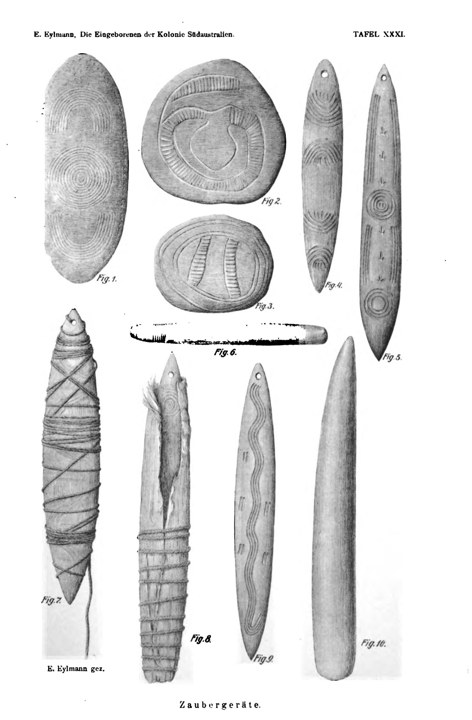
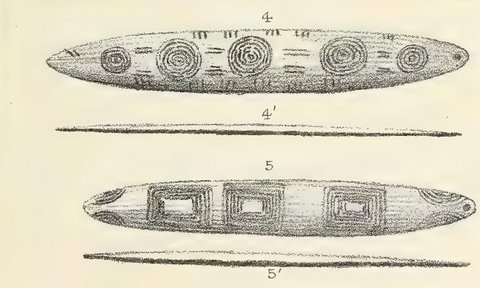
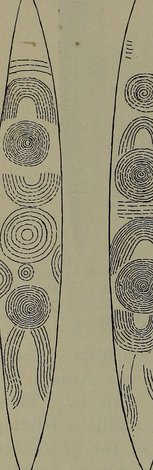
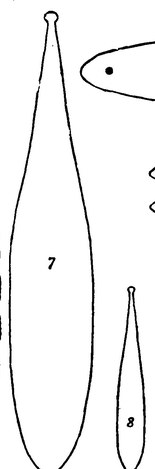
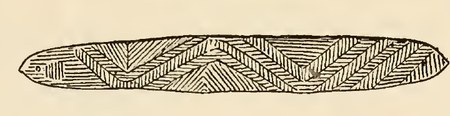
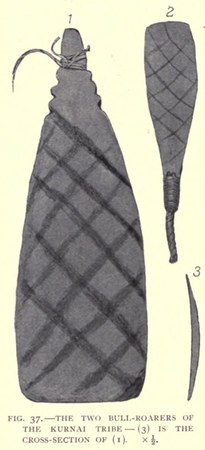
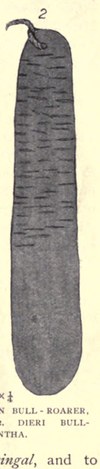
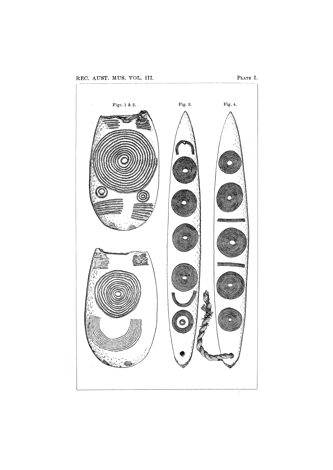
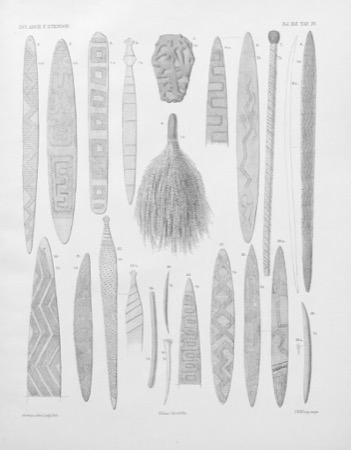
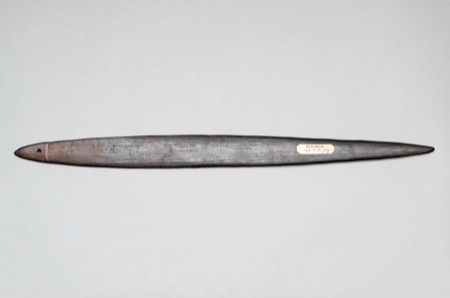
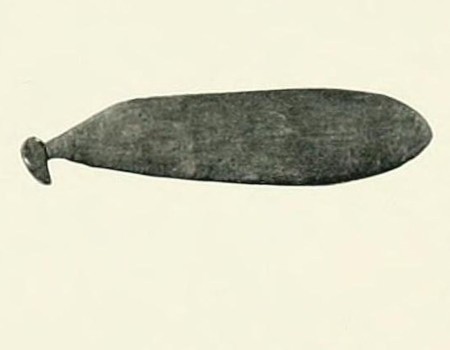
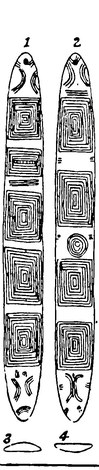
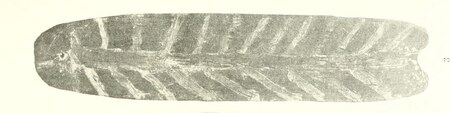
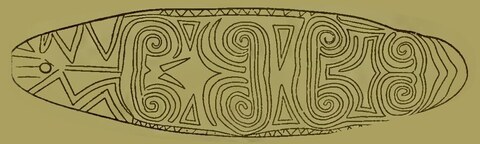
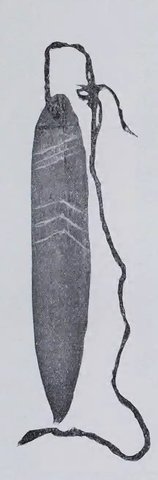
Kurnai / Gunai Two bull-roarers of the Kurnai (Gunai), figured by Howitt (1904, Fig. 37). A. W. Howitt, The Native Tribes of South-East Australia (1904), Fig. 37 · Public domain On this page A voice with a body and a name Hearing first, seeing later The first owners explain the present owners Torres Strait joins the view The voice and the flood A shared world at several scales The records Sources In Gippsland, boys were told they were about to meet their grandfather. In the Huon Gulf, a hut became the belly of the being that had swallowed them. Near Kokoda, hooded children heard their parents plead with named dead ancestors before the hoods were lifted and the sounding blades revealed. Across the old continent of Sahul, the bullroarer repeatedly does this work: an ancestral presence is heard, a transformation is enacted, and a person is admitted to knowledge previously held by others. 1 , 3 , 4
Kurnai / Gunai · Bukawa / Yabim · Hunjara (Koko), Yodda Valley
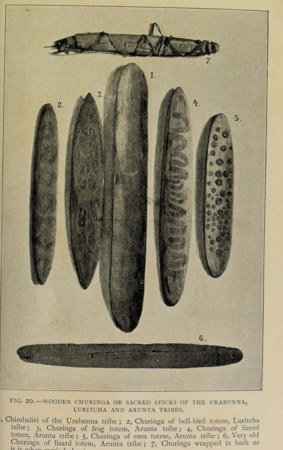
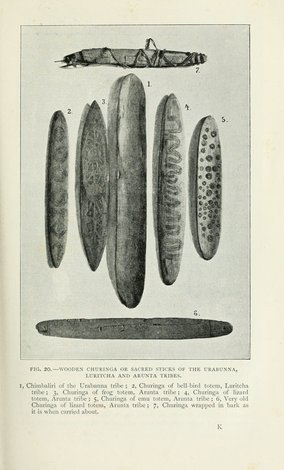
A voice with a body and a name The Kurnai Tundun was a grandfather, a son and an instrument. Howitt’s account of the Jeraeil initiation describes sixteen men emerging from the scrub around kneeling novices. The larger blade gave a dull roar; the smaller Rukut-Tundun, Tundun’s wife, gave a high screech. The names attached the sounds to a family whose deeds explained the ceremony. In central Australia, Spencer and Gillen described small wooden churinga, bored and tied with hair or fur string, sounding as Twanyirika’s voice at initiation. The larger class of sacred churinga embodied ancestral presence and ties to particular places. A piece of wood could consequently be far more than the apparatus behind a noise. 1 , 2
Kurnai / Gunai · Arunta / Arrernte
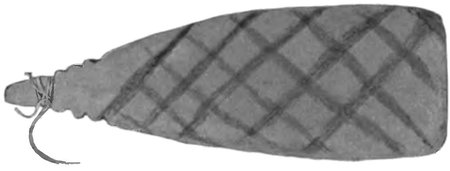
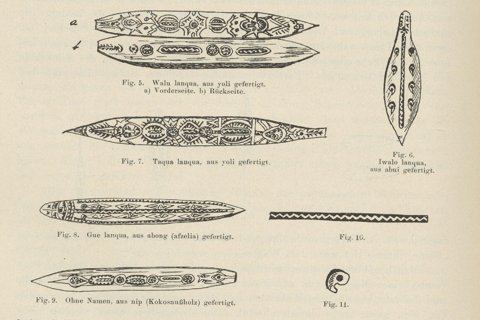
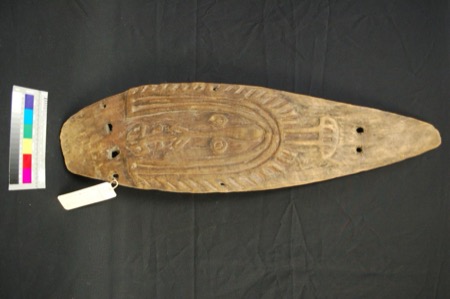
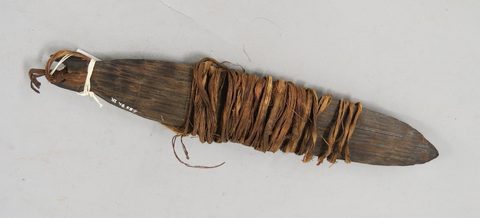
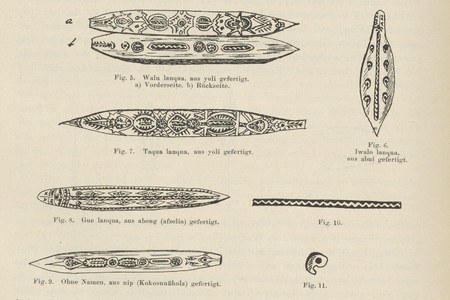
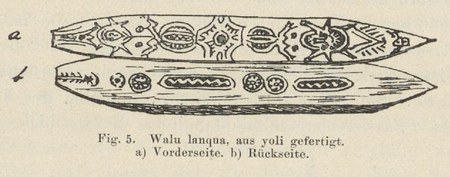
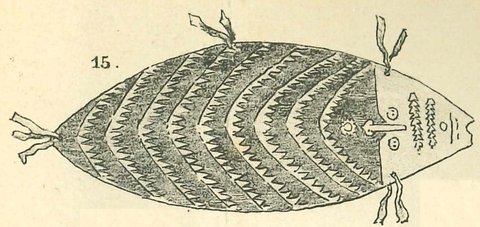
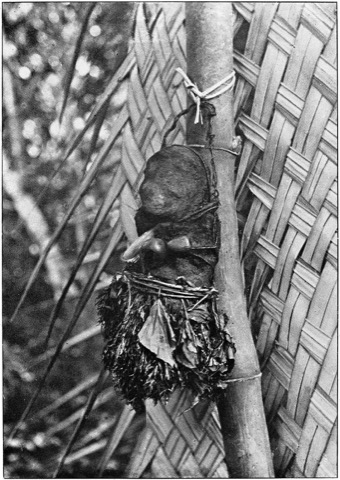
On New Guinea’s southwestern coast, the Kamoro kept very secret payu or mirapoway in the ceremonial house, representing the voices of honoured dead people. Farther east, Lehner’s Bukaua account gives ruling bullroarers the names of dead men, adding lanqua, the Old One. One blade hung obliquely on its cord so that its rasp recalled a named ancestor’s damaged nose; another carried two raised humps recalling a dead man’s hip bones. The small, brighter-voiced instruments of the ancestors’ wives formed a separate class. The resemblance across Sahul is strongest at this particular level: a sounding object can carry a person’s name, bodily character and place in a family. 5 , 3
Kamoro · Bukaua (Bukawa), Huon Gulf
Hearing first, seeing later The instrument often organizes a sequence of knowledge. At the Kurnai Jeraeil of 1884, the novices first heard the surrounding Tundun company, then received warnings about keeping the secret, and finally took the instruments in their own hands to sound them. Among the Keraki, a sponsor covered a boy’s eyes before the moiank was revealed; Williams recorded that the secret could not be trusted to a younger child who might tell his mother. Voice, object and the ability to use it belonged to successive moments of becoming an initiate. 1 , 6
Kurnai / Gunai · Keraki
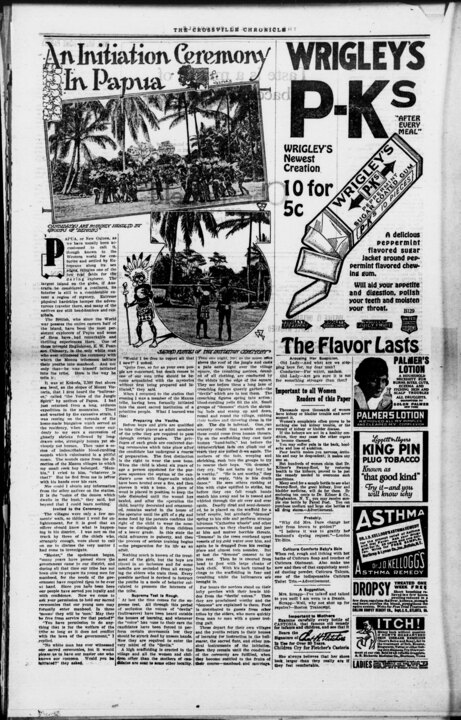
Chinnery’s 1911 Hunjara ceremony makes that sequence unusually visible. Some thirty wowow sounded around hooded initiates while adults called on named ancestors and asked them not to kill their children. Girls and women were among the people being initiated. When the hoods came off, the blades behind the voices were shown; at the end, the decorated handles were burned while blades and strings were secretly put away. Revelation concerned more than learning a mechanism. The person was brought through an encounter with the dead into a new relationship with the living custodians of the instruments. 4
Hunjara (Koko), Yodda Valley
The first owners explain the present owners Stories of the first instrument often explain a present right to hold it. In the Keraki account, the moiank sounded first for Yuma, Kambel’s wife, before Kambel took it. At Rouku, the Komnzo story places the sounding object inside a wife’s belly and sends birds to recover it; the wooden instrument thereafter belongs to initiated men. The neighboring Kwavaru telling recorded by Williams has its own people, birds and actions. These are related ways of making possession meaningful: the men’s present object has come out of an earlier woman’s keeping. 6 , 7
Keraki · Komnzo speakers (Farem), Rouku · Gambadi (Torou, Gambadi and Yetakuma tribes), Kwavaru / Kau
Among the Mungarai, Spencer heard a tradition in which a woman carried wrapped sacred boards, joined other women’s ceremonies and lost her instruments to Kumkum. Here too, present custody has an earlier female beginning. The concrete telling matters. Huon Gulf stories start with a woman finding a sounding chip while chopping wood, whereas Bamler’s Tami telling begins with a blade, already fitted with a cord, washed ashore. In each, acquiring the instrument changes who may command its voice. Read together, these accounts make a recurring regional question audible: how did a power once held elsewhere come into the hands of the people who keep it now? 14 , 8 , 9
Mungarai · Kai · Tami
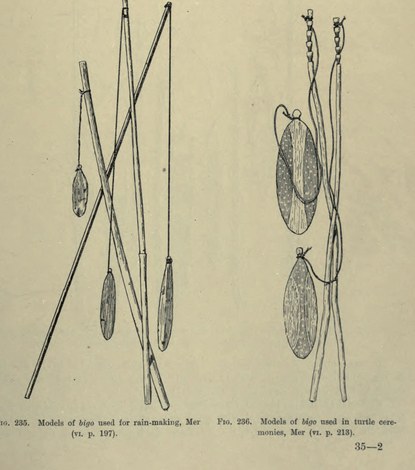
Torres Strait joins the view Torres Strait provides especially concrete links between the Australian and New Guinean sides. On Muralug, Haddon’s sources described initiation as showing boys the wanes and teaching them its use. On nearby Keriri, maternal uncles secluded and instructed a novice before showing him a bullroarer. Haddon placed the Kiwai madubu beside these accounts: at Iasa, boys learned its use behind a taboo fence while growing yams, sweet-potatoes and bananas during their instruction. The shared sequence brings the old continent into focus through actual neighboring communities. 10
Muralug / Prince of Wales Island, Torres Strait · Keriri / Hammond Island (Kaurareg), western Torres Strait · Kiwai
The same instrument family also worked beyond the initiation enclosure. At Mabuiag, men sounded the large bigu and smaller wanes over canoes before turtle hunting. A hilltop lookout later roared news of a successful catch, and returning crews sounded the blades again. At Yam, bigu belonged to sweet-potatoes, yams and turtle; Maino described a suspended, human-shaped garden charm that came alive at night and went among the plants swinging bullroarers. Sound summoned growth and game as well as ancestral authority. These island accounts connect the cultivated garden, the hunting canoe and the named being within the same regional family. 10
Mabuiag, Torres Strait · Yam / Iama Islanders (Kulkalgal), central Torres Strait
The voice and the flood In Gippsland, disclosure of the Jeraeil secrets brings the sea over the ancestral Kurnai. Among the Muyu, ancestors whirl bullroarers and blow flutes against the returning water that makes the Kao River islands and the rivers of their world. Yolngu Kunapipi ceremony gives Yurlunggur, the serpent who calls the first wet-season rain, a body and voice in the sounding instrument. In these accounts the ancestral voice repeatedly belongs to the powers that change country, seasons and human life. 1 , 15 , 16
Kurnai / Gunai · Muyu · Yolngu, Arnhem Land · Rirratjingu clan (Dhuwa moiety), Yolngu; painted at Yirrkala
The Morehead initiation stories, including bullroarer origins, are also guarded against a deluge: Williams recorded destructive rain if the secrets were disclosed, and Murphy heard of a sky snake drilling the ground to release water if women learned the men’s stories. Each account gives the instrument its own relation to the water—disclosure, attempted restraint or ancestral embodiment—while keeping flood and sacred sound in the same world of inherited law. 17
Keraki
A shared world at several scales Sahul names the former landmass comprising Australia, Tasmania and New Guinea, including western New Guinea now in Indonesia. Its bullroarer traditions can be explored as a broad family while local histories remain legible within it. The similarities traced here lie in what people do with a voice: name it, give it ancestral identity, guard or reveal its material body, and tell how its owners acquired it. Together these make a substantial ceremonial grammar across the region. A narrower account, such as Huon Gulf balum or southeastern Daramulun, shows how that grammar becomes a particular institution. 11 , 1 , 3
Kurnai / Gunai · Bukawa / Yabim · Kamoro
Some relationships can also be followed through words and remembered exchange. Kunst linked the Kanum and Marind Sosom feast to a neighboring Trans-Fly instrument called sosa; the paired flute vocabulary offers another thread. Those accounts support a local history of contact, even though scholars disagreed about its direction. They make the broader family more interesting by giving it routes, participants and disagreements that can be investigated. Sahul gathers the shared patterns; its smaller networks supply the names and events through which people actually carried them. 12 , 13
Kanum · Marind-anim · Kaya-Kaya / Tugeri
Names that carry the tradition Objects, voices and stories
Stories from the region
Haddon (ed.), Reports Cambridge Anthrop. Exped. Torres Straits IV (1912), Fig. 237 A-D · Public domain
Mabuiag, Torres Strait
bigur / uainis
On Mabuiag, bullroarers worked the turtle fishery. Before canoes set out, men swung the large painted bigu over the vessels and whirled it with smaller wanes around the agu platform of turtle skulls and shells. A lookout later sounded one from a hill to tell women the catch had succeeded; on…
Ethnologisches Museum, Staatliche Museen zu Berlin (VI 29955); photo Anika Niemeck · CC BY-NC-SA 4.0
Bukaua (Bukawa), Huon Gulf
banko lanqua
Banko lanqua - "Banko the Old." Among the Bukaua of the Huon Gulf each clan's ruling bull-roarer bore a dead man's name joined to lanqua, "the Old One," and the name doubled as the clan's war-cry, shouted in war, at pig-netting, at the pig market and at the girls' consecration; a man whose roarer…
A. W. Howitt, The Native Tribes of South-East Australia (1904), Fig. 37 · Public domain
Kurnai / Gunai
Tundun / Rukut Tundun
Among the Kurnai of Gippsland, the men in charge of the boys at the Jeraeil told them that in the afternoon they would be shown their grandfather. What they were shown was the Tundun, the larger of two bull-roarers, "the man"; the smaller blade was the Rukut-Tundun, "the woman," his wife. Both are…
Erhard Eylmann, Die Eingeborenen der Kolonie Südaustralien (1908), Plate XXXI · Public domain
Arunta / Arrernte
Churinga / Churinga irula
Among the Arunta of the MacDonnell Ranges, the sacred objects called churinga could be seen by women or uninitiated men only on penalty of death, or of being blinded with a fire-stick. Spencer and Gillen, working in the Alice Springs district in the 1890s, described two kinds: flattened stones and…
Crossville Chronicle, October 26, 1921, p. 3, retelling E. W. P. Chinnery’s Koko account · Public domain
Hunjara (Koko), Yodda Valley
wowow
Near Kokoda in 1911, hooded Hunjara initiates—including girls and women—waited while some thirty wowow roared around them. Men called on dead ancestors and pleaded, “Do not kill my child,” before lifting the hoods and revealing the instruments behind the voices. At the ceremony’s end, their handles…
Collectie Wereldmuseum (Nationaal Museum van Wereldculturen), RV-3070-90 · CC BY-SA 4.0
Kamoro
payu / mirapoway
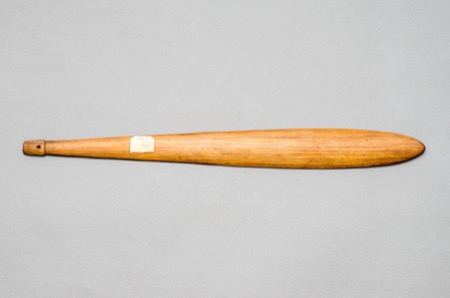
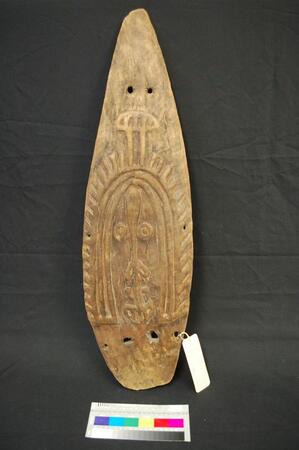
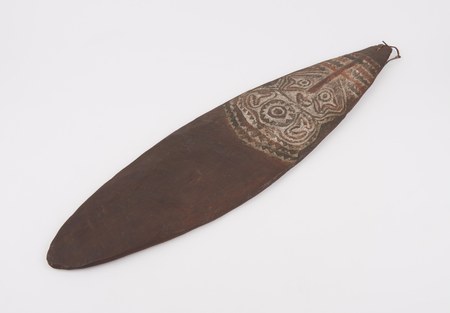
A Kamoro bull-roarer from the Mimika coast of southwest Papua, now in the Wereldmuseum (the former Rijksmuseum voor Volkenkunde) in Leiden. For what such an instrument did among the Kamoro the fullest account is Jan Pouwer's ethnography, drawn from fieldwork begun in the early 1950s. Swung on a…
Find a people, name or story 363 records
Wereldmuseum / NMVW (acc. RV-2087-5) · CC BY-SA
Yir-Yoront
yoq-par-muw
Representative — not this record’s object · carved Australian bullroarer board, Wereldmuseum RV-2087-5.
W. E. Roth, Ethnological Studies among the North-West-Central Queensland Aborigines (1897), Plate XVII · Public domain
Burdekin River near Townsville
Representative — not this record’s object · Roth’s plate of north-central Queensland bullroarers.
W. D. Hambly, Tribal Dancing and Social Development (London, 1926), plate facing p. 46 · Public domain
Mulgrave River near Cairns
Periperipo
Wereldmuseum / NMVW (acc. RV-1709-18) · CC BY-SA
Koko-yimidirr / McIvor River
dunggul
Representative — not this record’s object · An elongated wooden board incised with fine wavy parallel lines.
Wereldmuseum / NMVW (acc. RV-2087-4) · CC BY-SA
Bloomfield River
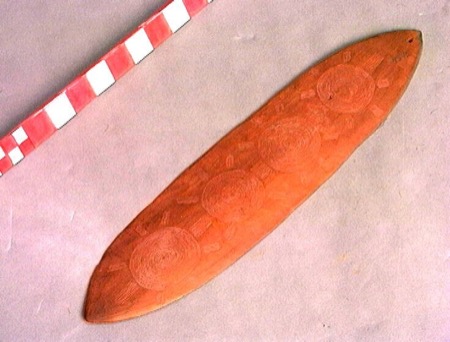
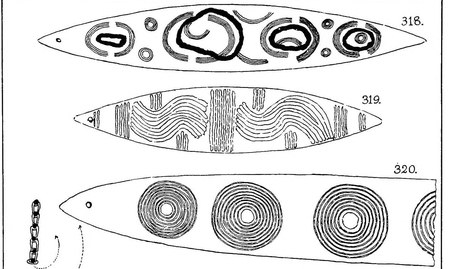
Representative — not this record’s object · A wooden board incised with a line of concentric circles down its length.
Wik-Mungkan / Archer Kendall Edward Rivers
moiya / paka paka / moipaka
Wereldmuseum / NMVW (acc. RV-2306-6) · CC BY-SA
Mitirinji / Quoin Island
panmadda
Representative — not this record’s object · Reddish wooden bullroarer incised with concentric rings.
Wereldmuseum / NMVW (acc. RV-2306-7) · CC BY-SA
Mycoololl / Flinders River
Mobolah
Representative — not this record’s object · A wooden board carved in a herringbone chevron pattern along its length.
Spencer, Native Tribes of the Northern Territory (Macmillan, 1914), Plate II · Public domain
Spencer, Native Tribes of the Northern Territory (Macmillan, 1914), Plate II · Public domain
Worgait / Wagait
Bidu-Bidu / Bidju-Bidju
Representative — not this record’s object · Spencer's own plate of the Larrakia bidu-bidu.
Iwaidja / Port Essington
Kurrabudji / Kurahudji
Spencer, Native Tribes of the Northern Territory (Macmillan, 1914), Plate II · Public domain
Djauan / Jawoyn area
Kunapippi / Kunabibbi
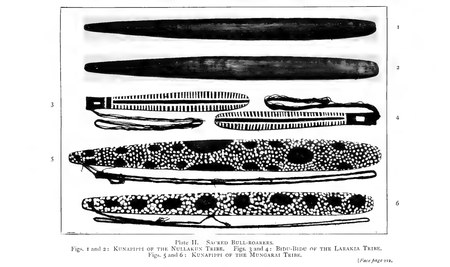
Representative — not this record’s object · Spencer's plate of the Mungarai kunapippi.
Spencer, Native Tribes of the Northern Territory (Macmillan, 1914), Plate II · Public domain
Wereldmuseum / NMVW (acc. WM-69882) · CC BY-SA
Murinbata / Murrinh-Patha
ngawuru / Punj
Representative — not this record’s object · A wooden board carved end to end with concentric scrolls and key-pattern.
E. T. Hardman, Proceedings of the Royal Irish Academy, 3rd ser., vol. 1 (1888), Plate II figs. 4-5, drawn by W. F. Wakeman · Public domain
Kimberley District
mero-mero
Representative — not this record’s object · Two carved mero-mero collected in the Kimberley by E. T. Hardman.
Science Museum Group (A140596) · CC BY-NC-SA 4.0
Wyndham (Miriwoong country)
W. D. Hambly, Primitive Hunters of Australia (Field Museum of Natural History, 1936), plate I, fig. 10 · Public domain
Gascoyne region
Mooryumkarr
W. D. Hambly, Primitive Hunters of Australia (Field Museum of Natural History, 1936), plate I, fig. 11 · Public domain
Southern Cross district
yeenma
W. D. Hambly, Primitive Hunters of Australia (Field Museum of Natural History, 1936), plate VII, fig. f · Public domain
Derby district
mudamud
Representative — not this record’s object · Hambly's plate of a Kimberley whirler carved with two square spirals.
Ada Janet Peggs, ‘Notes on the Aborigines of Roebuck Bay, Western Australia’ (1903), Plate XV · Public domain
Roebuck Bay district (people not recorded)
Willilambi / Twilight Cove
boorbing / yeenma
Ungarinyin and Wurara/Worora
University of Edinburgh (MIMEd 3112) · CC BY 3.0
Yedinjie (?) — probably Yidinji
Milparinka district (people not recorded)
Toon Doon
Wereldmuseum / NMVW (acc. RV-2087-5) · CC BY-SA
Wiknatara (Wik-Iiyanh)
moiya / pakapaka / moipaka
Representative — not this record’s object · A wooden board carved with a line of concentric circles.
Spencer & Gillen, The Northern Tribes of Central Australia (1904), Fig. 91 · Public domain
Kaitish (Kaytetye)
churinga
Baldwin Spencer and F. J. Gillen, The Northern Tribes of Central Australia (1904), p. 276, Fig. 94 · Public domain
Wambaya (Umbaia in Spencer and Gillen)
Purtuli
R. H. Mathews, Notes on the Aborigines of New South Wales (1907), pl. 9 (fig. 9) · Public domain
Biripi (Birpai)
gonnandhakeen
R. H. Mathews, Notes on the Aborigines of New South Wales (1907), pl. 9 (figs. 7–8) · Public domain
Murawari (Muruwari)
wuddoolnurran (large) / ghidjoolkumbal (small)
Representative — not this record’s object · Mathews' figs. 7-8, the same type as the Culgoa blades.
A. W. Howitt, The Native Tribes of South-East Australia (1904), fig. 37 · Public domain
Theddora (Dhudhuroa)
madjigani / yirragaminanga
Representative — not this record’s object · A Kurnai (Gunai) bull-roarer as figured by Howitt in 1904.
Baldwin Spencer and F. J. Gillen, The Northern Tribes of Central Australia (1904), p. 276, Fig. 94 · Public domain
Tjingilli (Jingulu)
Purtiili
Representative — not this record’s object · Spencer and Gillen's Fig. 94, the wooden purtuli of a snake-totem waterhole.
© KMKG-MRAH — Musée des Instruments de Musique, Brussels, 1988.010-03; “Peer boor egah”, culture recorded only as Aboriginal, made in Australia before 1988. Regional support for the northern Victorian name; the Bangerang object itself is Museums Victoria SH 990088, of which there is no photograph. · CC BY-SA 4.0
Bangerang (Pangerang)
Representative — not this record’s object · Peer boor egah, 24.7 × 4.3 cm — a leaf blade pierced at the tip, cut with chevrons.
A. W. Howitt, The Native Tribes of South-East Australia (1904), fig. 29 · Public domain
Ngarigo
Mudji
Representative — not this record’s object · Howitt’s drawing of the Yuin bull-roarer mudthi.
A. W. Howitt, The Native Tribes of South-East Australia (1904), fig. 29 · Public domain
Wolgal (Walgalu)
Mudji
Representative — not this record’s object · Howitt’s drawing of the Yuin mudthi.
R. H. Mathews, Notes on the Aborigines of New South Wales (1907), pl. 9 (fig. 9) · Public domain
Geawe-gal
Representative — not this record’s object · Mathews’s plate 9 of NSW bullroarers (1907)
R. H. Mathews, Notes on the Aborigines of New South Wales (1907), pl. 9 (fig. 9) · Public domain
Gringai
Torikotti
Representative — not this record’s object · Mathews’s plate 9 of NSW bullroarers (1907)
R. H. Mathews, Journal and Proceedings of the Royal Society of NSW (1898), plate 9, fig. 9 · Public domain
Butchulla (Badtjala)
Bon'da'ban
Wathi-wathi (Wadi-wadi)
Kalari
R. H. Mathews, 'Bullroarers used by the Australian Aborigines', Journal of the Anthropological Institute 27 (1898), Plate VI · Public domain
Itchumundi
Bungumbelli (large) / Purtali (small)
Representative — not this record’s object · Mathews' 1898 survey plate of Australian bull-roarers.
W. D. Hambly, Primitive Hunters of Australia (Field Museum of Natural History, 1936), plate VII, fig. f · Public domain
Ngarinyin (Ungarinyin)
Representative — not this record’s object · Hambly's plate of a Kimberley whirler.
Yale Peabody Museum of Natural History, Division of Anthropology (YPM ANT 009818) · CC0
Pitjantjatjara
tjurunga
Representative — not this record’s object · Incised bull-roarer from the Musgrave Ranges.
E. T. Hardman, Proceedings of the Royal Irish Academy, 3rd ser., vol. 1 (1888), Plate II figs. 4-5, drawn by W. F. Wakeman · Public domain
Sunday Island (Bardi/Jawi), Kimberley
Representative — not this record’s object · Kimberley bullroarers on Hardman’s 1888 plate.
Wereldmuseum / NMVW (RV-1321-47) · CC BY-SA 4.0
Roebourne, Western Australia
Representative — not this record’s object · Incised Yindjibarndi bullroarer from the Pilbara.
W. D. Hambly, Primitive Hunters of Australia (Field Museum of Natural History, 1936), plate VII, fig. f · Public domain
Mount Barnett, Kimberley
Representative — not this record’s object · Kimberley whirler on a classic museum plate.
Lower (Southern) Arrernte, Charlotte Waters, Central Australia
tywerrenge
A. W. Howitt, The Native Tribes of South-East Australia (1904), fig. 37 · Public domain
Bunganditj / Meintangk / Tanganekald, southeast South Australia
Mimikur
Representative — not this record’s object · A Kurnai (Gunai) bull-roarer as figured by Howitt in 1904.
W. D. Hambly, Primitive Hunters of Australia (Field Museum of Natural History, 1936), plate I, fig. 11 · Public domain
Mardu / Mardudjara (Western Desert; Jigalong)
Representative — not this record’s object · Hambly's plate of the Field Museum's Mount Margaret bull-roarer.
Yale Peabody Museum of Natural History, Division of Anthropology (YPM ANT 009818) · CC0
Pindupi (Pintupi)
mandagi (Luritja group); namatuna
Representative — not this record’s object · Incised bull-roarer from the Musgrave Ranges.
Mara (Marra), western Gulf of Carpentaria, mouth of the Limmen Bight River
watanurra
Leopold A. D. Montague, Weapons and Implements of Savage Races (1921), fig. 19 no. 1 · Public domain
Ngatatara (Ngadadjara / Ngaatjatjarra)
namatuna
Representative — not this record’s object · Ochre-dark Wiluna bullroarer carved with herringbone zigzags.
Yale Peabody Museum of Natural History, Division of Anthropology (YPM ANT 009818) · CC0
Matuntara (Kukata / Southern Luritja), western neighbours of the Aranda, Central Australia
namatuna (Aranda); mandagi (Luritja)
Representative — not this record’s object · Incised bull-roarer from the Musgrave Ranges.
Mularatara / Matuntara
namatuna
Iliaura (Alyawarre / Alyawarr)
churinga
Nyulnyul (Nyul Nyul)
mudamud
R. H. Mathews, Journal and Proceedings of the Royal Society of NSW (1898), plate 9, fig. 9 · Public domain
Awabakal
bubu
Representative — not this record’s object · Fig. 9 from Mathews' 1898 plate of New South Wales bull-roarers
© The Trustees of the British Museum (Oc1906,1013.153) · CC BY-NC-SA 4.0
Kapau-Kamea / Titamnga
mautwa
Representative — not this record’s object · Masingara turtleshell bullroarer Oc1906,1013.153
Notulen van het Bataviaasch Genootschap van Kunsten en Wetenschappen, deel LI (1913), Bijlage VII · Public domain
Armati (Sarmi hinterland)
Western Arrarnta (Western Aranda) country, Palm Valley
Etarratarra (Battarbee/Edmond spelling); Itaratharra (Ross 2003 plate caption)
A. W. Howitt, The Native Tribes of South-East Australia (1904), fig. 37, p. 628 · Public domain
Gubbi-Gubbi (Kabi Kabi)
bon’da’ban
Representative — not this record’s object · Howitt's engraving of the two Kurnai bull-roarers
Mandobo (Wakeriop)
tenotkok; Murinop (when sounding)
A. W. Howitt, The Native Tribes of South-East Australia (1904), Fig. 37 · Public domain
Bungyarlee and Parkungi (Bonney's terms)
moola-uncka
Representative — not this record’s object · two hatched Kurnai bullroarers, Howitt fig. 37.
E. J. Eyre, Journals of Expeditions of Discovery (1845), vol. II, Plate IV (figs 6-8) · Public domain
Tasmanian Aboriginal people
Representative — not this record’s object · Eyre's 1845 South Australian Mooyumkarr; Bonwick later used the name.
Wereldmuseum / NMVW (RV-1321-47) · CC BY-SA 4.0
Burgess Point / Stingray Creek Area, Port Hedland Complex
Representative — not this record’s object · Incised Yindjibarndi bullroarer from the Pilbara.
R. Neuhauss, Deutsch-Neu-Guinea, Bd. III (1911), p. 412, figs. 5–11 (S. Lehner, 'Bukaua') — Universitätsbibliothek Frankfurt, DSDK · Public domain
Numbami (Siboma)
bolomana
Representative — not this record’s object · Named balum bullroarers of the Bukaua, across the Huon Gulf from Siboma.
Howitt, The Native Tribes of South-East Australia, 1904, Fig. 29 no. 2 · Public domain
Yandruwandha (Jandruwanta)
thuburu
Representative — not this record’s object · Howitt’s Dieri yuntha, a long corded bullroarer.
Felix von Luschan, Festschrift für Adolf Bastian (1896), p. 135; Berlin VI 10488 · Public domain
Kariyarra (Kariera)
banangari
Representative — not this record’s object · Berlin VI 10488, a human-hair-corded bullroarer from the Upper Murchison
W. D. Hambly, Primitive Hunters of Australia (Field Museum of Natural History, 1936), plate I, fig. 10 · Public domain
Ngarluma (Ngaluma)
banangari
Representative — not this record’s object · Gascoyne bullroarer
A. W. Howitt, The Native Tribes of South-East Australia (1904), Fig. 40 · Public domain
Darkinjung / Guringai communities
Representative — not this record’s object · Narrang-ga (Narungga) bull-roarer, both sides.
The Metropolitan Museum of Art (501354), Public Domain · Public domain
Tati Tati (Cameron's Ta-ta-thi)
Kalk
Representative — not this record’s object · Australian bullroarer carved with concentric circles, The Met 501354.
Collectie Wereldmuseum (Nationaal Museum van Wereldculturen), TM-2541-45, via Wikimedia Commons · CC BY 4.0
Crossville Chronicle, October 26, 1921, p. 3, retelling E. W. P. Chinnery’s Koko account · Public domain
Hunjara (Koko), Yodda Valley
wowow
Science Museum Group, object 1937-682/123 · CC BY-NC-SA 4.0
North Queensland; the maker and community are unrecorded
Barda / Bardadjawa (Bardi / Baada)
galaguru
Antakirinya / Antikirinya / Antakarinja
pulpiŋba
R. Etheridge Jr, Records of the Australian Museum 3(1), 1897, Plate I · Public domain
Upper Paroo-Warrego and Mungalella Creek tribes (incl. Peechera)
Representative — not this record’s object · Etheridge's Plate I, figures 3 and 4.
W. D. Hambly, Tribal Dancing and Social Development (London, 1926), plate facing p. 46 · Public domain
Jabunbarra Jirrbal / Girramay
bibu
Representative — not this record’s object · Hambly’s Mulgrave River bullroarer plate.
W. D. Hambly, Tribal Dancing and Social Development (London, 1926), plate facing p. 46 · Public domain
Waribarra Mamu / Dulgubarra Mamu / Gulŋay
wungumali
Representative — not this record’s object · Hambly’s Mulgrave River bullroarer plate.
Christian Döhler and Nakre Abia, frame at 01:18 from the recording 'tci20120914 - Frfr a Kifikifi', Rouku, 14 September 2012 · CC BY-NC 4.0
Komnzo speakers (Farem), Rouku
frfr (children's coconut-leaf toy); ŋofoŋofo (wooden, formerly secret)
Emile Clement, Ethnographische Beobachtungen in Nordwest-Central-Australien (1903), Plate IV; Bayerische Staatsbibliothek scan · Public domain
Badimaya
nganirri
Representative — not this record’s object · Clement 1903 Plate IV; figs. 12/12a and 4 are the two recorded forms
R. Etheridge Jr, Records of the Australian Museum 3(1), 1897, Plate I · Public domain
Urania Tribe / Linda Creek
© The Trustees of the British Museum (E/Oc1906-1013-759) · CC BY-NC-SA 4.0
Nen speakers, Bimadbn
meyang (synonym är bolo); mérmér; agalsge; basolsge; giñgiñ meyang
Representative — not this record’s object · a palmwood bullroarer from the Bensbach River.
Stichting Papua Erfgoed, object EA/1001/13
Boven-Bian Marind (Ezam-Oezoem cult)
Ezam (the bromhout embodies it)
Collectie Wereldmuseum (Nationaal Museum van Wereldculturen), WM-51637 · CC BY-SA 4.0
Yimar (Yimas-Karawari area)
irimundur
Collectie Wereldmuseum (Nationaal Museum van Wereldculturen), WM-31841 · CC BY-SA 4.0
Biliau village area, Rai Coast
A. C. Haddon, Head-Hunters: Black, White, and Brown (1901), fig. 24, p. 191 — via archive.org · Public domain
Yaraikanna (Yadhaykenu)
umbalako / iwaika (large); maumata (small)
Ethnologisches Museum, Staatliche Museen zu Berlin (VI 29955); photo Anika Niemeck · CC BY-NC-SA 4.0
Moando language area
takilat (Mopu, general cult-object term); wuyamb (Widaro, general cult category); kamoa (Widaro, proper name)
Representative — not this record’s object · A long, dark, finely tapered wooden blade incised along its length.
© The Trustees of the British Museum (E/Oc1912-1217-5) · CC BY-NC-SA 4.0
Borli/Boli
bora
Representative — not this record’s object · A ceremonial bull-roarer from Baramura on the Fly River.
© The Trustees of the British Museum (E/Oc1906-1013-759) · CC BY-NC-SA 4.0
Mawai
Representative — not this record’s object · A palmwood bull-roarer from the Bensbach River.
Wereldmuseum / NMVW (acc. WM-69882) · CC BY-SA
Awarai (Warai)
Representative — not this record’s object · A wooden board carved end to end with concentric scrolls and key-pattern
Spencer, Native Tribes of the Northern Territory (Macmillan, 1914), Plate II · Public domain
Wulwulam (Eylmann's Wulwanga)
Representative — not this record’s object · Spencer's own plate of the Larrakia bidu-bidu.
Finnish Heritage Agency / Museovirasto, National Museum of Finland, Landtman collection VK4902:716 · CC BY 4.0
Aimei village / northeastern Kiwai (Gibaio dialect)
Kaiaimuru
Representative — not this record’s object · Kiwai blade, Fly River mouth, VK4902:716.
O. Finsch, Ethnologischer Atlas (1888), Taf. V · Public domain
Kranket/Grager Islanders (Bel/Gedaged-speaking area, affiliation kept qualified)
Djabobibi
Turrbal / Brisbane River allied tribes
Bugerum / Wobblekum
Unmatjera / Anmatyerre
luringa
Spencer & Gillen, The Native Tribes of Central Australia (1899), fig. 20 · Public domain
Urabunna / Arabana
chimbaliri / tjimbaliri
Binbinga / Binbinka
watanurra / watamura
Anula / Anula neighbours of Binbinga
mura-mura; Wi-dirpi
© The Trustees of the British Museum (E/Oc1987-05-121) · CC BY-NC-SA 4.0
Wosera Abelam (Serangwandu village)
Haddon (ed.), Reports Cambridge Anthrop. Exped. Torres Straits IV (1912), Fig. 237 A-D · Public domain
Mabuiag, Torres Strait
bigur / uainis
Haddon (ed.), Reports of the Cambridge Anthropological Expedition to Torres Straits, vol. IV, 1912, Plate XII fig. 7; figure rotated for display · Public domain
Muralug / Prince of Wales Island, Torres Strait
waness
Haddon (ed.), Reports Cambridge Anthr. Exped. Torres Straits, vol. IV, 1912, figs. 235 & 236 · Public domain
Mer / Murray Island, Torres Strait
bigo
A. W. Howitt, The Native Tribes of South-East Australia (1904), Fig. 37 · Public domain
Kurnai / Gunai
Tundun / Rukut Tundun
A. W. Howitt, The Native Tribes of South-East Australia (1904), fig. 29 · Public domain
Howitt, The Native Tribes of South-East Australia, 1904, Fig. 29 no. 2 · Public domain
South-West Australian Aboriginal people (Noongar country)
woondah
© The Trustees of the British Museum (E/Oc1987-05-122) · CC BY-NC-SA 4.0
Baruya
Representative — not this record’s object · A plain New Guinea bull-roarer.
© The Trustees of the British Museum (E/Oc1987-05-121) · CC BY-NC-SA 4.0
Auyana
Representative — not this record’s object · A New Guinea bull-roarer.
© The Trustees of the British Museum (E/Oc1894-105) · CC BY-NC-SA 4.0
Tairora
Representative — not this record’s object · A New Guinea bull-roarer.
© Pitt Rivers Museum, University of Oxford (acc. 2006.87.1)
Angaataha
Representative — not this record’s object · Anga bullroarer with bark-fibre cord, collected on the Upper Watut in 1937.
© Pitt Rivers Museum, University of Oxford (acc. 2006.87.1)
Yagwoia / Yagqoia (Kokwaiyakwa)
Representative — not this record’s object · Anga bullroarer with bark-fibre cord, collected on the Upper Watut in 1937.
© Pitt Rivers Museum, University of Oxford (acc. 2006.87.1)
Wojokeso
Representative — not this record’s object · Anga bullroarer with bark-fibre cord, collected on the Upper Watut in 1937.
© Pitt Rivers Museum, University of Oxford (acc. 2006.87.1)
Menya
Representative — not this record’s object · Anga bullroarer with bark-fibre cord, collected on the Upper Watut in 1937.
© The Trustees of the British Museum (E/Oc1906-1013-1450) · CC BY-NC-SA 4.0
Gende
Representative — not this record’s object · A plain, unengraved New Guinea bull-roarer blade with a drilled hole
Collectie Wereldmuseum (Nationaal Museum van Wereldculturen), TM-2834-54, via Wikimedia Commons · CC BY 4.0
Dugum Dani
aneivu-aneivu
Representative — not this record’s object · A decorated bull-roarer (bromhout) from the Netherlands New Guinea.
A. W. Howitt, The Native Tribes of South-East Australia (1904), Fig. 40 · Public domain
Nukunu
wiithanha
Representative — not this record’s object · a Narungga bullroarer, both faces, drawn by Howitt (1904)
The Metropolitan Museum of Art (501354), Public Domain · Public domain
Kuyani-centred tradition
Representative — not this record’s object · an incised Aboriginal bullroarer, wilmurra (The Met)
Sambia (pseudonym)
duka’ yungalu
R. Hamlyn-Harris, Memoirs of the Queensland Museum II (1913), pl. XVII fig. 2 · Public domain
Mekeo, Central Province (PNG)
Wangkangurru (Wonkonguru)
inchitcha
A. W. Howitt, The Native Tribes of South-East Australia (1904), Fig. 40 · Public domain
R. Brough Smyth, The Aborigines of Victoria, vol. I (1878), fig. 17, p. 176 — via archive.org · Public domain
Wurunjerri / Wurundjeri, Kulin
Ball-berau-gan
Representative — not this record’s object · Per-bo-re-gan whirler at Coranderrk.
O. Finsch, Ethnologischer Atlas (1888), Taf. V · Public domain
Yopno; oldest-lineage eserong near Teptep
Representative — not this record’s object · a blade Finsch drew below the Finisterre Range.
Kings Tableland, Blue Mountains (NSW)
Aranda / Arrernte
tjurunga (чуринга)
A. W. Howitt, The Native Tribes of South-East Australia (1904), fig. 35 · Public domain
Kate L. Lindsey, Ghost Elements in Ende Phonology (PhD dissertation, Stanford University, 2019), p. 288 · CC BY-NC 3.0
Ende (Pahoturi River, Western Province PNG), Limol
waglla
Howitt, The Native Tribes of South-East Australia, 1904, Fig. 29 no. 1 · Public domain
Gulf of Papua peoples (Loeb's regional synthesis)
Collectie Wereldmuseum (Nationaal Museum van Wereldculturen), TM-2670-368, via Wikimedia Commons · CC BY 4.0
Kaya-Kaya / Tugeri
Sosom
Representative — not this record’s object · Marind bull-roarer, per the museum record used during boys' initiation.
E. J. Eyre, Journals of Expeditions of Discovery (1845), vol. II, Plate IV (figs 6-8) · Public domain
Adelaide tribes / Kaurna region
kadnomarngutta / wimmarri
E. J. Eyre, Journals of Expeditions of Discovery (1845), vol. II, Plate IV (figs 6-8) · Public domain
Port Lincoln tribes / Barngarla region
witarna / pullakalli
Representative — not this record’s object · Eyre's 'Mooyumkarr', Plate IV figs 6–8: incised slats on cord.
R. H. Mathews, Notes on the Aborigines of New South Wales, 1907, Plate 9 figs. 1-4 (after Mathews 1898, JAI 27) · Public domain
R. H. Mathews, Notes on the Aborigines of New South Wales, 1907, Plate 9 figs. 5-6 · Public domain
Kamilaroi
murrawan / mooniburrigean
R. H. Mathews, Notes on the Aborigines of New South Wales, 1907, Plate 9 figs. 7-8 · Public domain
Wiradthuri / Wiradjuri
mudthega / moonibear
R. H. Mathews, Notes on the Aborigines of New South Wales, 1907, Plate 9 figs. 7-8 (shared type) · Public domain
Culgoa River tribes
wuddoolnurran / ghidjoolkumbal
R. H. Mathews, Notes on the Aborigines of New South Wales, 1907, Plate 9 fig. 9 (with cross-section fig. 10) · Public domain
Tribes between the Hunter and Macleay Rivers
gonnandhakeen
R. H. Mathews, Notes on the Aborigines of New South Wales, 1907, Plate 9 fig. 11 · Public domain
Shoalhaven and southeast coast tribes
mooroonga / jummagong
R. H. Mathews, Notes on the Aborigines of New South Wales, 1907, Plate 9 figs. 7-8 · Public domain
Wiradthuri tribes on the upper Murrumbidgee
mundjeegong
R. H. Mathews, Notes on the Aborigines of New South Wales, 1907, Plate 9 figs. 12, 13 & 15 · Public domain
Clarence and Richmond River tribes
dhooanbooka / yoolundry / dhalgungun
R. H. Mathews, Notes on the Aborigines of New South Wales, 1907, Plate 9 fig. 14 · Public domain
Macleay and Bellinger River tribes
gheewarra / ngaranya / yeemboomul
R. H. Mathews, 'Bullroarers used by the Australian Aborigines', Journal of the Anthropological Institute 27 (1898), Plate VI · Public domain
Novan / Anaiwan and Yungai-speaking New England peoples
Boolpee
Representative — not this record’s object · Mathews’s Australian survey plate; Kamilaroi blade at fig. 5.
A. C. Haddon, Head-Hunters: Black, White, and Brown (1901), fig. 24, p. 191 — via archive.org · Public domain
Tjungundji (Mathews's Joonkoonjee) and neighbouring western Cape York tribes
pipe-ra-chy
Representative — not this record’s object · Haddon's own drawing of two painted umbalako swinging from their sticks
R. H. Mathews, 'Bullroarers used by the Australian Aborigines', Journal of the Anthropological Institute 27 (1898), Plate VI · Public domain
Kurnu
yantamakaddya / wambinggulli / nyugara
Representative — not this record’s object · Mathews’s Australian survey plate; Kamilaroi blade at fig. 5.
Birdhawal (Bidawal)
Turndun
Leopold A. D. Montague, Weapons and Implements of Savage Races (1921), fig. 19 no. 1 · Public domain
Wiluna locality; people unrecorded
Leopold A. D. Montague, Weapons and Implements of Savage Races (1921), fig. 19 no. 2 · Public domain
Kookynie district; people unrecorded
© The Trustees of the British Museum, Oc1906,1013.152.a · CC BY-NC-SA 4.0
Masingara (Bine)
rirangode / erapisa-pisa
Spencer, Native Tribes of the Northern Territory (Macmillan, 1914), Plate II · Public domain
Wardaman
Kuraba
Representative — not this record’s object · Spencer’s plate of six Northern Territory sacred roarers.
Wereldmuseum / NMVW (RV-1321-47) · CC BY-SA 4.0
Mulga Downs (rock-art)
Representative — not this record’s object · Incised Yindjibarndi bullroarer, Wereldmuseum RV-1321-47.
© Pitt Rivers Museum, University of Oxford (acc. 1905.63.49)
The Metropolitan Museum of Art (501354), Public Domain · Public domain
unrecorded (register 'Algamurra'; sent by W. I. Weatherill of Brisbane)
Wilmurra; Wobbilcong (Moreton Bay)
W. D. Hambly, Primitive Hunters of Australia (Field Museum of Natural History, 1936), plate VII, fig. f · Public domain
Birdungu
Representative — not this record’s object · Hambly's plate of a Kimberley whirler carved with two square spirals.
Emile Clement, Ethnographische Beobachtungen in Nordwest-Central-Australien (1903), Plate IV; Bayerische Staatsbibliothek scan · Public domain
Martuthunira
Boonangharry
Emile Clement, Ethnographische Beobachtungen in Nordwest-Central-Australien (1903), Plate IV; Bayerische Staatsbibliothek scan · Public domain
Nyamal
bonangharry / cora
Felix von Luschan, Festschrift für Adolf Bastian (1896), p. 135; Berlin VI 10488 · Public domain
Wajarri / Wadjarri
Churinga
Representative — not this record’s object · Berlin VI 10488, a human-hair-corded bullroarer from the Upper Murchison.
Wereldmuseum / NMVW (RV-1321-47) · CC BY-SA 4.0
© Pitt Rivers Museum, University of Oxford (acc. 1938.36.1562)
© Pitt Rivers Museum, University of Oxford (acc. 1900.60.3)
© Pitt Rivers Museum, University of Oxford (acc. 1905.63.14)
© Pitt Rivers Museum, University of Oxford (acc. 1938.36.787)
© Pitt Rivers Museum, University of Oxford (acc. 1905.63.50)
© The Trustees of the British Museum (E/Oc1951-07-7) · CC BY-NC-SA 4.0
Yonggom
kanim / watmung yawat
Representative — not this record’s object · A wooden board painted with pale zigzag bands framing a stylized face.
Collectie Wereldmuseum (Nationaal Museum van Wereldculturen), RV-3070-90 · CC BY-SA 4.0
Collectie Wereldmuseum (Nationaal Museum van Wereldculturen), WM-72118 · CC BY-SA 4.0
Wereldmuseum / NMVW (acc. WM-69881) · CC BY-SA
Nunggubuyu
Representative — not this record’s object · A board carved with fine diagonal chevron patterning.
© Pitt Rivers Museum, University of Oxford (acc. 1916.31.1)
Übersee-Museum Bremen (D11950) · CC BY-SA
Yale Peabody Museum, YPM ANT 250128 · CC0
Kubka (museum spelling: Kubkin) / Upper Sepik
© The Trustees of the British Museum (E/Oc1905-0609-38) · CC BY-NC-SA 4.0
Milingimbi Island / Yurruwi
Yale Peabody Museum, YPM ANT 249221 · CC0
Grass Country regional provenance (community unrecorded)
Howitt, The Native Tribes of South-East Australia, 1904, Fig. 29 no. 2 · Public domain
Ooldea native camp
Representative — not this record’s object · Howitt’s Dieri yuntha, a long corded bullroarer.
© The Trustees of the British Museum (Oc1902,0417.34) · CC BY-NC-SA 4.0
Victoria River (Aboriginal Australian)
P. Wirz, Die Marind-anim von Holländisch-Süd-Neu-Guinea, Teil III (Hamburg, 1925), Tafel 6 · Public domain
Kubu (Western Province)
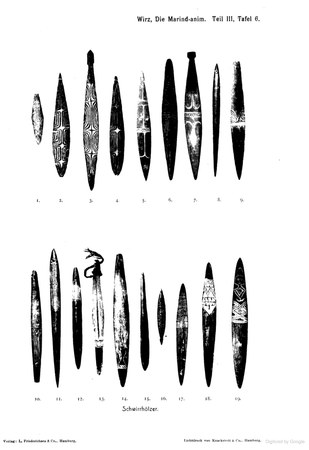
Representative — not this record’s object · Wirz’s plate of nineteen Marind schwirrhölzer from the Bian–Torassi cult
© The Trustees of the British Museum (Oc1912,1217.5) · CC BY-NC-SA 4.0
Baramura (Balamula) village
Wereldmuseum / NMVW (TM-287-17) · CC BY-SA 4.0
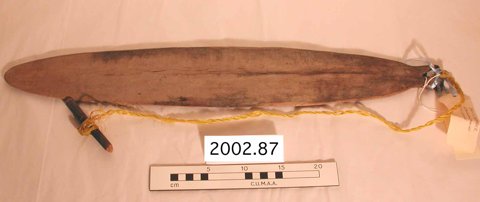
Museum of Archaeology and Anthropology, University of Cambridge, 2002.87; made by Luke Kamangari · CC BY-NC-ND 4.0
W. E. Roth, North Queensland Ethnography Bulletin 11 (1908), Plate XX; photo H. Barnes, Junr., Australian Museum (E.13712) · Public domain
Gugu Yalanji area
jinna-juronggor
Fitzroy River (people unrecorded)
Gupapuyngu Daygurrgurr
burala
Anika Niemeck / Ethnologisches Museum, Staatliche Museen zu Berlin (VI 48045) · CC BY-NC-SA 4.0
Central Iatmul / Palimbei
Nationalmuseet, Denmark (I.5625) · CC BY-SA 4.0
Daly Waters (people unrecorded)
Representative — not this record’s object · a Warlpiri blade tooled with concentric rings, Yuendumu.
© The Trustees of the British Museum (Oc1953,15.1) · CC BY-NC-SA 4.0
Unrecorded Aboriginal makers; acquired at Kalgoorlie, Western Australia
© Pitt Rivers Museum, University of Oxford (acc. 1938.36.787)
Kwaplalim
Representative — not this record’s object · An Anga bull-roarer from the Upper Watut, near Kwaplalim (Pitt Rivers 1938.36.787).
J. D. E. Schmeltz, catalogue of the Clement collection, Internationales Archiv für Ethnographie 16 (1904), Plate IV; drawn and lithographed by R. Raar from the Leiden ethnographic museum; Internet Archive scan by Robarts Library, University of Toronto · Public domain
Ngarluma / Kariyarra (Sherlock River district)
cora / bonangharry
Wereldmuseum / NMVW (RV-1207-17) · CC BY-SA 4.0
Table-land, inland Pilbara (people not recorded)
cora / bonangharry
Representative — not this record’s object · Table-land cora, Wereldmuseum RV-1207-17.
Wereldmuseum / Nationaal Museum van Wereldculturen, RV-1207-18 · CC BY-SA 4.0
Western Desert margin, inland Pilbara ("Desert-tribe")
cora / bonangharry
J. D. E. Schmeltz, catalogue of the Clement collection, Internationales Archiv für Ethnographie 16 (1904), Plate IV; drawn and lithographed by R. Raar from the Leiden ethnographic museum; Internet Archive scan by Robarts Library, University of Toronto · Public domain
Nyamal (Clement's "Gnamo"), Nullagine district
cora / bonangharry
© Pitt Rivers Museum, University of Oxford (acc. 1938.34.34)
Gulf Province, people unassigned
Representative — not this record’s object · A Gulf mask-lot blade, PRM 1938.34.34: a face carved above the plain lower body.
Spencer, Native Tribes of the Northern Territory (Macmillan, 1914), Plate II · Public domain
Katherine River district (people unrecorded)
Representative — not this record’s object · Mungarai kunapippi (Northern Territory); not the Katherine River object.
Charlotte Waters / Hermannsburg, Northern Territory (people not named on the record; Arandic country)
Ilia; Namatuma
Ada Janet Peggs, ‘Notes on the Aborigines of Roebuck Bay, Western Australia’ (1903), Plate XV · Public domain
Broome / Western Kimberley district (people not named on the record)
Representative — not this record’s object · Peggs’s Roebuck Bay plate, fig. 23; not MAA E 1915.20.3.
Wereldmuseum / Nationaal Museum van Wereldculturen, RV-1207-18 · CC BY-SA 4.0
Fortescue River, Pilbara
Representative — not this record’s object · a Desert-tribe cora from the inland Pilbara.
Enrico H. Giglioli, Western Australian objects at the Colonial Exhibition, London (1886) · Public domain
Momba Station, northern River Darling (people not named on the record; Paakantyi country)
Representative — not this record’s object · Giglioli’s 1886 plate of Western Australian objects; Mooryumkarr is no. 3
Staatliche Museen zu Berlin, Ethnologisches Museum / Heinz-Günther Malenz (VI 57792) · CC BY-NC-SA 4.0
Middle Sepik (no village or people recorded)
© Pitt Rivers Museum, University of Oxford (acc. 1938.36.361)
Purari Delta (no village or people recorded)
Representative — not this record’s object · Namau companion, PRM 1938.36.361: neck notched below the fish-shaped head.
Wereldmuseum / NMVW (RV-1321-47) · CC BY-SA 4.0
Cossack (?) / Hamersley Range (?) - no people recorded
boonangharry / burnangarra
Representative — not this record’s object · Pilbara comparison: a Yindjibarndi bullroarer, not British Museum Oc1896,-.1066.
© The Trustees of the British Museum (Oc1906,1013.1452) · CC BY-NC-SA 4.0
Bensbach River (no village or people recorded)
Methodist Mission Aboriginal Craft shop, Yirrkala, north-east Arnhem Land (maker and community not named on the record)
Collectie Wereldmuseum Rotterdam, WM-54159
Arrernte attribution in Penn catalog
Churinga ilkinia (Penn card); churinga irula (Spencer and Gillen's term for the bullroarer)
Nationalmuseet, Denmark (I.5625) · CC BY-SA 4.0
Warlpiri (museum: Wailbri)
Howitt, The Native Tribes of South-East Australia, 1904, Fig. 29 no. 2 · Public domain
Aboriginal Australian; people unrecorded
Representative — not this record’s object · Fig. 29, no. 2: the Dieri (Diyari) bull-roarer (yuntha), grooved blade
Sepik region; people unrecorded
People unrecorded; Fly River region
Sosom
A. W. Howitt, The Native Tribes of South-East Australia (1904), fig. 37, p. 628 · Public domain
People unrecorded
PEER BOOR E GAH
Representative — not this record’s object · Howitt's engraving of the two Kurnai bull-roarers
© Pitt Rivers Museum, University of Oxford (acc. 1938.36.785.1)
© Pitt Rivers Museum, University of Oxford (acc. 2006.87.1)
People unrecorded; Papuan Gulf
gope
Nationalmuseet, Denmark (I.7291) · CC BY-SA 4.0
Erhard Eylmann, Die Eingeborenen der Kolonie Südaustralien (1908), Plate XXXI · Public domain
People unrecorded
Representative — not this record’s object · Eylmann’s Plate XXXI (1908)
Spencer & Gillen, The Native Tribes of Central Australia (1899), Fig. 20 · Public domain
Arrernte (Penn attribution); collected at Newcastle Waters, Jingulu country
Churinga ilkinia (Penn catalogue); peeta (collector J. T. Huston)
Representative — not this record’s object · Spencer and Gillen's wooden churinga of the Urabunna, Luritja and Arunta.
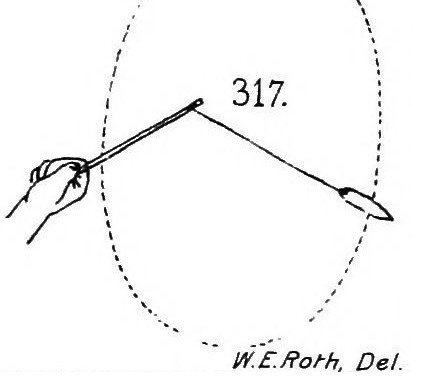
W. E. Roth, Ethnological Studies among the North-West-Central Queensland Aborigines (1897), Plate XVII, fig. 317 · Public domain
People unrecorded; Western Queensland
Representative — not this record’s object · Roth's 1897 drawing of a Queensland whirler swung from a small stick.
Spencer & Gillen, The Native Tribes of Central Australia (1899), Fig. 20 · Public domain
Luritja (museum: Loritja), Jay Creek
tjuringa
Representative — not this record’s object · Spencer and Gillen's wooden churinga; figure 2 is a Luritja one.
Western Arrarnta, Hermannsburg (museum: Arrernte)
aritunga
Museum der Kulturen Basel · CC BY 4.0
Collectie Wereldmuseum (Nationaal Museum van Wereldculturen), TM-2541-44, via Wikimedia Commons · CC BY 4.0
Kimam (Kolepom / Frederik-Hendrik Island)
Jet / Wèwi; Kuriowa (Wanggambi)
Representative — not this record’s object · Dark wooden bullroarer with a forked, pierced end and faint incised bands.
Collectie Wereldmuseum (Nationaal Museum van Wereldculturen), TM-3474-3, via Wikimedia Commons · CC BY 4.0
Yei-nan (Yei / Yey)
kupor
Representative — not this record’s object · a dark blade with pale cross-hatched bands.
© UBC Museum of Anthropology (2623/2); photo Jessica Bushey · CC BY-NC-ND 2.5 CA
Sirorata, Oro Province
sova
Museum of Archaeology & Anthropology, University of Cambridge, E 1905.242 · CC BY-NC-ND 4.0
Lala (Nara), Central Province, Papua New Guinea
Biliva
Orokaiva, Kokoda District
The Metropolitan Museum of Art, Crosby Brown Collection (acc. 09.163.3) · CC0
Namau (Purari Delta), Baroi River
Imunu Viki
Representative — not this record’s object · A dark wooden blade painted with fine white featherlike striping.
© The Trustees of the British Museum, Oc1906,1013.663-664 · CC BY-NC-SA 4.0
Koriki, Kairu (Purari Delta)
Imunu-viki
Representative — not this record’s object · Purari (Maipua) bull-roarers with lime-infilled anthropomorphic carving.
Mairipepia village, Gulf Province
C. G. Seligman, The Melanesians of British New Guinea (Cambridge, 1910), fig. 25 · Public domain
Roro Islands, Central Province (PNG)
beriwa
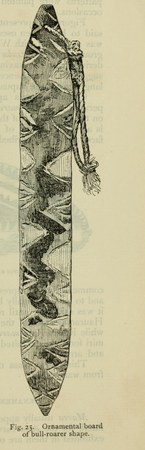
Representative — not this record’s object · Seligman’s ornamental board of bullroarer shape.
© The Trustees of the British Museum (E/Oc1925-0213-4) · CC BY-NC-SA 4.0
Ankave-Anga, Suowi Valley
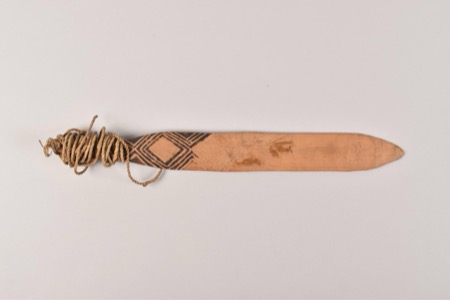
Representative — not this record’s object · A pale wooden board painted at its corded end with a dark.
Ethnologisches Museum, Staatliche Museen zu Berlin (VI 29955); photo Anika Niemeck · CC BY-NC-SA 4.0
Bukaua (Bukawa), Huon Gulf
banko lanqua
Collectie Wereldmuseum (Nationaal Museum van Wereldculturen), TM-2670-418 · CC BY-SA 4.0
Boazi (Boadzi / Kuni-Boazi; incl. Zimakani / Suki ethnonyms)
aut
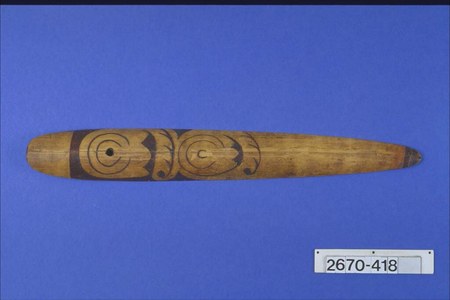
Representative — not this record’s object · Gogodala bull-roarer with incised and burned-in figures.
© The Trustees of the British Museum (E/Oc1906,1013.1448) · CC BY-NC-SA 4.0
Burum-Mindik (Somba-Siawari)
esöŋ (cult, spirit, and bullroarer; Siawari asa); köwawöŋ / muwum-muwum
Representative — not this record’s object · Daniels-expedition palmwood blade marked ‘Bensbach’.
R. H. Mathews, Notes on the Aborigines of New South Wales, 1907, Plate 9 figs. 5-6 · Public domain
Euahlayi (Yuwaalaraay)
Gayandi / Gurraymi; garrarana (regional Yuwaalaraay)
Representative — not this record’s object · Kamilaroi murrawan from the Weir River.
Leopold A. D. Montague, Weapons and Implements of Savage Races (1921), fig. 19 no. 2 · Public domain
Lake Naddern
Representative — not this record’s object · Kookynie bullroarer grooved with nested squares.
Museum of Ethnography (SMVK), Stockholm · CC BY
Drysdale River, Kimberley
Representative — not this record’s object · a long wooden bullroarer with a worn, dark surface.
Ada Janet Peggs, ‘Notes on the Aborigines of Roebuck Bay, Western Australia’ (1903), Plate XV · Public domain
Karadjeri / Karajarri
Representative — not this record’s object · Roebuck Bay, Peggs 1903 Plate XV.
R. H. Mathews, 'Bullroarers used by the Australian Aborigines', Journal of the Anthropological Institute 27 (1898), Plate VI · Public domain
Myall Creek Memorial, Wirrayaraay / Gamilaraay country
Representative — not this record’s object · Mathews’s Australian survey plate; Kamilaroi blade at fig. 5.
© The Trustees of the British Museum (E/Oc1951-07-9) · CC BY-NC-SA 4.0
Vanimo (incl. Warimo, Wutung and Yako)
Representative — not this record’s object · A dark wooden blade with a forked fish-tail tip.
Ethnologisches Museum, Staatliche Museen zu Berlin (VI 48559), made by Tarigo, Kalabu I, coll. Gerd Koch 1965 · CC BY-NC-SA 4.0
Abelam (incl.Maprik)
ulke / wulké; puku
Science Museum Group, A242490 (Wellcome Collection) · CC BY-NC-SA 4.0
Moripi
tiparu
Representative — not this record’s object · Carved Papuan Gulf bull-roarer.
Science Museum Group, A655886 (Wellcome Collection) · CC BY-NC-SA 4.0
Sepoe
tiparu
Representative — not this record’s object · Carved Papuan Gulf bull-roarer.
Collectie Wereldmuseum (Nationaal Museum van Wereldculturen), TM-2541-43, via Wikimedia Commons · CC BY 4.0
Keraki
moiank
Representative — not this record’s object · A plain dark wooden bullroarer.
Finnish Heritage Agency / Museovirasto, Landtman collection (VK4902:716), CC BY 4.0 · CC BY 4.0
© The Trustees of the British Museum (E/Oc1951-07-10) · CC BY-NC-SA 4.0
Duo Yangoru
Representative — not this record’s object · A wooden bullroarer carved in relief with mirrored spiral and face.
© The Trustees of the British Museum (E/Oc1906-1013-663-664) · CC BY-NC-SA 4.0
Lake Kutubu
amaga
Representative — not this record’s object · A long dark red-brown bull-roarer blade.
© The Trustees of the British Museum (E/Oc1906-1013-54) · CC BY-NC-SA 4.0
Maipka
Representative — not this record’s object · A long, tapering wooden blade with fine incised triangles near the pierced end.
© The Trustees of the British Museum (E/Oc1906-1013-1452) · CC BY-NC-SA 4.0
Dom / Sinasina
Representative — not this record’s object · Cord-wound oval New Guinea bullroarer with an old accession tag.
Murik / Kaup / Kerau
urubaia
© The Trustees of the British Museum (E/Oc1910-344) · CC BY-NC-SA 4.0
Agarabi
Representative — not this record’s object · Eastern Highlands bullroarer from Papua New Guinea.
© The Trustees of the British Museum (E/Oc1910-344) · CC BY-NC-SA 4.0
Kamano, Fore, Jate, Usurufa
obubugariye / pubunanune
Representative — not this record’s object · Eastern Highlands blade with triangular borders and its fibre cord.
© The Trustees of the British Museum (E/Oc1989-02-3) · CC BY-NC-SA 4.0
Kwoma
Representative — not this record’s object · A deeply incised New Guinea bull-roarer showing a stylized ancestor.
Staatliche Museen zu Berlin, Ethnologisches Museum / Heinz-Günther Malenz (VI 57796) · CC BY-NC-SA 4.0
Mundugumor
Representative — not this record’s object · an Iatmul bullroarer from the Middle Sepik (Berlin)
O. Reche, Der Kaiserin-Augusta-Fluss (Hamburg, 1913), Taf. LXV fig. 1 · Public domain
Avatip
Representative — not this record’s object · Richly carved Schwirrholz from Mụåńgêm village.
O. Reche, Der Kaiserin-Augusta-Fluss (Hamburg, 1913), p. 350, fig. 385 · Public domain
Staatliche Museen zu Berlin, Ethnologisches Museum / Heinz-Günther Malenz (VI 41596) · CC BY-NC-SA 4.0
Staatliche Museen zu Berlin, Ethnologisches Museum / Heinz-Günther Malenz (VI 57796) · CC BY-NC-SA 4.0
Chambri
Representative — not this record’s object · An Iatmul bull-roarer from the Middle Sepik.
Yale Peabody Museum of Natural History, Division of Anthropology (YPM ANT 249221) · CC0
Banaro
Representative — not this record’s object · Bull-roarer with original fiber cord.
Staatliche Museen zu Berlin, Ethnologisches Museum / Heinz-Günther Malenz (VI 57795) · CC BY-NC-SA 4.0
Wapei
Representative — not this record’s object · An Iatmul bull-roarer from the Middle Sepik.
L. Bíró, Beschreibender Catalog der ethnographischen Sammlung (Astrolabe Bay), Ung. Nationalmuseum (1901), Tafel XXI — UB Frankfurt, DSDK · Public domain
Serang
Representative — not this record’s object · Twenty carved Astrolabe Bay Schwirrbretter and love-charm slats.
L. Bíró, Beschreibender Catalog der ethnographischen Sammlung (Astrolabe Bay), Ung. Nationalmuseum (1901), Tafel XXI — UB Frankfurt, DSDK · Public domain
Basken
Representative — not this record’s object · Twenty carved Astrolabe Bay Schwirrbretter and love-charm slats.
L. Bíró, Beschreibender Catalog der ethnographischen Sammlung (Astrolabe Bay), Ung. Nationalmuseum (1901), Tafel XXI — UB Frankfurt, DSDK · Public domain
Rao
Representative — not this record’s object · Twenty carved Astrolabe Bay Schwirrbretter and love-charm slats.
Ubersee-Museum Bremen (inv. D09264, coll. Kapitan Rohde, Bogadjim), via museum-digital · CC BY-SA 4.0
Astrolabe Bay
Tonde
Representative — not this record’s object · A lanceolate Astrolabe Bay bull-roarer.
Übersee-Museum Bremen (D09862), coll. Kapitän Rohde · CC BY-SA
Maclay Coast
Lyop-lyop
Representative — not this record’s object · Bogadjim bullroarer from Astrolabe Bay, Maclay Coast.
Übersee-Museum Bremen (D09862), coll. Kapitän Rohde · CC BY-SA
Ngaing
Representative — not this record’s object · Bogadjim bullroarer from Astrolabe Bay, Maclay Coast.
Übersee-Museum Bremen (D09862), coll. Kapitän Rohde · CC BY-SA
Tapen
Representative — not this record’s object · Bogadjim bullroarer from Astrolabe Bay, Maclay Coast.
R. Neuhauss, Deutsch-Neu-Guinea, Bd. III (1911), p. 412, figs. 5–11 (S. Lehner, 'Bukaua') — Universitätsbibliothek Frankfurt, DSDK · Public domain
Sio
Representative — not this record’s object · Named Bukaua balum bullroarers of the Huon Gulf.
R. Neuhauss, Deutsch Neu-Guinea, Bd. 1 (Berlin, 1911), fig. 173h · Public domain
O. Reche, Der Kaiserin-Augusta-Fluss (Hamburg, 1913), Taf. LXV fig. 1 · Public domain
Wampar
Representative — not this record’s object · Reche’s Plate LXV, including carved Middle Sepik object H.S. 6596
Museum of Archaeology & Anthropology, University of Cambridge, 1930.429 · CC BY-NC-ND 4.0
Kai
Ngosa
Representative — not this record’s object · Iatmul bullroarer from Korigo Hill, collected by Gregory Bateson
Museum of World Culture (SMVK), Gothenburg — CC0 · CC0
Ethnographic Museum, Leiden (553/8), in Jaap Kunst, Music in New Guinea: Three Studies (1967), illustration 33d · CC BY-NC 4.0
Världskulturmuseet, Göteborg (1938.21.0001) · CC BY 4.0
R. Neuhauss, Deutsch-Neu-Guinea, Bd. III (1911), p. 412, figs. 5–11 (S. Lehner, 'Bukaua') — Universitätsbibliothek Frankfurt, DSDK · Public domain
Huon Gulf (General)
balum
Ethnologisches Museum, Staatliche Museen zu Berlin (VI 29955); photo Anika Niemeck · CC BY-NC-SA 4.0
Busama
balum
Representative — not this record’s object · Bukaua balum, Berlin VI 29955.
Stefan Lehner, 'Bukaua,' in R. Neuhauss, Deutsch Neu-Guinea III (1911), p. 412, Fig. 5; scan Universitätsbibliothek Frankfurt · Public domain
Ethnologisches Museum, Staatliche Museen zu Berlin (VI 48559), made by Tarigo, Kalabu I, coll. Gerd Koch 1965 · CC BY-NC-SA 4.0
Boiken
Representative — not this record’s object · an Abelam ulke-maira from Kalabu, wound with its cord.
© The Trustees of the British Museum, Oc1906,1013.1448 · CC BY-NC-SA 4.0
Museum of Archaeology & Anthropology, University of Cambridge, E 1905.242 · CC BY-NC-ND 4.0
Tubulamo
Representative — not this record’s object · Lala biliva model from Central Province.
Science Museum Group, A1451 (Wellcome Collection) · CC BY-NC-SA 4.0
Wapo-Era
Representative — not this record’s object · Carved Papuan Gulf bull-roarer with crocodile motif and fibre cord.
© The Trustees of the British Museum, Oc1906,1013.663-664 · CC BY-NC-SA 4.0
R. Hamlyn-Harris, Memoirs of the Queensland Museum II (1913), pl. XVII fig. 1 — Queensland Museum E.13/219 · Public domain
Science Museum Group / © The Board of Trustees of the Science Museum (A29976) · CC BY-NC-SA 4.0
J. D. E. Schmeltz, "Das Schwirrholz" (1896), fig. 15, after Edge-Partington, Ethnographical Album of the Pacific Islands, 2nd ser., pl. 201 fig. 1 · Public domain
Toaripi (Motumotu)
tiparu
Baldwin Spencer and F. J. Gillen, The Northern Tribes of Central Australia (1904), p. 276, Fig. 93 · Public domain
Warlpiri / Walbiri
Gadjari
Representative — not this record’s object · Spencer and Gillen's Fig. 93, a wooden churinga held by a Warumungu man.
A. C. Haddon, The Study of Man (1898), fig. 40 no. 10 · Public domain
Dorf Bunu, Morobe Province (no people recorded)
Representative — not this record’s object · Haddon's figure of a large spiral-carved Toaripi blade, 20 inches long
Stefan Lehner, 'Bukaua,' in R. Neuhauss, Deutsch Neu-Guinea III (1911), p. 411, Fig. 1; scan Universitätsbibliothek Frankfurt · Public domain
Sorang (Nekeni/Nekgini-speaking village)
sapana
Representative — not this record’s object · Wabo lanqua, hung askew on its cord so it rasps.
Haddon (ed.), Reports Cambridge Anthr. Exped. Torres Straits, vol. IV, 1912, figs. 235 & 236 · Public domain
Gungganyji (Gunggandji), Cape Grafton / Jilliburri, Yarrabah peninsula
Representative — not this record’s object · Haddon's Mer boys' toy bullroarer models.
Yale Peabody Museum of Natural History, Division of Anthropology (YPM ANT 009818) · CC0
Kokata/Pitjantjatjara-linked Gerard recording
Representative — not this record’s object · Musgrave Ranges bullroarer incised with concentric circles.
Nationalmuseet, Denmark (I.5625) · CC BY-SA 4.0
MacDonald Downs expedition; Iliaura/Alyawarr- and Arrernte-linked catalogue, song ownership unassigned
Representative — not this record’s object · The Yuendumu svingtræ I.5625, tooled over with concentric rings
Nationalmuseet, Denmark (I.5625) · CC BY-SA 4.0
MacDonald Downs; photographed man and cultural affiliation unrecorded in public catalogue
Representative — not this record’s object · The Yuendumu svingtræ I.5625, tooled over with concentric rings
Nationalmuseet, Denmark (I.5625) · CC BY-SA 4.0
People unrecorded; Francis James Gillen photograph
Representative — not this record’s object · The Yuendumu svingtræ I.5625, tooled over with concentric rings
© The Trustees of the British Museum, Oc1906,1013.152.a · CC BY-NC-SA 4.0
Nungon (Towet, Worin, Kotet)
Representative — not this record’s object · Masingara bullroarer from western New Guinea.
Collectie Wereldmuseum (Nationaal Museum van Wereldculturen), WM-31841 · CC BY-SA 4.0
Sepa (Sepa language)
Representative — not this record’s object · a zoemhout, a carved blade from Astrolabe Bay.
Ubersee-Museum Bremen (inv. D09264, coll. Kapitan Rohde, Bogadjim), via museum-digital · CC BY-SA 4.0
Dagu / Dagoi (Pay / Mala language)
Representative — not this record’s object · a lanceolate Astrolabe Bay bullroarer.
Schmeltz 1896, pl. fig. 20 · Public domain
Port Moresby (cultural affiliation unrecorded)
Papan
Muyu
mulin / áyerèt / áyeèt
Erhard Eylmann, Die Eingeborenen der Kolonie Südaustralien (1908), Plate XXXI · Public domain
Arunta / Arrernte
Churinga / Churinga irula
W. E. Roth, Ethnological Studies among the North-West-Central Queensland Aborigines (1897), Plate XVII · Public domain
Pitta-Pitta, Roxburgh, Yaroinga, Kalkadoon, Mitakoodi, and neighboring groups
pril-ling-a; mer-pul-li-mung-i; un-mun-ja; pi-ri pi-ri; wilmurra
Erhard Eylmann, Die Eingeborenen der Kolonie Südaustralien (1908), Plate XXXI · Public domain
Warumungu (Warramunga)
murtu-murtu
Baldwin Spencer and F. J. Gillen, The Northern Tribes of Central Australia (1904), p. 277, Fig. 95 · Public domain
Spencer, Native Tribes of the Northern Territory (Macmillan, 1914), Plate II figs. 1-2 · Public domain
Ngalakan (Spencer's Nullakun)
kunapippi
Spencer, Native Tribes of the Northern Territory (Macmillan, 1914), Plate II figs. 1-2 · Public domain
Jangman (Spencer's Yungman)
Purdagiair
Representative — not this record’s object · Spencer’s Nullakun kunapippi pair, Plate II.
Nanggumiri (Nangiomeri)
Karwadi
Spencer & Gillen, The Native Tribes of Central Australia (1899), Fig. 20 · Public domain
Clews Ridge, a major ridgeline south of Gallery Rock, southern Wollemi National Park, Greater Blue Mountains World Heritage Area
Representative — not this record’s object · Spencer & Gillen Fig. 20: wooden churinga or sacred sticks of the Urabunna.
Potaruwutj (Bindjali / Bodaruwitj)
mimikur
Haddon, Reports of the Cambridge Anthropological Expedition to Torres Straits, vol. IV (1912), figs. 235-236 · Public domain
Meriam (Mer / Murray Island), Eastern Torres Strait
bigo
A. C. Haddon (ed.), Cambridge Expedition to Torres Straits, vol. IV (1912), fig. 8 · Public domain
Yam / Iama Islanders (Kulkalgal), central Torres Strait
bigu
Representative — not this record’s object · Haddon’s model bigu from Moa, British Museum.
A. C. Haddon (ed.), Cambridge Expedition to Torres Straits, vol. IV (1912), fig. 8 · Public domain
Moa (Mua) Islanders, western Torres Strait (Kauralaig group)
wanes
Haddon (ed.), Reports of the Cambridge Anthropological Expedition to Torres Straits, vol. IV, 1912, Plate XII fig. 7; figure rotated for display · Public domain
Keriri / Hammond Island (Kaurareg), western Torres Strait
wanes
Representative — not this record’s object · Haddon’s 1912 figure of a Muralug wanes model.
© The Trustees of the British Museum, Oc1951,07.9 · CC BY-NC-SA 4.0
Karama (Elema group 7)
tiparu
Representative — not this record’s object · Elema bull-roarer from the Vailala River, Gulf of Papua.
Anika Niemeck / Ethnologisches Museum, Staatliche Museen zu Berlin (VI 48045) · CC BY-NC-SA 4.0
Gambadi (Torou, Gambadi and Yetakuma tribes), Kwavaru / Kau
thowatti
Representative — not this record’s object · Palimbei monumental bullroarer, Berlin VI 48045, before 1912
Uaripi / Tairuma (Eastern Eleman)
rubu
E. Krause, Verhandlungen der Berliner Ges. f. Anthropologie, 26. Mai 1888, in ZfE 20 (1888), p. (267) — HathiTrust, Univ. of Michigan copy · Public domain
Kaiser-Wilhelmsland (unlocalized), ex Neu-Guinea-Compagnie
Wereldmuseum / NMVW (RV-1207-17) · CC BY-SA 4.0
Walmajarri and Kukatja (Walmadjeri, Gugadja)
Representative — not this record’s object · a Kimberley roarer, catalogued as cora.
R. Brough Smyth, The Aborigines of Victoria, vol. I (1878), fig. 17, p. 176 — via archive.org · Public domain
Dja Dja Wurrung (Jajaurung), Kulin
Representative — not this record’s object · a Kulin whirler drawn at Coranderrk (Smyth 1878).
Ada Janet Peggs, ‘Notes on the Aborigines of Roebuck Bay, Western Australia’ (1903), Plate XV · Public domain
Yawuru (Jauor, Yaoru)
galiguru
Representative — not this record’s object · Peggs’s 1903 Roebuck Bay plate, Yawuru country.
R. H. Mathews, Notes on the Aborigines of New South Wales, 1907, Plate 9 figs. 1-4 (after Mathews 1898, JAI 27) · Public domain
Bunuba (Bunaba)
Representative — not this record’s object · an Oscar Ranges bullroarer, edge of Bunuba country.
Wereldmuseum / NMVW (RV-746-38) · CC BY-SA 4.0
Mato (Nengaya)
lupranggina
Representative — not this record’s object · a black-palm Tami roarer, Huon Peninsula.
Wereldmuseum / NMVW (RV-1904-691) · CC BY-SA 4.0
Kemtuik (Kamtuk) and Nimboran
wap
Representative — not this record’s object · a north Papuan roarer, Leiden 1914.
Ubersee-Museum Bremen (inv. D09264, coll. Kapitan Rohde, Bogadjim), via museum-digital · CC BY-SA 4.0
Kalam, Upper Kaironk Valley
wtt
Representative — not this record’s object · a carved lanceolate bullroarer from Astrolabe Bay (Bremen)
R. Neuhauss, Deutsch-Neu-Guinea, Bd. III (1911), p. 412, figs. 5–11 (S. Lehner, 'Bukaua') — Universitätsbibliothek Frankfurt, DSDK · Public domain
Buang of the Snake valley (families descended from Bulolo immigrants)
Representative — not this record’s object · named Bukaua roarers of the Huon Gulf.
Show 24 more Show all 363 records
8 candidates These records have been proposed as bullroarer attestations. Their individual accounts explain the evidence; archaeological finds include their dates.
Wereldmuseum / NMVW (acc. TM-2670-1050) · CC BY-SA
Hidden Valley (Mirima), Kununurra, Kimberley, Western Australia; AIATSIS item AKERMAN.K06.DF-D00011034
Candidate only
Representative — not this record’s object · Australian bullroarer incised with an interlocking wave pattern
R. Hamlyn-Harris, Memoirs of the Queensland Museum II (1913), pl. XIII fig. 1 — Queensland Museum Q.E. 13/237 · Public domain
Unghi (Gunggari, AUSTLANG D37), country between the Maranoa and Warrego Rivers, extending south to the Balonne River
Candidate only
Representative — not this record’s object · Kalkadoon wilmurra from Queensland’s Selwyn District, Q.E. 13/237
W. D. Campbell, Aboriginal Carvings of Port Jackson and Broken Bay (Geological Survey of New South Wales, 1899), Broken Bay Plate 12, fig. 2 · Public domain
Ellis Trig North, Cottage Point, Ku-ring-gai Chase National Park; site ID 45-6-0278; Campbell BROKEN BAY Plate 12 fig. 2, McCarthy BROKEN BAY Group 122
Candidate only
Rirratjingu clan (Dhuwa moiety), Yolngu; painted at Yirrkala
Candidate only
Spencer, Native Tribes of the Northern Territory (Macmillan, 1914), Plate II · Public domain
Flat Rocks Ridge, Group 10, Series IV, motif 30
Candidate only
Representative — not this record’s object · Spencer’s plate of six Northern Territory sacred bullroarers
W. E. Roth, North Queensland Ethnography Bulletin 11 (1908), Plate XX; photo H. Barnes, Junr., Australian Museum (E.13713) · Public domain
Cromer Valley Shark engraving site, Red Hill Reserve; McCarthy's MANLY Group 38
Candidate only
Representative — not this record’s object · Red-edged companion blade E.13713, with white-painted ends
Pitt Rivers Museum, University of Oxford, accession 1902.68.1
West Papua, people unknown
Candidate only
Haddon, Reports of the Cambridge Anthropological Expedition to Torres Straits, vol. VI (1908), Pl. VIII fig. 1 — Wellcome Collection M0005261 · CC BY 4.0
Kulgera district, southern Northern Territory (people not named on the record)
Candidate only
Representative — not this record’s object · Dugena rain charm from Mer, wearing a miniature bigo bullroarer
Sources A. W. Howitt, The Native Tribes of South-East Australia (1904) Kurnai Jeraeil, pp. 625–632; Tundun ancestral family, pp. 493–494. The ceremonial company was witnessed in 1884; the myth is separately reported.
Back to passage ↑ Baldwin Spencer and F. J. Gillen, The Native Tribes of Central Australia (1899) Churinga, pp. 128–158, especially the sounding wooden objects at p. 143; Twanyirika initiation voice, p. 246. Stone churinga and unsounding boards are not treated as sounded bullroarers.
Back to passage ↑ Stefan Lehner, Bukaua, in Deutsch Neu-Guinea III (1911) Pp. 402–418, especially 411–412: named dead, bodily carving and wives’ instruments. Serving ngasengomi are distinct from auwi lanqua wives.
Back to passage ↑ E. W. P. Chinnery and W. N. Beaver, Notes on the Initiation Ceremonies of the Koko (1915) Journal of the Royal Anthropological Institute 45, pp. 69–78, especially 71, 75 and 77. Chinnery’s witnessed 1911 ceremony includes female initiates.
Back to passage ↑ Jan Pouwer, Gender, Ritual and Social Formation in West Papua (2010) Kamoro Kaware ceremonies and the very secret payu / mirapoway voices of the dead; based on Pouwer’s 1950s fieldwork. Museum specimen RV-3070-90 supplies the linked object.
Back to passage ↑ F. E. Williams, Papuans of the Trans-Fly (1936) Keraki initiation pp. 181–188; distinct Keraki and Kwavaru origin accounts pp. 307–309. The Semariji locality Setavi carries sosa; the Keraki instrument is moiank.
Back to passage ↑ Christian Döhler, A Grammar of Komnzo (2018), and Komnzo Lexicon (2022) Origin narrative, grammar pp. 348–349, after Ayres’s Rouku fieldwork; lexicon pp. 34, 65 and 78 distinguishes children’s leaf frfr from wooden ŋofoŋofo.
Back to passage ↑ Christian Keysser, Aus dem Leben der Kaileute (1911) In Neuhauss III, p. 34: sister’s discovery of the whirring chip and the feast secret; oral testimony.
Back to passage ↑ Georg Bamler, Tami (1911) In Neuhauss III, p. 495: Tami’s ready-corded blade found in driftwood, distinct from the flying-chip account of the nearby Boang islands by Nassau Bay. Women’s first discovery and transfer to men.
Back to passage ↑ A. C. Haddon, Reports of the Cambridge Anthropological Expedition to Torres Straits V (1904) Muralug, Keriri and Kiwai pp. 217–219; Mabuiag turtle ceremony pp. 330–332; Yam garden charm p. 347. These neighboring accounts are a comparison, not a dated migration route.
Back to passage ↑ Geoscience Australia, Australian Landforms and their History Australia, Tasmania and New Guinea joined at lowered sea levels. Geography defines the broad membership; the ritual synthesis is developed from the particular accounts cited here.
Back to passage ↑ Jaap Kunst, Music in New Guinea (1967) P. 173, note 215: Kanum, Marind and the Trans-Fly Sosom / sosa comparison, after Wirz and Williams. Direction attributed to Kunst’s synthesis, not treated as settled.
Back to passage ↑ K. A. Gourlay, Sound-Producing Instruments in Traditional Society (1975) P. 26 and pp. 70–71 compare Sosom and paired sacred flutes. Gourlay is a comparative source drawing on earlier ethnographers, not an additional field witness.
Back to passage ↑ Baldwin Spencer, Native Tribes of the Northern Territory of Australia (1914) Pp. 214–218: separately told Mungarai Kunapippi origin accounts, including a woman’s sacred boards taken by Kumkum. The male-founder version is a distinct telling.
Back to passage ↑ J. W. Schoorl, Kebudayaan dan Perubahan Suku Muyu dalam Arus Modernisasi Irian Jaya (1997) Printed pp. 170–171: Kamberap’s restricted bullroarers and flutes; ancestors sounding both against the water that makes Kao islands and all rivers. No postglacial date is assigned.
Back to passage ↑ James A. Davidson, Mathaman: warrior, artist, songman, Art Bulletin of Victoria 29 NGV primary essay records the Kunapipi bullroarer as snake body, human-hair fangs and voice, and separately narrates Yurlunggur singing the first wet-season rain over the Wawaluk sisters.
Back to passage ↑ Kevin Michael Murphy, The Cultural Organisation of Social Difference and Relatedness at the Border between Australia and Papua New Guinea (2013) ANU PhD thesis, pp. 184–185: guarded initiation stories including bullroarer origins; Williams 1936 p. 293; Murphy’s own Arufi and Serki sky-snake flood accounts.
Back to passage ↑