BERNDT1984-001 - ethnographic attestation
Bullroarers the Ganabuda women swung first
Balgo (Wirrimanu), northern Western Desert, Western Australia
Restricted
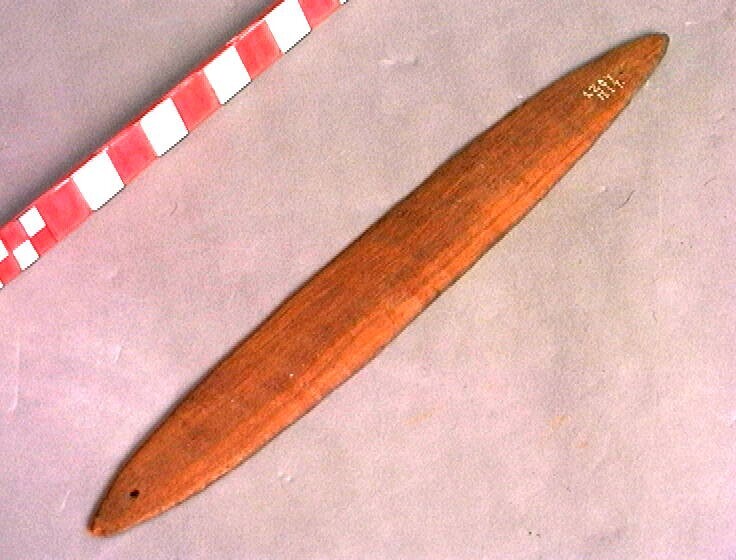
Source term: bullroarers; darugu
darugu: the sacred objects, boards among them, that the women first owned; dingari: the men's ritual cycle and its mythic men; maia: the power the women kept under their armpits.
In the beginning the sacred things belonged to the women. The Ganabuda women travelled the desert hunting and holding their rituals; they brought down game by throwing their sacred boards, the darugu, at it, swung bullroarers, and rode the darugu through the sky. The men had nothing. One man, Djalaburu, watched them and was astonished. In the night he stole the women's power, their maia, from under their armpits, and afterwards they could no longer work the darugu. The men changed places with them and took the sacred things over; the women were given digging sticks and wooden dishes, and Djalaburu explained to them how things now stood. In the dingari, the men's ritual cycle of the Walmajarri and Kukatja, it is the dingari men who circumcise the youths and swing the bullroarers. Yet the cult keeps the women's name: the Ganabuda are the Gadjeri, the Old Woman, the Mother.
They are watched by a man named Djalaburu, who is astonished to find that they possess darugu and swing bullroarers while the men have no sacred objects.
Ronald M. Berndt, in Religion in Aboriginal Australia (1984), p. 186
- Object
- Bullroarers swung in the men's dingari rites, alongside the sacred boards, darugu.
- Function
- Swung by the dingari men in the ritual cycle in which youths are circumcised; in the founding myth the Ganabuda women swung them first.
- Source
- Ronald M. Berndt, "Traditional Morality as Expressed through the Medium of an Australian Aboriginal Religion," in Max Charlesworth, Howard Morphy, Diane Bell and Kenneth Maddock (eds), Religion in Aboriginal Australia: An Anthology (St Lucia: University of Queensland Press, 1984), pp. 175-208, at pp. 186, 202 (first published 1970)
- Source location
- pp. 186, 202
- Source confidence
- medium to high
- Location note
- Balgo (Wirrimanu), the community anchor for the Walmadjeri-Gugadja dingari; the myth route runs south to Wilgin (Lake White). Not a ritual site.
- Initiation rite
- Women-linked
- Female-origin myth