No. LOEB1929-007
Gulf of Papua initiation bullroarer
Papua New Guinea · Gulf of Papua · British New Guinea · Oceania
Restricted
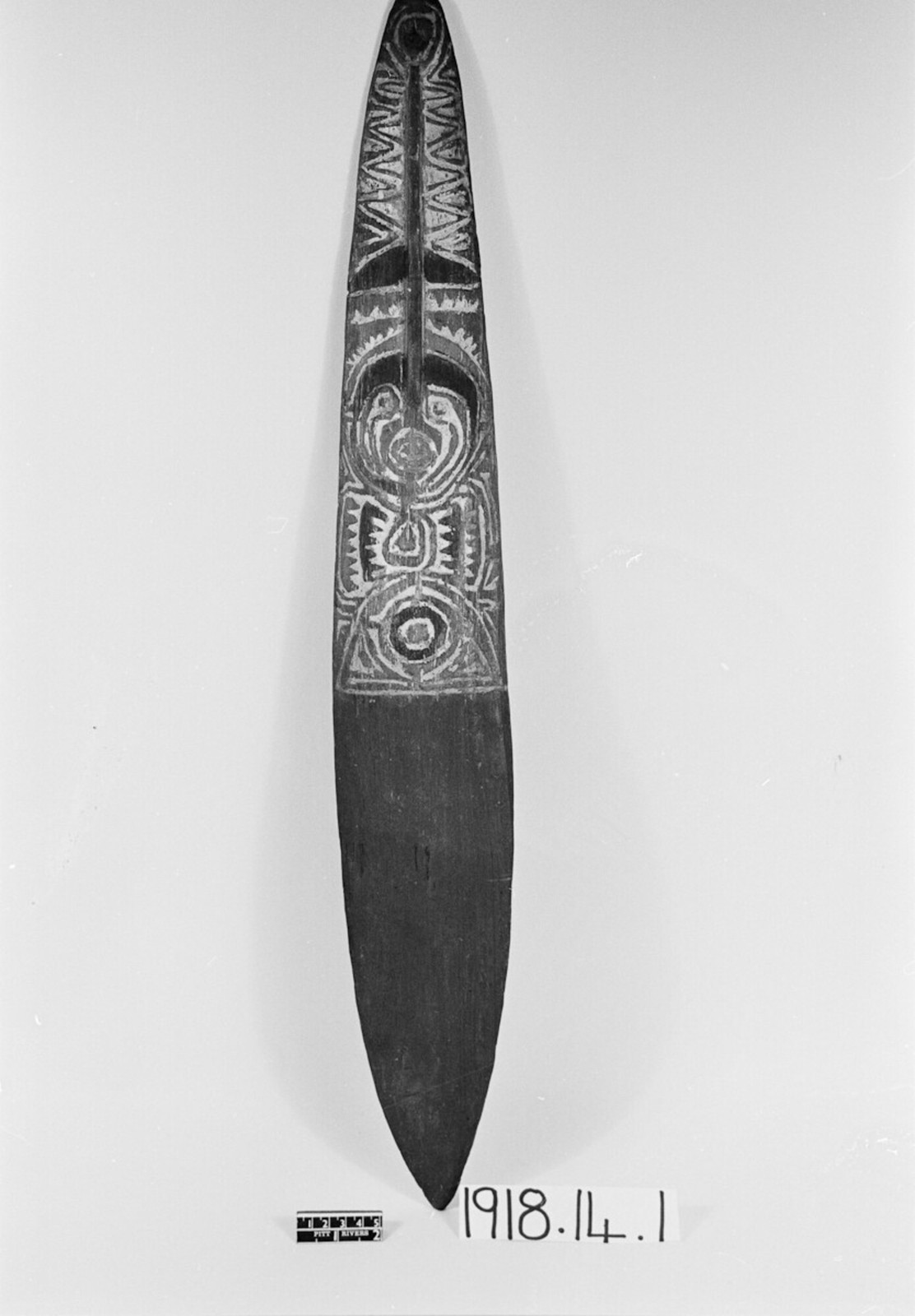
Source term: bullroarer
Masked secret societies around the Gulf of Papua turned the bullroarer's voice into the voice of a malignant god, even while saying the wooden instrument itself had no supernatural power. The boys' initiation centered on revealing what made that sound. Before the secret was disclosed, novices endured harsh treatment, including being made to drink chiefs' urine.
It is said not to possess any supernatural power in itself, but is used as the voice of a malignant god or deity. The disclosure of the identity of the bullroarer forms the kernel of the boys' initiation rites.
Loeb 1929:253, Tribal Initiations and Secret Societies (Univ. of California Publications in American Archaeology and Ethnology 25[3])
Particulars
- Function
- Bullroarer used as the voice of a malignant god or deity; disclosure forms the kernel of boys' initiation.
Source
Edwin M. Loeb, 'Tribal Initiations and Secret Societies,' University of California Publications in American Archaeology and Ethnology 25(3), 1929, p. 253