No. KUNST2026-003
Aranda churinga: an ancestor's other body
Central Australia (Aranda · Arrernte country)
Restricted
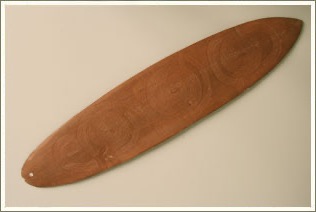
tjurunga
Source term: чуринга — знак предков ('a sign of the ancestors')
In Aranda (Arrernte), tjurunga marks the sacred, secret, and hidden — most often the flat engraved stones and boards of the totemic ancestors.
Etymology. In Arrernte, churinga (tjurunga) means 'sacred, secret': Spencer and Gillen gloss it as a term applied both to the sacred objects and to the sacred quality they possess — above all the engraved stones and boards of the totemic ancestors, whose smaller perforated wooden members are the whirled bull-roarers (churinga irula, 'wooden churinga or bull-roarer'). Each board houses the spirit of the ancestor who carried it, so the bull-roarer shares its name with the entire class of ancestor-spirit boards.
For Aranda initiates, a churinga was not merely a decorated board. It held the continuing presence of an ancestral being and could be revealed to a young man as his ‘other body.’ The revelation came in blood. While a boy was circumcised, bull-roarers roared all round the ground, and the women in their camp heard Twanyirika, the spirit come to take him away. With the wound still bleeding, one of his elder brothers pressed the bull-roarers against it and told him the truth: these made the sound, not Twanyirika. Then the oldest man handed him a bundle of wooden churinga — “Here is Twanyirika” — to help him heal, to guard and never lose, on pain of death for himself, his mothers and his sisters.
Право прикасаться к чурингам и даже видеть их принадлежит только мужчинам, прошедшим сложные обряды инициации.
The right to touch churingas — and even to see them — belongs only to men who have passed through the complex rites of initiation.
Kunstkamera, «Чуринга — знак предков» exhibition (2008)
Particulars
- Object
- Elongated pointed-oval wooden churinga engraved with concentric-circle designs and pierced near one narrow tip; it entered the Kunstkamera with Baldwin Spencer’s collection in 1908. A companion piece from the same Spencer collecting, in the Pitt Rivers Museum as 1903.39.1, is a long wooden ceremonial object with several bullroarers attached to it and human hair, which the museum attributes to Arrernte people at Alice Springs.
- Function
- Secret-sacred ancestral board, pierced at one tip for the cord, shown only to initiated men.
Sources
- Kunstkamera (MAE RAS), St Petersburg, exhibition «Мир одного предмета: Чуринга — знак предков» (The world of one object: the churinga, sign of the ancestors), 2008, curator P. L. Belkov. Baldwin Spencer collection, received 1908. View · archived
- Baldwin Spencer and F. J. Gillen, The Native Tribes of Central Australia (London: Macmillan, 1899), pp. 246 (and n. 1), 248-249. View