No. FRAZER1894-001
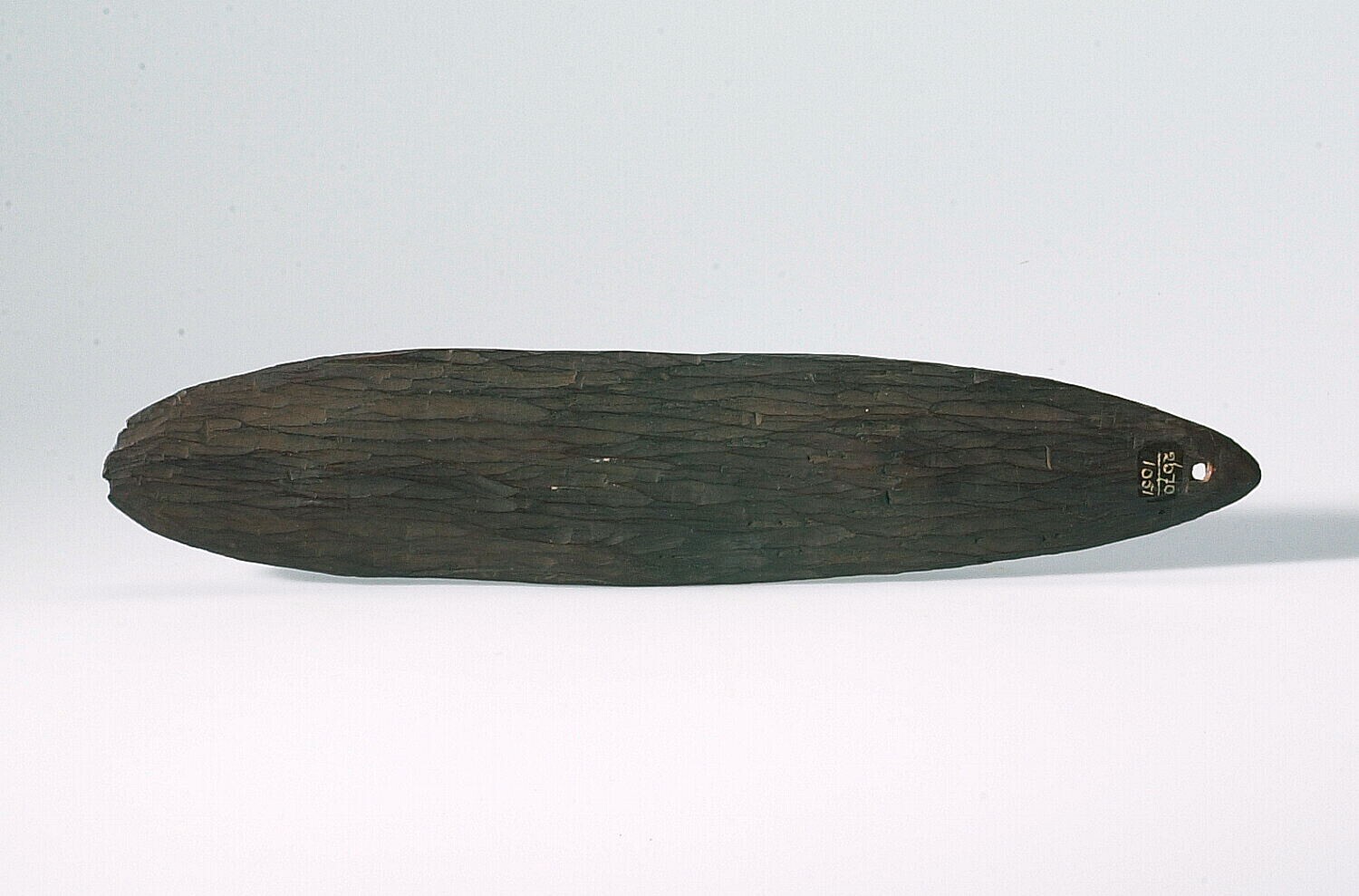
Wonghi/Wonghibon initiation bullroarer
Australia · New South Wales
Restricted
Source term: bull-roarer
At the Bora of the Wonghi, the moment a novice's tooth was knocked out a loud humming noise rose from the cleared ground, made by a flat piece of wood with serrated edges, holed at one end, strung and whirled. The uninitiated were not even allowed to see it; women were forbidden to be present, and the penalty for a woman who witnessed the ceremony, by accident or otherwise, was death, as was probably the penalty for revealing its secrets. The version permitted to outsiders held that each youth, sent away one by one, was met by a Being called Thuremlin, half blackfellow and half spirit, who took him a distance off, killed him, in some instances cut him up, then restored him to life and knocked out a tooth. That was the story told to the women and children. A. L. P. Cameron, the primary ethnographer of the Wonghibon, set it down in the Journal of the Anthropological Institute in 1885, and Howitt reproduced it in 1904. Cameron knew the Wonghi for many years and never got further: the men kept the real secrets of the Bora from him.
The initiation is a sacred rite, and I know of only one instance beside that of Mr. Howitt of a white man having been present.
A. L. P. Cameron, "Notes on Some Tribes of New South Wales," Journal of the Anthropological Institute of Great Britain and Ireland, vol. XIV (1885), p. 357, n. 2
Particulars
- Function
- Secret male initiation instrument; women and uninitiated people were forbidden to see it, and the surrounding ritual dramatized death and restoration by Thuremlin.
Source
A. L. P. Cameron, "Notes on Some Tribes of New South Wales," Journal of the Anthropological Institute of Great Britain and Ireland, vol. XIV (1885), pp. 344-370; A. W. Howitt, The Native Tribes of South-East Australia (Macmillan, 1904), pp. 588-589