MUS2026-210 - museum specimen
West Papuan clay-filled bullroarer trio
Papua New Guinea (catalogue gives both) - West Papua (catalogue provenance "Indonesia - Papua New Guinea, West Papua", all elements flagged uncertain) - Oceania
Function not recorded Candidate only

Source term: Bullroarer
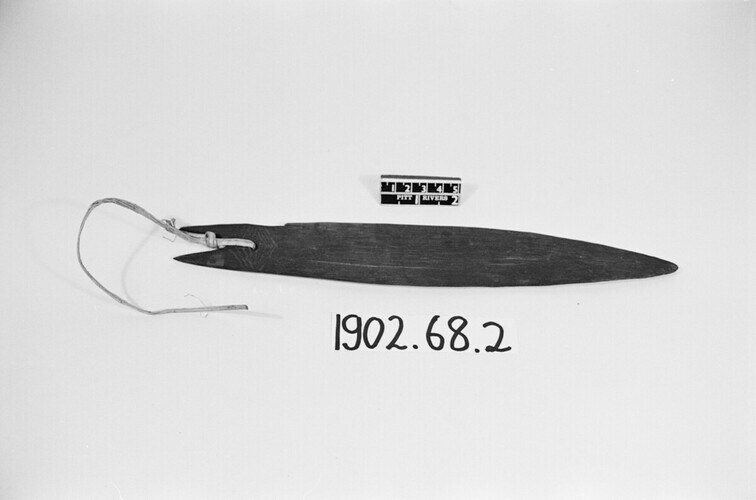
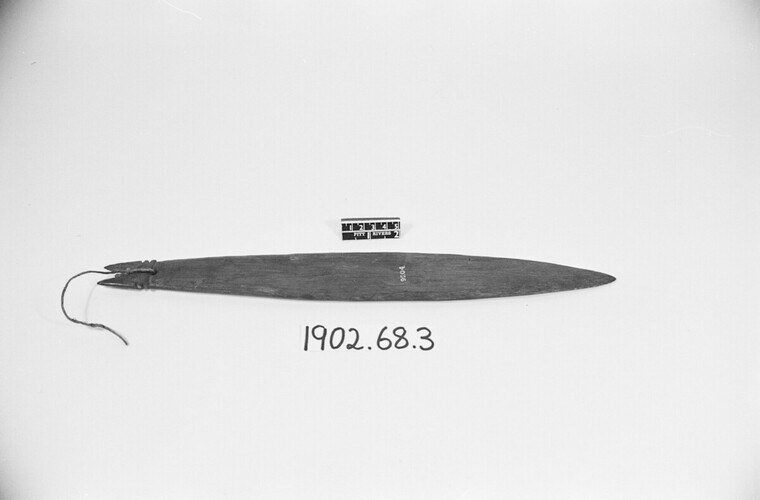
Three wooden bullroarers survive from West Papua as a single dealer's lot, and the largest is remarkable: a carved board nearly seventy-five centimetres long, its incised patterns packed with pale clay, though no perforation or tie was ever recorded for it. Its two smaller companions keep their fibre ties — one blade ringed with a concentric diamond around its hole, the other notched above a shoulder, both ending in a forked top. No maker, people, or village travelled with the group; only the objects and the carving survive.
'Bullroarer' with concentric diamond pattern around perforation. Forked top. Fibre tie.
Pitt Rivers Museum catalogue record 1902.68.2 (retrieved 2026-08-01)
- Object
- Three wooden bullroarers acquired as one lot. 1902.68.1 is very large, 745 x 130 mm, carved and incised with clay in the worked surfaces; the museum record describes no perforation, notch, tie or cord, so no suspension survives or was recorded for it. 1902.68.2, 317 x 47 mm, has a terminal perforation ringed by a concentric diamond pattern, a forked top and a fibre tie. 1902.68.3, 445 x 54 mm, has notches above a slight shoulder at the terminal end, a forked top and a fibre tie. On .2 and .3 the surviving ties show single-end free-air rigging.
- Function
- Not recorded.
- Source
- Pitt Rivers Museum catalogue record 1902.68.2 (retrieved 2026-08-01)
- Source location
Page references
PRM catalogue records 1902.68.1, 1902.68.2 and 1902.68.3 with photographs PRM_RS486213, PRM_RS374187 and PRM_RS374292 (retrieved 2026-08-01)
- Source confidence
- low Broad landmass anchor for western New Guinea, standing in for the museum's uncertain "West Papua" region tag. The catalogue also names Indonesia and Papua New Guinea, which do not agree with each other; this point represents the western half of the island and no smaller unit.