No. AUSMAIN-028
Yumu (Jumu)
Western MacDonnell Ranges, Northern Territory — Haast Bluff (Paura) and Mount Liebig country, west of the central MacDonnell Ranges · Central Australia
Restricted
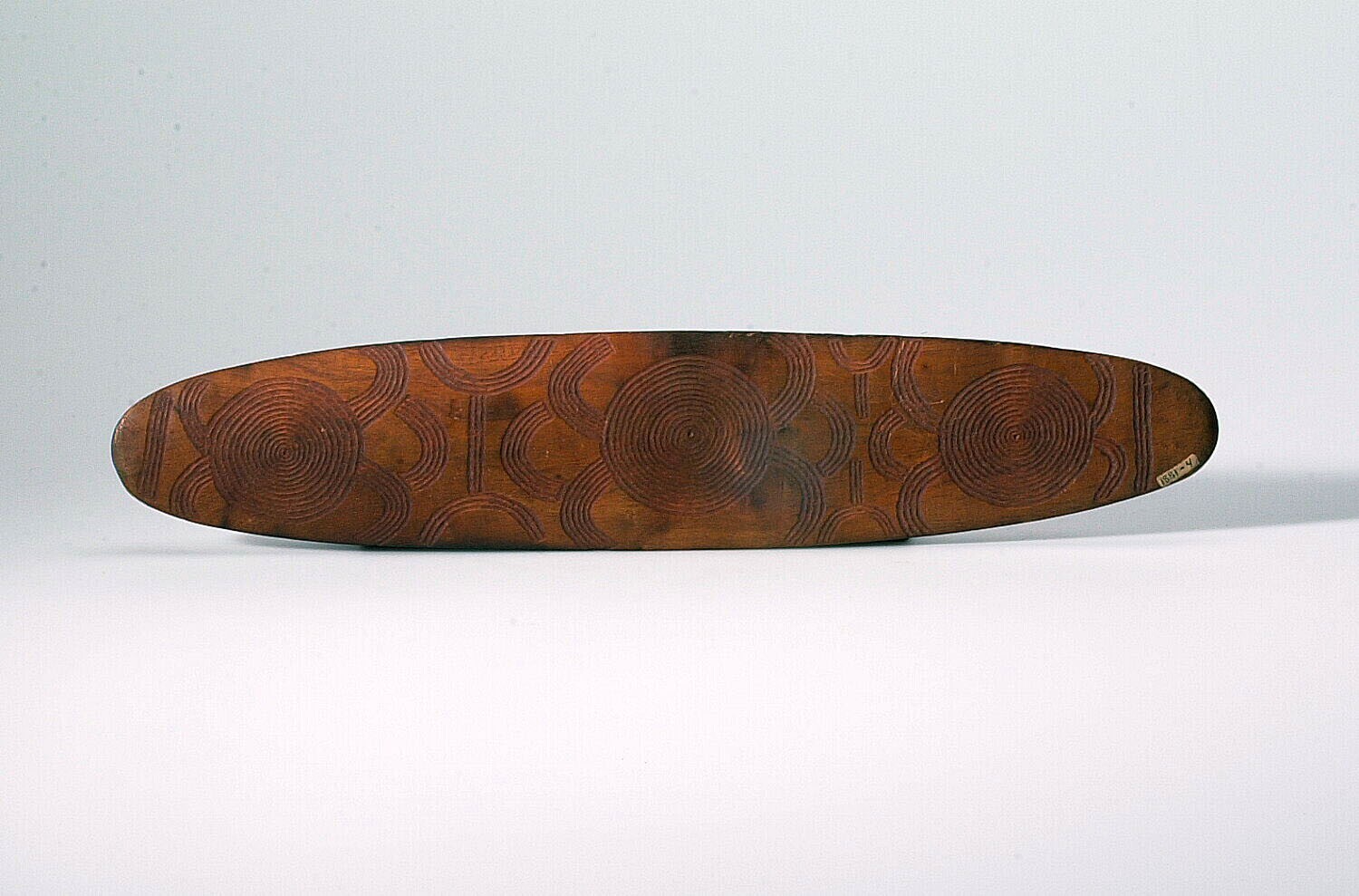
namatuna
Source term: namatuna (Aranda); mandagi (Luritja)
namatuna - the Aranda term for the small holed, whirled bull-roarer (Luritja mandagi).
Etymology. In Róheim's account of the Aranda–Luritja initiation complex shared by the Yumu, the namatuna is the small holed bullroarer handed to newly circumcised boys with the warning to keep it from the women's road, and afterwards the instrument of love magic.
In the western MacDonnell Ranges around Haast Bluff and Mount Liebig, the Yumu were one of the Luritja-speaking desert peoples whose initiation rites the Hungarian anthropologist Géza Róheim recorded during his 1929 fieldwork. After circumcision, a boy was handed the namatuna — a small holed slat whirled on a cord to a roaring hum — and sent into a long bush-wandering, warned to keep it from the "woman's road" and never to let women or children see it. The same slat drove the ilpindja love-magic said to bring women to a man. Yet Róheim also recorded the older belief that turns the secrecy on its head: the namatuna first belonged to the alknarintja, the women who "turn their eyes away" from their suitors, and only later passed to men.
It is a general Aranda belief that the small bull-roarer (namatuna) now used for winning the love of the alknarintja women was originally owned by the alknarintja women themselves. It then passed into the possession of men.
Géza Róheim, The Eternal Ones of the Dream (1945), p. 175.
Particulars
- Object
- A small, thin holed wooden slat (a namatuna-type tjurunga) threaded on a single cord and whirled at arm's length to its roaring, whirring hum. Róheim distinguishes 'small ones with holes in them to be used as bull-roarers and to be whirled' from the large unholed tjurunga.
- Function
- Whirled slat handed to newly circumcised boys during the post-initiation bush-wandering and used in love magic; kept hidden from women and children.
Source
Géza Róheim, The Eternal Ones of the Dream: A Psychoanalytic Interpretation of Australian Myth and Ritual (New York: International Universities Press, 1945), pp. 13, 83, 174-175