No. ETHERIDGE1897-001
Urania Tribe Linda Creek bull-roarer
Australia · Western Queensland · Linda Creek
Restricted
Source term: Bull-roarer
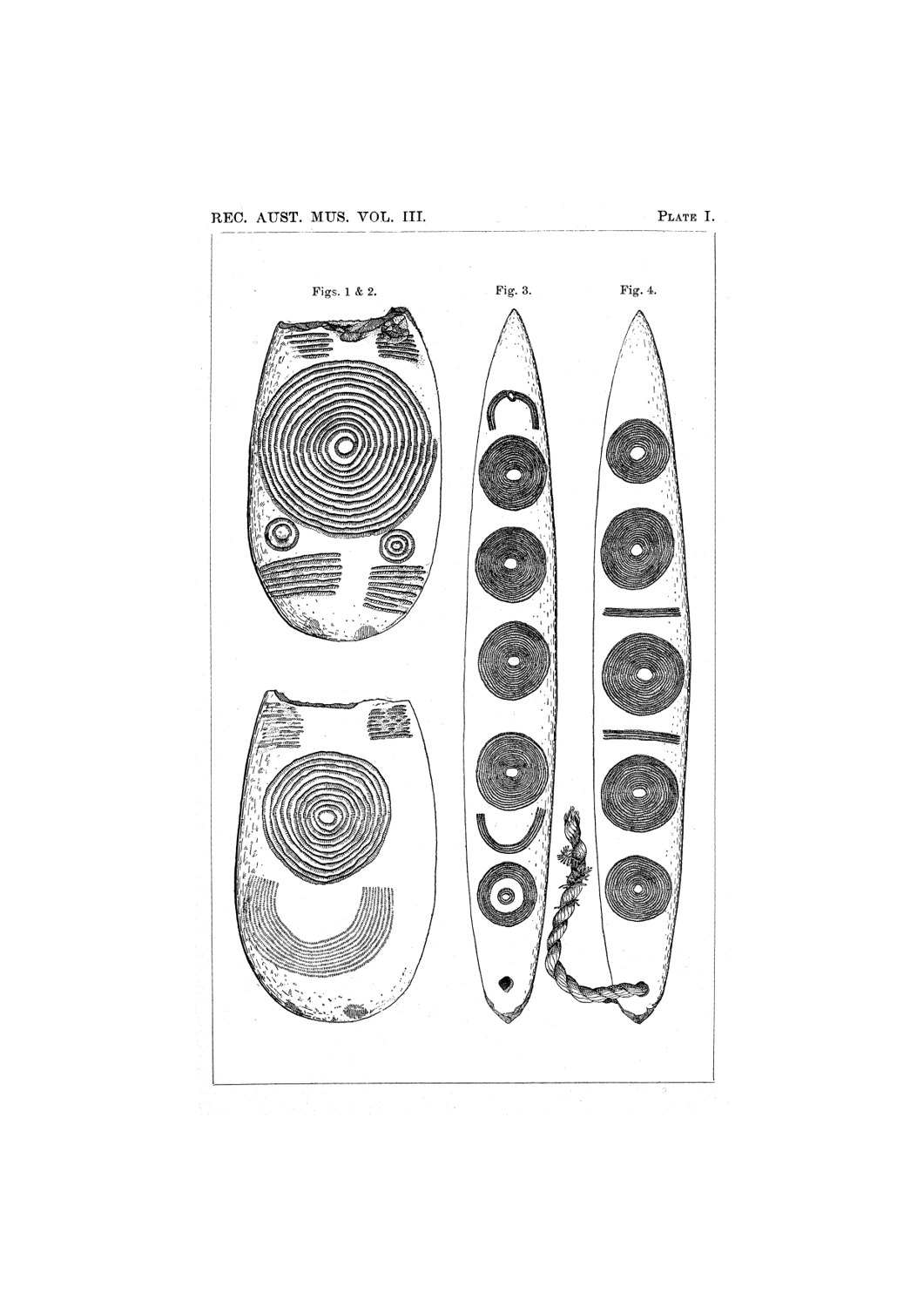
Sixteen inches long and just over two wide, this bull-roarer carries five concentric-circle figures on each face, the central and largest disc holding sixteen rings set off by crossbars of four incised lines above and below. It is attached to a long cord of human hair and fine emu down, and the whole is covered with ruddle and grease. Robert Etheridge Jr. recorded it in 1897 as one of the most beautiful examples of circular concentric sculpture he knew, from the Urania Tribe at Linda Creek in western Queensland. Walter Roth, working the same Georgina country in the 1890s, sorted its whirlers by size and graving: the small plain ones were toys for anyone, while the graved and larger varieties were brought into requisition at certain of the initiation ceremonies, or among the Yaroinga put to the special use of love-charms, and both were always kept away from the view of women. At the Roxburgh circumcision two whirlers sounded to tell the women the ceremony was over. Sixteen inches of ruddled wood covered in concentric rings is the graved and larger variety.
the only published objects bearing this circular ornamentation are "Bull-roarers," and as everyone knows these are the most precious and sacred of the Black's possessions, and only used in the mysteries of the Bora.
R. Etheridge, Jr., 'On circular and spiral incised ornament on Australian Aboriginal implements and weapons', Records of the Australian Museum 3(1) (1897), pp. 4-5
Particulars
- Object
- Incised bull-roarer with five circular/concentric figures on each face, sixteen inches long by two and a quarter wide, attached to a long cord of human hair and fine emu down, and covered with ruddle and grease.
- Function
- A graved whirler: sounded at initiation ceremonies or swung as a Yaroinga love-charm, and kept from women.
Source
R. Etheridge, Jr., 'On circular and spiral incised ornament on Australian Aboriginal implements and weapons', Records of the Australian Museum 3(1), 1897, pp. 1-6, plates i-ii