No. MATHEWS1900-002
Dhalguñgun at the Walloonggurra
Australia · Orara, Boyd, Mitchell and upper Clarence rivers, below the New England tableland, northern New South Wales · Southeast
Restricted
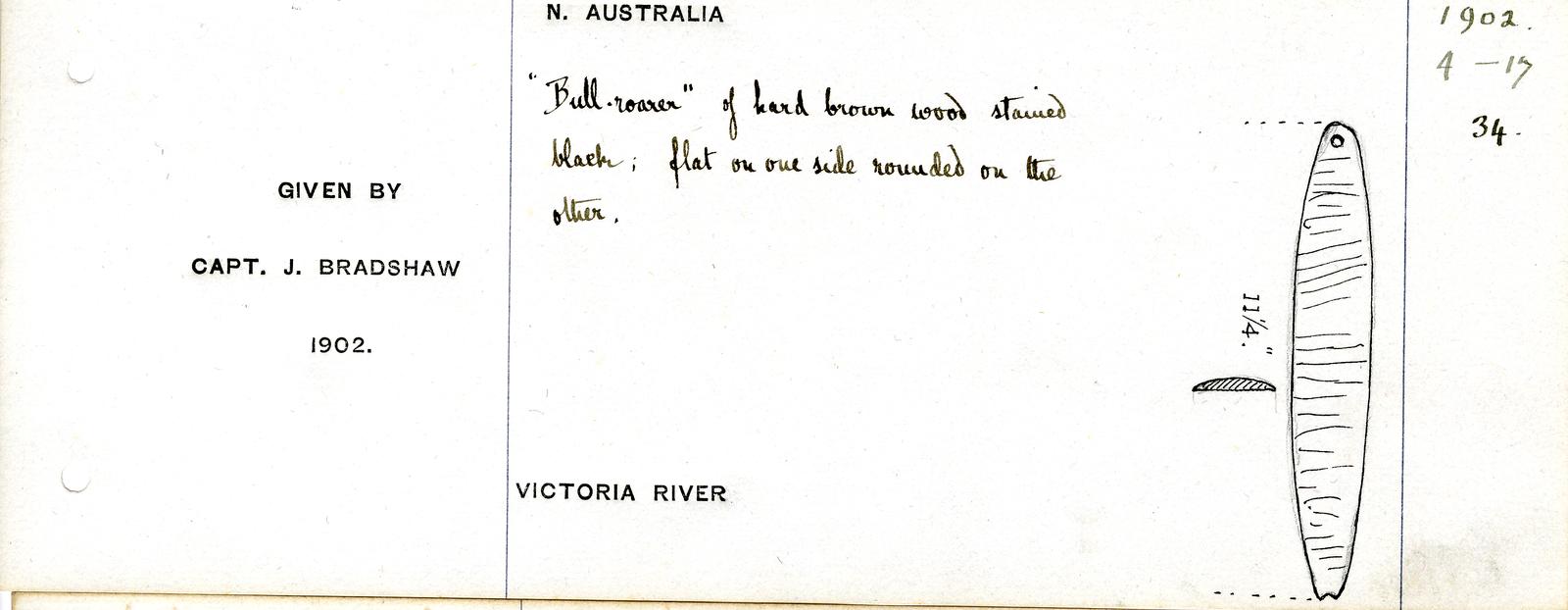
dhalguñgun
Source term: small bull-roarer, dhalguñgun
dhalguñgun: the small bullroarer. yoolooduree: the larger bullroarer shown at the Burbung. Walloonggurra: the elementary initiation, and the name of its cleared circular ground. kungara: flat carved boards. Dharroogan: the evil being who controls the initiation rites.
At the Walloonggurra the first sacred thing a boy met was the dhalguñgun, the small bullroarer of the Orara and upper Clarence country. At dusk the men went to the cleared circle, singing and swinging it, while the women stripped the novices, put feathers in their hair and laid them in a row under rugs. The guardians carried them off on their shoulders as the mothers threw burning sticks after the men. Later, eyes on the ground, the boys watched old men step out swinging the instrument. One rubbed it over each boy's body and hung its string round his neck, and armed men warned them of death if they told. Coming home, each boy sat beside his sister, who took his hand, and his mother led him into the smoke of green boughs. This was only the first stage. At a later Burbung they would see the larger yoolooduree, and boards carved by Dharroogan, the evil being who rules the rites.
The Walloonggurra is an elementary form of initiation, and the neophytes who graduate in this way must subsequently submit to the Burbung ceremonies of the tribes to which they belong.
R. H. Mathews, “The Walloonggurra Ceremony,” Queensland Geographical Journal 15 (1900), p. 73
Particulars
- Object
- The dhalguñgun, the small bullroarer of these districts; a larger one, the yoolooduree, was reserved for the later Burbung.
- Function
- Swung by the men at the Walloonggurra ground at dusk when the novices were taken from their mothers; later swung before the novices, rubbed on their bodies and its string put round each boy's neck, with a warning of death if they revealed the ceremonies.
Source
R. H. Mathews, “The Walloonggurra Ceremony,” Queensland Geographical Journal 15 (1899–1900): 67–74