No. MENNIS2006-001
Meziab secret from a sacrificed child
Papua New Guinea · Rai Coast, Madang Province · Oceania · Sahul
Restricted
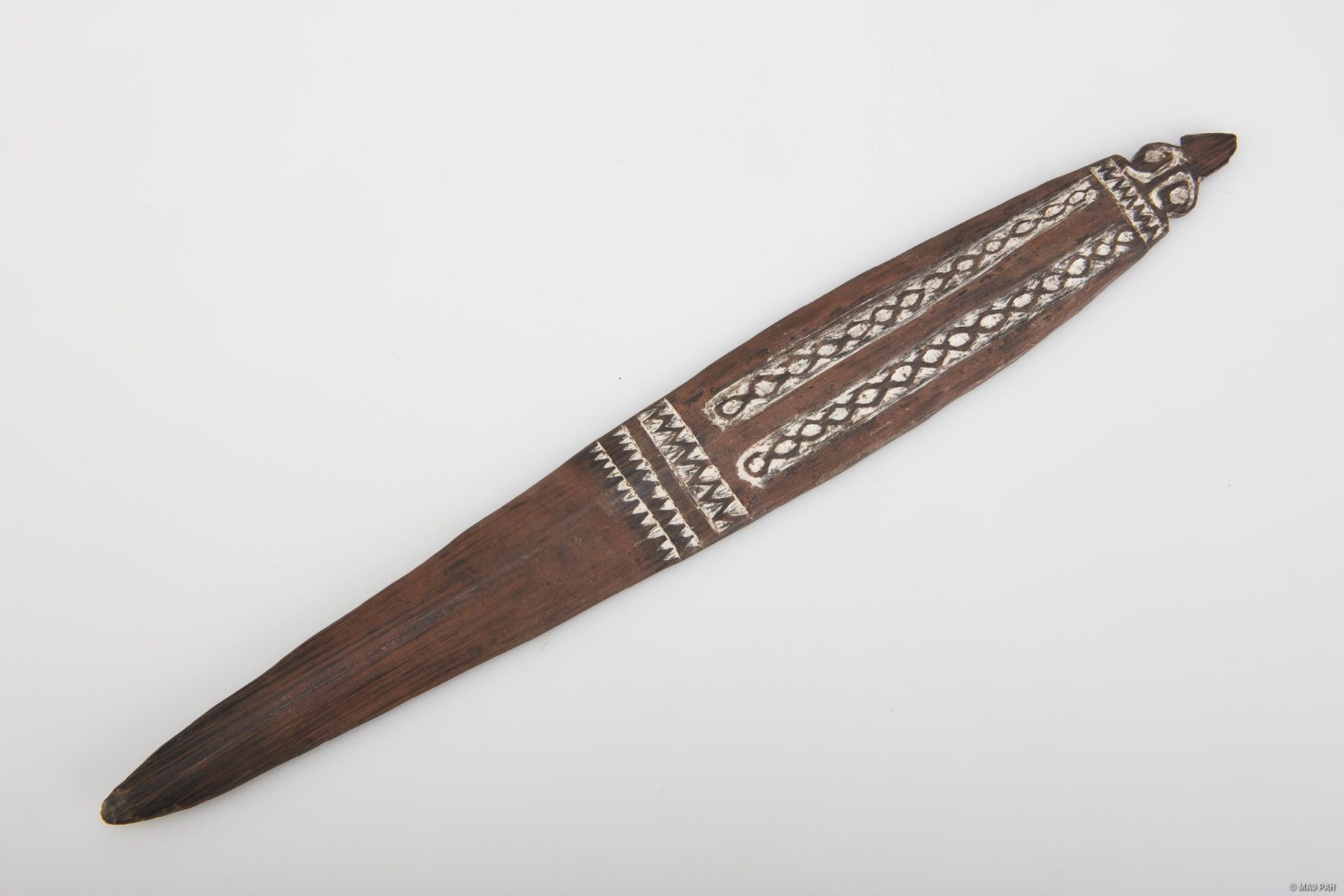
Source term: bullroarer used in the meziab
meziab (also mesiab): the men's cult of the Madang coast, its spirit and its ceremonies; the bullroarer gives it voice. piziz: the tree whose split trunk made the first bullroarer. aiau: a tree whose aerial roots bind blade to rod. bilum: string bag.
A man went fishing on the reef with his wife, leaving their baby asleep in a string bag hung from a bough. A man from Saror village stole the child and raised him as his own. Years later the boy told his foster-father, "If you kill me, I shall do something extraordinary." The man killed him, and the boy's spirit revealed the secrets of the meziab: cut down a piziz tree, split the trunk, take a piece as long as a man's arm, bind it with aerial roots to a bamboo rod, and whirl it above the head, and it will speak with the voice of the meziab. The man sent his wife into the woods to try it first. She swung it round and round, but no sound came, only the slap of her breasts against her body. "You go and do it," she said. "I will cook the food; you look after the meziab." That is why, on the Rai Coast, women may not join the meziab or see its instruments.
She swung it round and round, but it did not give forth a sound, only her breasts flapped against her body, pappappap.
Mary R. Mennis, A Potted History of Madang (2006), p. 37, after Hannemann
Particulars
- Object
- In the origin story, a bullroarer cut from a split piziz trunk to the length of a man's arm and fastened with aiau aerial roots to a bamboo rod.
- Function
- Whirled above the head to produce the voice of the meziab, the men's cult; its origin story, in which a wife fails to make the first bullroarer sound, explains why women may not take part in meziab celebrations or see its instruments.
Source
Mary R. Mennis, A Potted History of Madang (2006), p. 37