No. MUS2026-009
Lardil blade that assembled the group
Australia · Mornington Island, Gulf of Carpentaria · Queensland
Play / practical
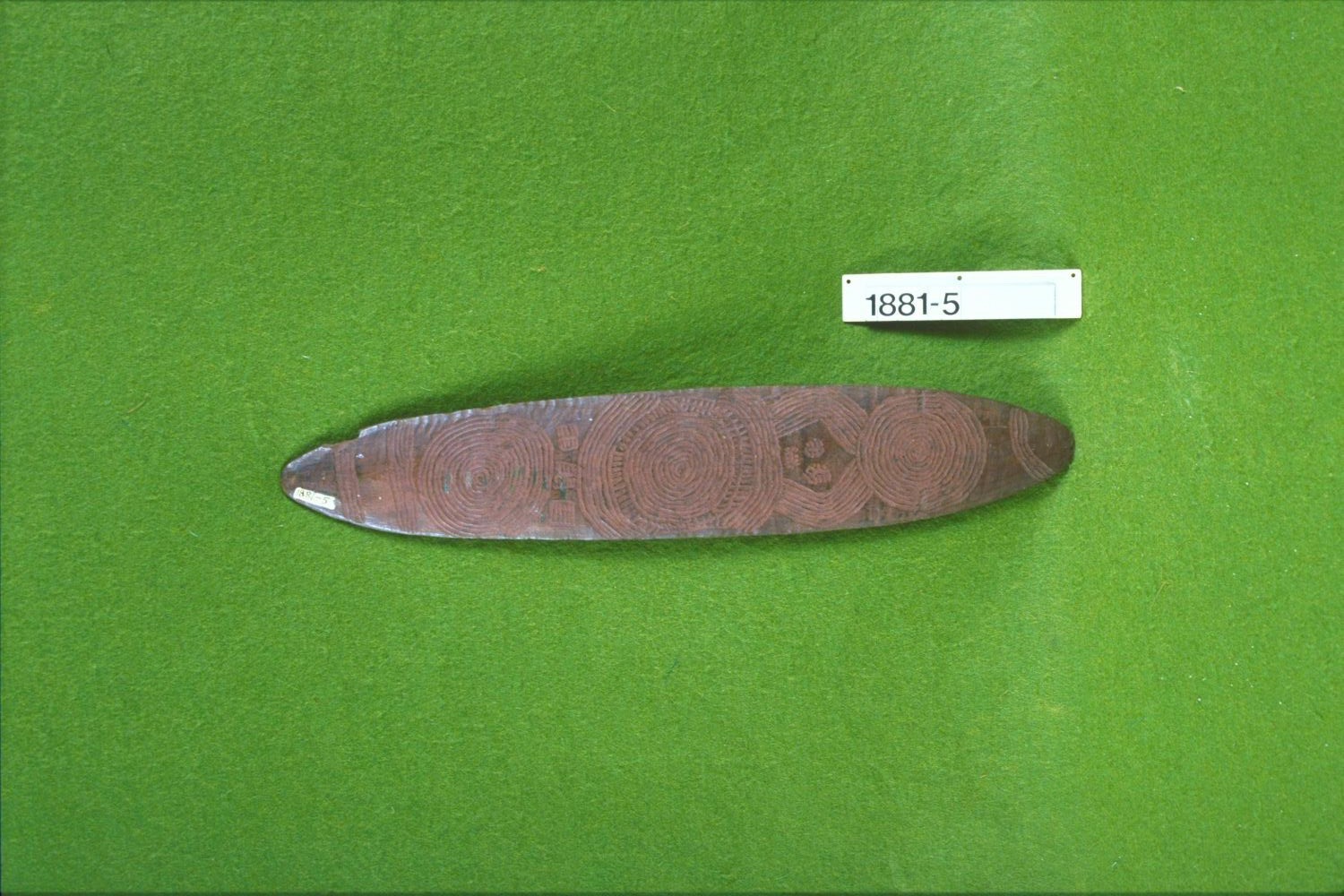
Source term: bull-roarer
A Lardil bull-roarer from Mornington Island, in the Gulf of Carpentaria, collected by George R. Moule and accessioned in 1955. The flat ovoid hardwood blade is painted vermilion ochre and worked over with white lines, V-shapes and rows of punctations, and still carries a stub of its cord. In the collector's words it was "used to assemble the group and in some of their dances" — a summoning call that drew people together and a sound carried into the dancing. Here the roar did working duty: a signal and a dance voice.
Particulars
- Object
- Bull-roarer of the Lardil, in the collection of Smithsonian NMNH (NMNH Anthropology).
- Function
- Called the group together, and sounded in some dances.
Source
Smithsonian NMNH, Department of Anthropology, catalogue record (accession no. 203876; USNM E392780-0), Bull-Roarer, Lardil (Kunhanaamendaa), Gulf of Carpentaria, Queensland; donated by George R. Moule, accessioned 20 Jan 1955