MUS2026-227 - museum specimen
Middle Sepik fishtail bullroarer
Papua New Guinea - Middle Sepik - Oceania - Sahul
Function not recorded
Source term: Schwirrholz
Schwirrholz - the standing German museum term for a bullroarer, literally "whirring wood". It is the Berlin catalogue's object type here, not a local Sepik name; no vernacular name is recorded for this object.
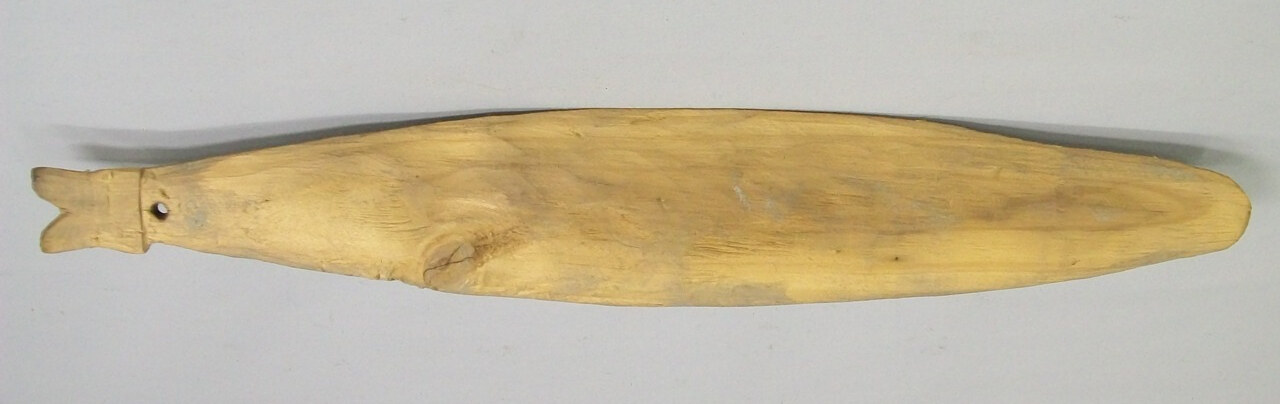
A blade of pale wood the length of a forearm — thirty-eight centimetres by six — and just eight millimetres thick, thin enough that the measurement alone shows it was made to be swung, not merely carved for display. It tapers to a rounded point at one end; at the other, a small drilled hole sits just short of a stubby notched tail shaped like a fish's fluke. Berlin's Ethnologisches Museum received it as a gift from Hermann Schlenker in 2012, cataloguing it as a Schwirrholz from the Middle Sepik — the region's whirring wood, though its own cord and any word for it are long gone.
- Object
- Carved wood, 38 x 6.2 x 0.8 cm. A pale, gently bowed leaf-shaped blade, widest at the middle and drawn to a rounded point at one end; at the other end a drilled circular hole sits immediately before a short notched, fishtail-shaped projection. No cord survives. At just 8 mm thick on a 380 mm blade, it is an unusually thin, clearly free-air profile.
- Function
- Not recorded.
- Source
- Ethnologisches Museum, Staatliche Museen zu Berlin, accession VI 57792, published by the Humboldt Forum as Sammlungen Online object 169088 "Schwirrholz": carved wood, 38 x 6.2 x 0.8 cm, place "Mittelsepik / Nordostneuguinea", gift of Hermann Schlenker in 2012. The catalogue supplies no local name, no collector, no maker, no manufacture date, no recorded…
- Source location
Page references
Ethnologisches Museum Berlin VI 57792; Humboldt Forum Sammlungen Online object 169088
- Source confidence
- low Middle Sepik regional anchor in the Ambunti-to-Angoram reach; the record's only place field is "Mittelsepik", with no village, people or collecting point.