No. CAMPBELL1959-001
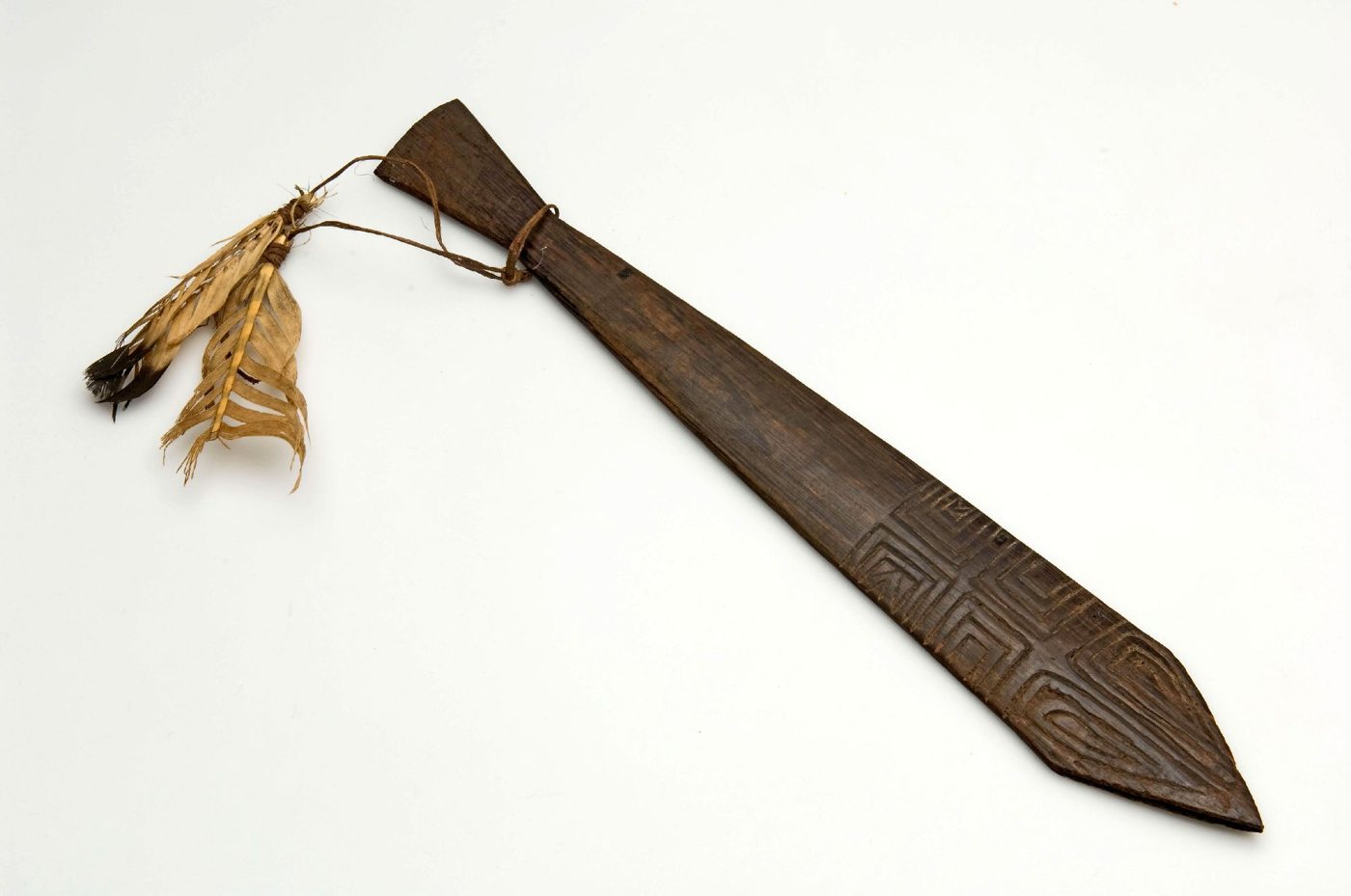
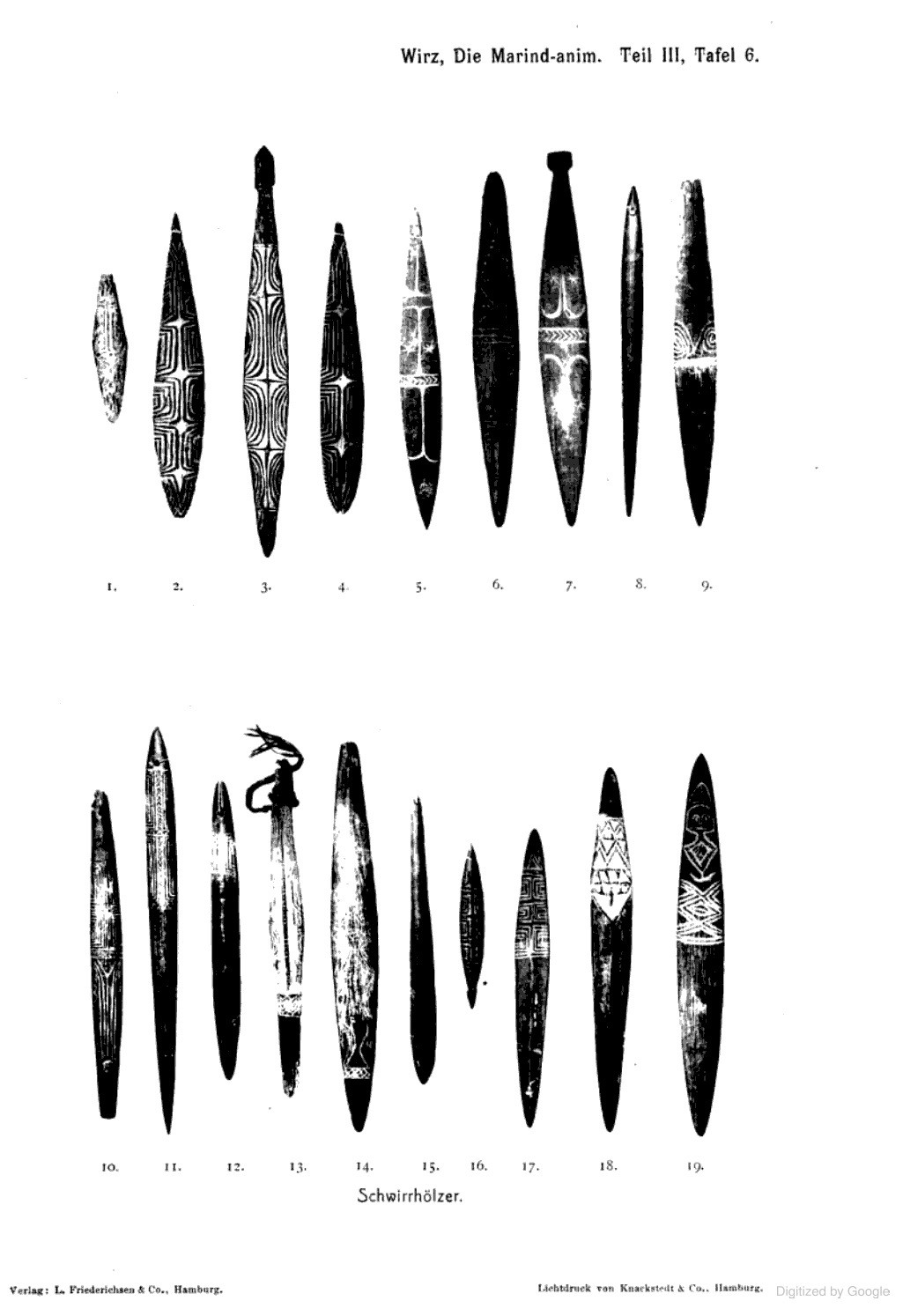
Marind-anim Dema-voice bullroarers
Indonesia · Dutch South New Guinea · South Papua · Oceania
Restricted
sosom
Source term: bull-roarers
sasam: the Marind-anim bullroarer, identified with Sosom, a dema (ancestor-spirit) and brother of Waba; distinct from the cordless tang. Kunst 1967 (section XXIV) records three further names for the same object: tepo-anim, and -- according to the palm species the blade is cut from -- gongai or arib.
Etymology. Among the Marind-anim of southern New Guinea (the 'Tugeri' or 'Kaya-Kaya' of early reports) the bull-roarer is called sosom, the same name as Sosom, a mythical giant and dema (ancestor-spirit) said to arrive each year with the south-east monsoon, when initiate boys are presented to him to be swallowed and disgorged; the whirling instrument is his voice.
Among the Marind-anim of Dutch South New Guinea, the whirring of the bull-roarer was the voice of the Dema, the ancestor-gods, rising out of the earth as the men danced. Joseph Campbell drew the account from the Swiss ethnologist Paul Wirz, who lived among the Marind near Merauke from 1916 to 1919; J. van Baal's definitive modern ethnography, Dema (1966), confirms and sharpens it. There the bullroarer (sasam) is the male symbol par excellence and is in effect Sosom himself, the dema said in myth to be the size of a coconut palm, to whom the men and boys were brought to be swallowed and given back unharmed. In the myth the older men, weary of the boy-giant's roaring, cut off his penis; it fell into the river and became a watersnake — and the bullroarer the men whirl is that severed member, the serpent's own voice. One tradition Wirz set down even makes the cult a counter-stroke in a war of secrecy between the sexes: the men, having discovered the women's secret dances, invented Sosom and his roar to frighten the women in turn. The whirled sasam is terminologically set apart from the tang, the cordless bullroarer-like object handed to each new initiate at the close of the Mayo rite.
die Schwirrhölzer, deren brummender Ton als Stimme eines gefürchteten Geistes ausgelegt wird
the bullroarers, whose droning sound is interpreted as the voice of a feared spirit
Paul Wirz, Die Marind-anim von Holländisch-Süd-Neu-Guinea, Teil I (1922), p. 82
Particulars
- Object
- A bull-roarer attributed to the Marind-anim, made of wood and lime and more than half a metre long, held in the Metropolitan Museum of Art.
- Function
- Ritual Dema-spirit voice in Marind-anim ceremonies and boys' puberty rites.
Sources
- Joseph Campbell, The Masks of God: Primitive Mythology (New York: Viking, 1959; London: Secker & Warburg, 1960), pp. 170-171
- Paul Wirz, Die Marind-anim von Holländisch-Süd-Neu-Guinea, Teil I (1922), p. 82; Teil II (1922), pp. 25, 54-56, 85-86; Teil III (1925), Tafel 6
- J. van Baal, Dema (1966), pp. 485ff., 534 View