No. MAT1898-010
Upper Murrumbidgee mundjeegong
Australia · Upper Murrumbidgee River · Southeast
Restricted
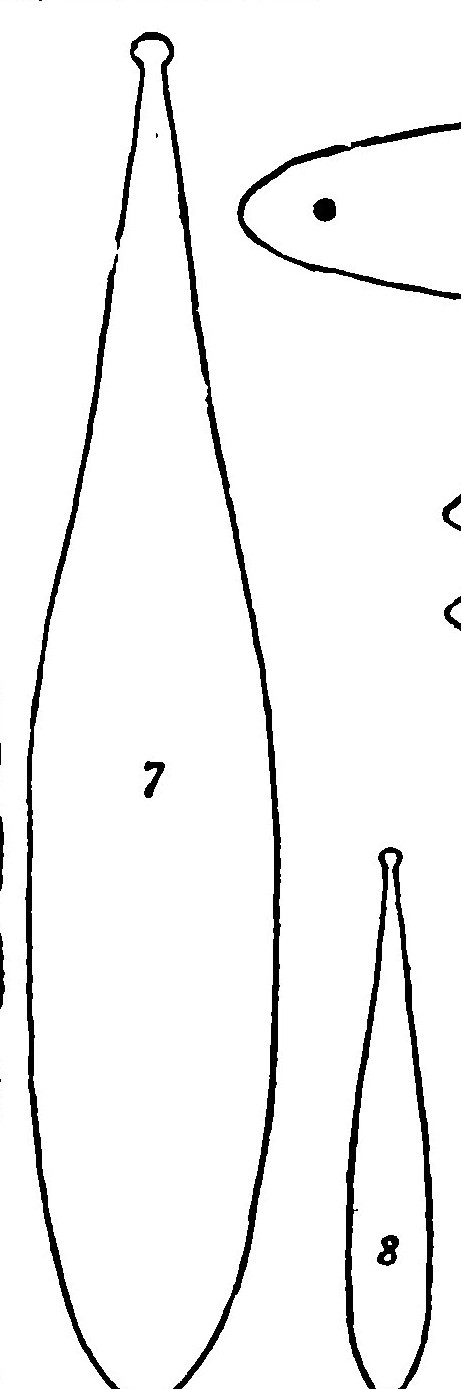
mundjeegong
Source term: bull-roarer
mundjeegong (also Mudjigang/mudthega): the Wiradthuri (Wiradjuri) bull-roarer; Burbung: the Wiradthuri male-initiation ceremony; Dhuramoolan: the being whose voice the bull-roarer carries; Baiamai (Baiame): the Wiradthuri All-Father who instituted the rite.
Etymology. Mundjeegong is the upper-Murrumbidgee Wiradthuri bull-roarer, the word Howitt writes Mudjigang (alongside Bobu) for the instrument the Duran-duran, or messenger, carries when calling the people to the Burbung initiation; among Wiradthuri tribes generally the bull-roarer carried the voice of the destroyed being Dhuramoolan and was even called by his name.
On the upper Murrumbidgee the Wiradthuri bull-roarer was the mundjeegong, the instrument R. H. Mathews knew by the triangular notch cut into its broad end. Mathews and Howitt together show what that wood carried. In the Wiradthuri Burbung the roarer the messenger called Mudjigang summoned the camps to the initiation ground, where the medicine-man swung it through the ceremony and the women were penned behind a screen of boughs while its din was made to frighten them. Its voice was the voice of Dhuramoolan, the being whose cry, the Wiradthuri said, Baiamai had sealed into every tree so that men could reproduce it. The boys had a tooth knocked out and were made into men; the women, kept from the instrument, were left believing that Dhuramoolan still came in person to carry the boys off, burn them, and bring them back to life.
A messenger in the Wiradjuri tribe is provided with a message-stick, the notches on which remind him of his message, and if it is to call the people together for initiation ceremonies, he carries a bull-roarer (Bobu or Mudjigang), a belt (Gulir), a man's kilt (Buran or Tala-bulg) made of kangaroo-rat skin, a head-string (Ulungau-ir), and a white head-band (Kambrun).
A. W. Howitt, The Native Tribes of South-East Australia (1904), p. 692
Particulars
- Object
- Bull-roarer with a triangular notch cut out of the wood at its wide end.
Sources
- R. H. Mathews, 'Bullroarers used by the Australian Aborigines,' Journal of the Anthropological Institute 27 (1898), pp. 52-60
- A. W. Howitt, The Native Tribes of South-East Australia (1904), p. 692, pp. 583-586
- R. H. Mathews, “The Burbung of the Wiradthuri Tribes,” Journal of the Anthropological Institute 25 (1896), pp. 295-318
- R. H. Mathews, Notes on the Aborigines of New South Wales (1907), reprint, sec. 8, “Bull-roarers used by the Aborigines” View · archived