No. MUS2026-075
The hair cord that swung Ngara-Mamurna
Australia · Numbulwar, Arnhem Land (NT)
Restricted
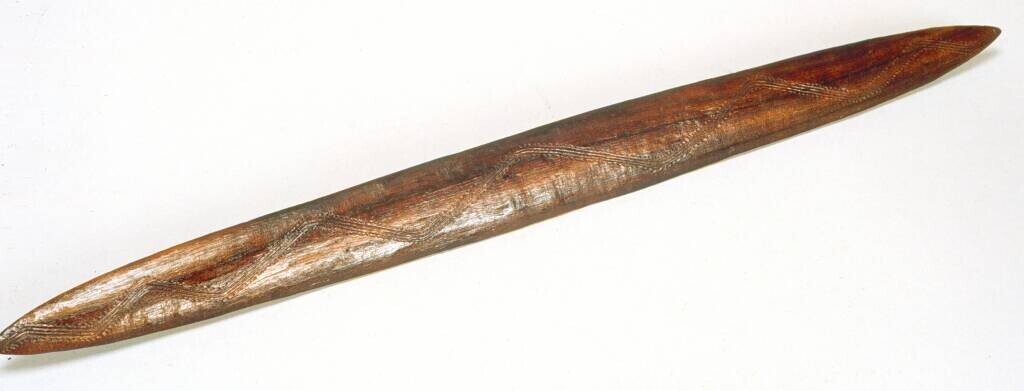
Source term: bull-roarer
What the Wereldmuseum holds here is not a bull-roarer but the cord that swings one: a length of twined human hair, the handle by which a Nunggubuyu man set the wooden plate roaring. The sound it made was the voice of Ngara-Mamurna, the mythical woman who, in the museum's account, swallows the initiands. The roarer belongs to the Gunabibi, the great initiation cult whose proprietors among the Nunggubuyu are the Mandayung moiety, in the Rose River country around Numbulwar on the Gulf of Carpentaria; in its rite the boys are swallowed and disgorged, taken in as children and brought out as men. Women and the uninitiated were not to see the plate, only to hear it and be frightened. The cord entered a Dutch national collection on its own, catalogued as a Nunggubuyu bull-roarer cord though the bull-roarer itself never followed.
Particulars
- Object
- Twined human-hair swing-cord (ana-laribirk) for a bull-roarer, Nunggubuyu, Wereldmuseum / NMVW (acc. RV-4090-21). The object is the hair cord by which the bull-roarer is swung, not the wooden plate itself.
- Function
- Sacred attribute of the Gunabibi initiation ritual: the twined human-hair cord used to swing the bull-roarer, whose sound is the voice of the mythical woman Ngara-Mamurna who is said to swallow the initiands. Used in male initiation and to frighten the women. The accessioned object is the hair cord, not the plate.
Source
Wereldmuseum / NMVW, acc. RV-4090-21