No. MUS2026-328
Four-holed Papuan Gulf gope cult board
Papua New Guinea · Gulf Province · Oceania · Sahul
Sacred / spirit
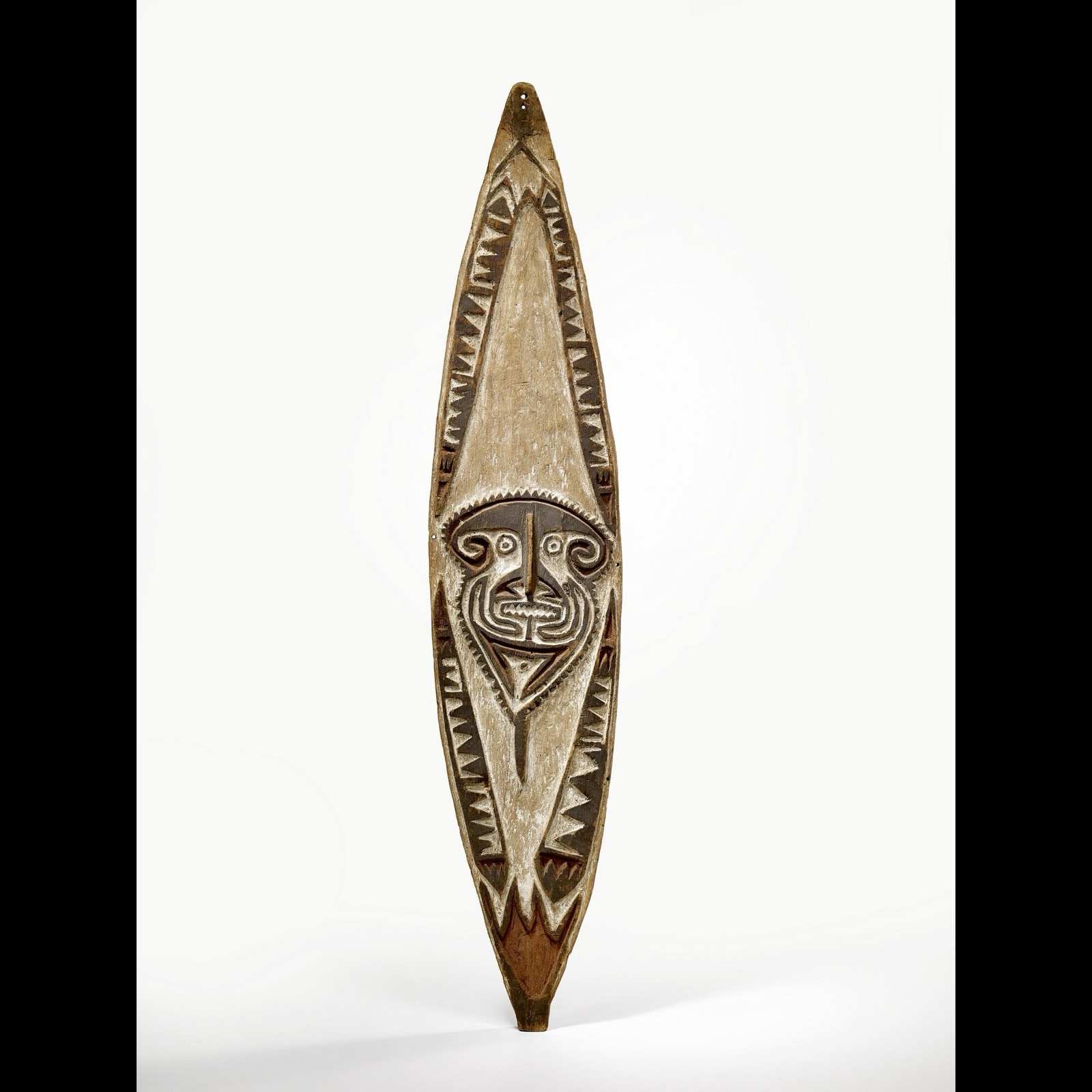
gope
Source term: Bullroarer
gope: the name recorded with the board.
Boards like this one stood in the alcoves of the long communal houses of the Papuan Gulf. This is 92.5 centimetres of oval plank, cut in champlévé and painted dark brown, light brown and white, and drilled to be swung: two holes at the top for the cord, two more through the sides. The Gulf never drew a hard line between the standing board and the whirled one. Seligman illustrated a plank four feet long of bull-roarer shape taken from an Elema clubhouse, a snake carved in such high relief that its head and tail stood free of the wood; and he found the Gulf's ceremonial decoration copied as far inland as Mekeo, 'bull-roarer derivatives' painted with the ancestors of the Elema tribes.
the whole apparatus of decoration has been borrowed including 'bull-roarer derivatives' on which are portrayed conventional human figures representing the ancestors of the Elema tribes
C. G. Seligman, The Melanesians of British New Guinea (Cambridge, 1910), p. 334
Particulars
- Object
- An oval gope-type cult board, 92.5 × 20 × 3.5 cm, carved in champlévé and painted dark brown, light brown and white, with two cord holes at the top and two lateral holes.
- Function
- A Papuan Gulf longhouse cult board rigged for whirling; the two top holes take the rotation cord.