CHRISTY1926-001 - museum specimen
Painted North Queensland fire-plough board
Australia - North Queensland
Function not recorded
Source term: possibly a bull-roarer
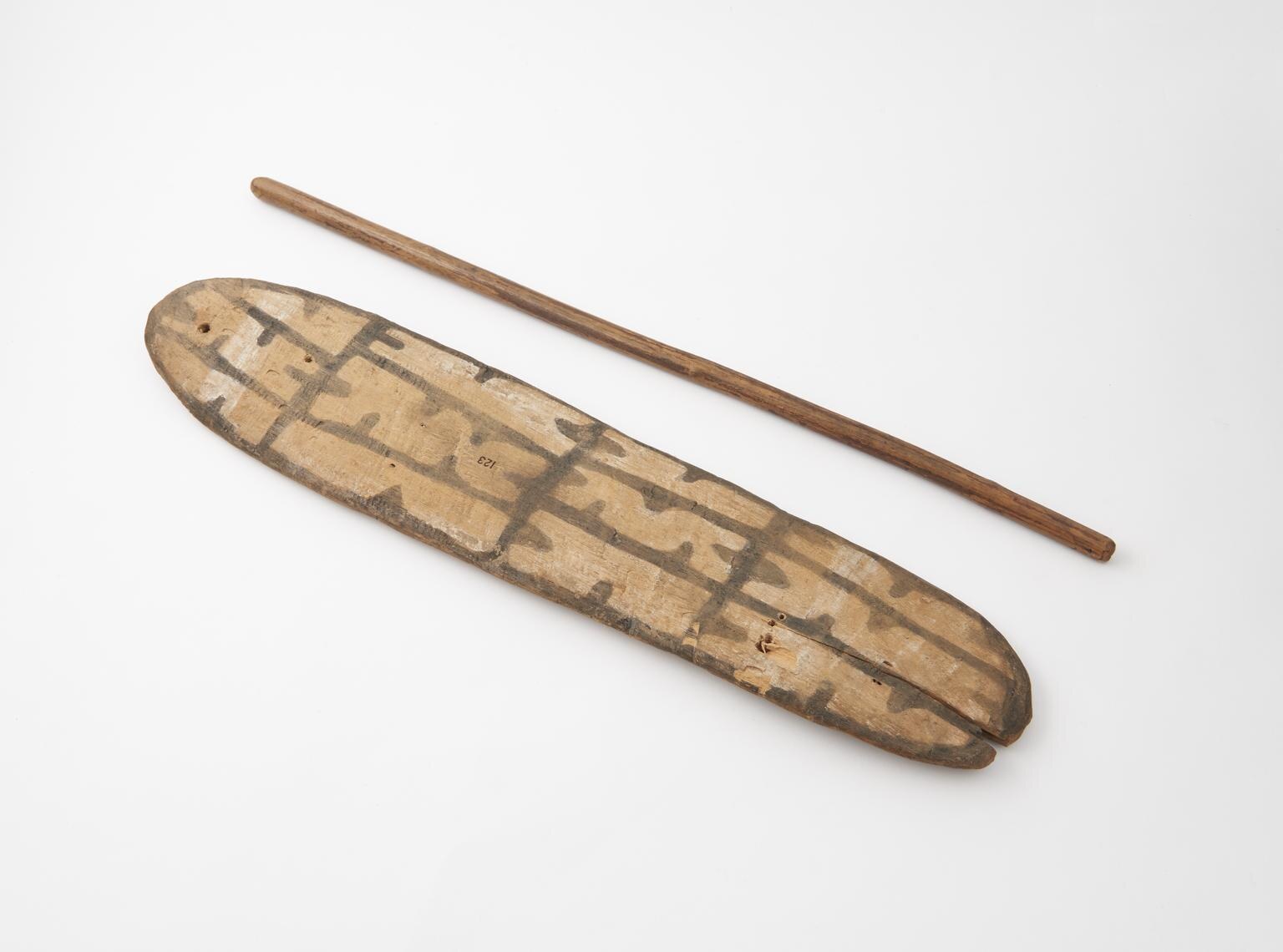
A painted oval board from North Queensland, about 43 centimetres long and almost flat, carries black rectangles on one face and a deep friction groove on the other. Two round holes are visible near one rounded end in the exact photograph. Miller Christy catalogued the board as the hearth of a fire-plough, but in the same entry called it possibly a bull-roarer and noted that this fire-plough form was otherwise unknown in Australia. No recorded field use settles the question: the groove supports the hearth reading, while the blade form and holes keep the bullroarer reading open.
hearth oval in shape, almost flat, and about half-an-inch thick; possibly a bull-roarer; a rude pattern, in rectangles, painted in black, on the back; has one furrow only on its surface; from North Queensland. (This is a very exceptional form of the fire-plough, which, apart from the evidence afforded by this specimen, is not known to have been used in Australia.)
Christy 1926, cat. 123
- Object
- Long oval wooden board, almost flat and about half an inch thick, 17 inches or roughly 43 cm long, painted with black rectangles on one face and cut by a deep longitudinal friction groove on the other. The exact photograph shows two round holes near one rounded end and the separate 18-inch fire stick catalogued with it. Science Museum Group 1937-682/123.
- Source
- Miller Christy, The Bryant and May Museum of Fire-Making Appliances: Catalogue of the Exhibits (London: Bryant and May, 1926), catalogue no. 123; the entry is carried verbatim in the Science Museum Group record for 1937-682/123, UID co8075907, barcode SMG00226539, which credits the description to Christy's catalogue; Part of the Bryant and May collection…
- Source location
Page references
Christy 1926, cat. no. 123; SMG 1937-682/123, UID co8075907, barcode SMG00226539, image i454964
- Source confidence
- low Deliberately generalised regional anchor in inland North Queensland, the only provenance the catalogue supplies; not a locality, community or collection point, and consistent with the atlas's generalised handling of Australian points for cultural-site sensitivity. The record's structured 'Made: Bow' field refers to Bryant and May's works at Bow in London and is expressly NOT used.