No. AUSIN-013
Iwaidja Port Essington Kurrabudji
Australia · Port Essington · Cobourg Peninsula · Top End
Restricted
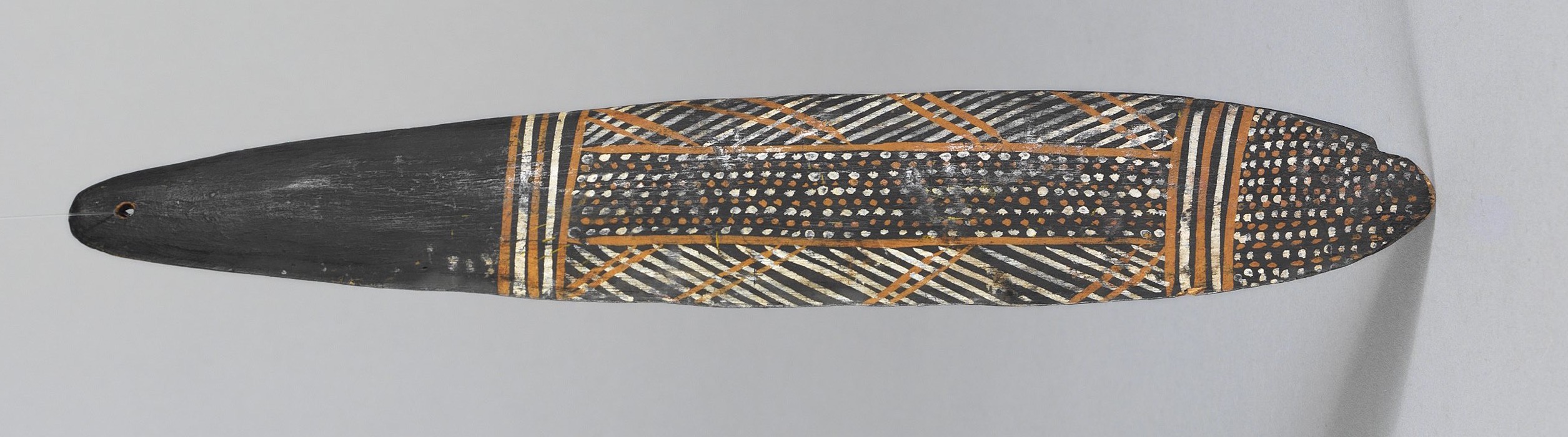
Kurrabudji / Kurabudji
Iwaidja name for the bull-roarer; Spencer also spells it Kurabudji.
At the Naialpur initiation of the Iwaidja, or Port Essington, tribe, the boy was made to sit on the koar ground with his head bent low so that he could not see; painted old men crept up behind him whirling the bull-roarers, and the pappam told him to look up. He was then shown the Kurrabudji and told that the noise was made by it, not, as the lubras believed, the voice of a great spirit that takes the boys away. At first he was very frightened. The sticks were thought to be full of magic, so the old men rubbed them over their own bodies to modify that power before placing them in his hands; he looked at them and handed them back. His body was rubbed over with the sticks, sometimes standing, sometimes lying down. Again and again the boy was shown the Kurrabudji, and warned that the lubras and children must not see them on any account.
As usual the lubras think it is the voice of a great spirit that takes the boys away, but the old men tell him that it is not so.
Spencer 1914, Native Tribes of the Northern Territory of Australia, p. 119
Particulars
- Object
- Bullroarer sticks shown to the youth during the Naialpur initiation.
- Function
- Port Essington bullroarer shown to young men during initiation; women and children must not see it.
Source
Baldwin Spencer, Native Tribes of the Northern Territory of Australia (1914), pp. 119, 213