No. MUS2026-205
Desert-tribe cora with snake and dancer
Pilbara · Western Australia
Sacred / spirit
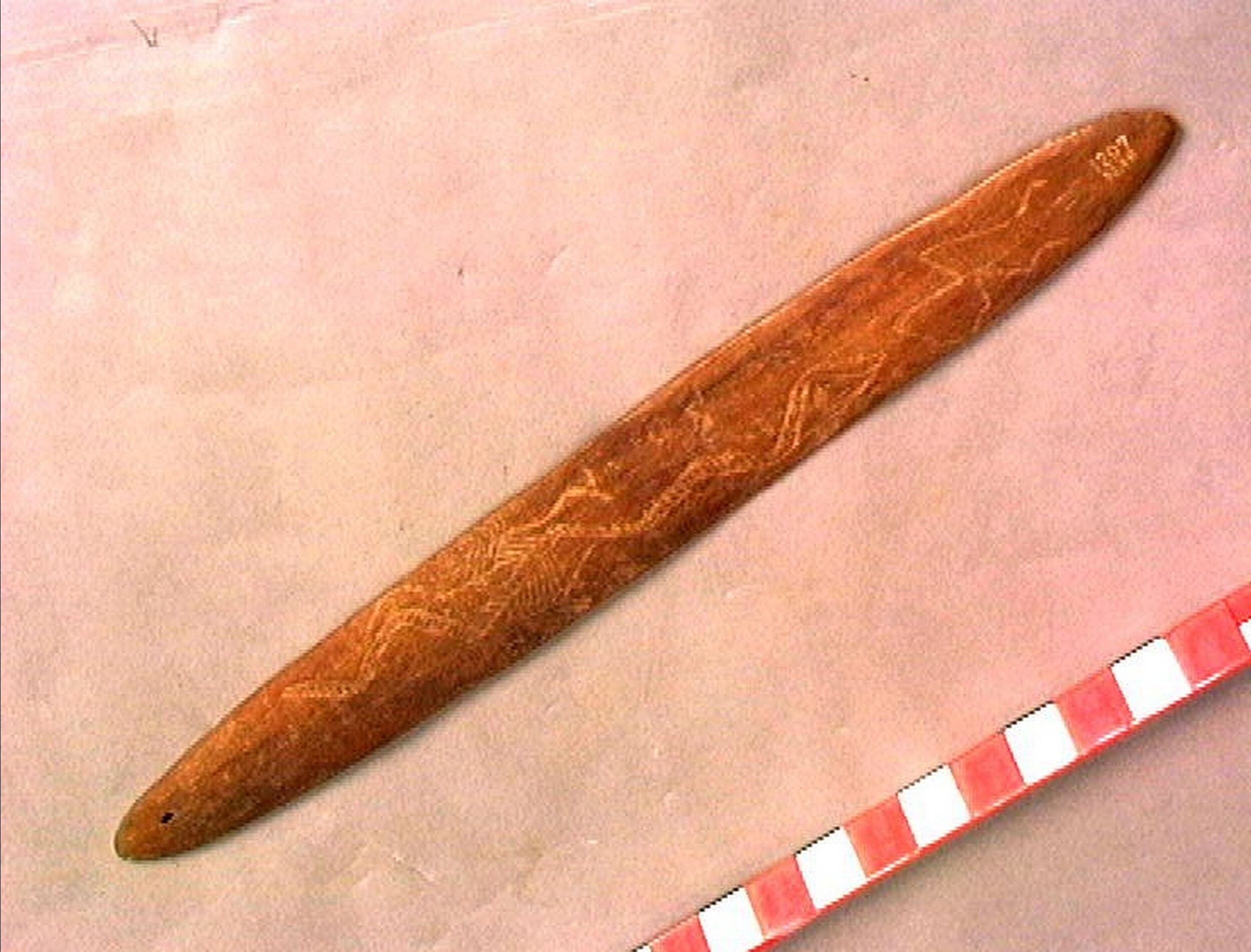
cora / bonangharry
Source term: devil scarer or bullroarer
cora / bonangharry (Clement's own spelling boonangharry; banangari in Radcliffe-Brown 1913): the Pilbara bullroarer, glossed 'devil-scarer' because it is swung to drive off the djuno, the evil spirit blamed for every illness and every death. A shared Ngayarta term; cora is recorded only in the Leiden catalogue headings and is never glossed.
Of the eleven bullroarers Emile Clement shipped out of the Pilbara, this is the one with pictures on it. Down the convex face of a forty-one-centimetre blade, under a meander stripe filled with alternating rectangles, four figures are cut: one snake-like, one a dancing person without a head, and two more that look like feathers. It is the same short list the Pilbara cut into its hilltops and cave walls — emus, kangaroos, snakes, turtles, and human beings in all sorts of positions — carried here on a thing made to be swung until it roared. The cora was the devil-scarer, sounded over the sick, over the dead, and through the circumcision camp to keep the djuno away. Where it came from nobody wrote down: the label says only Desert-tribe, which was what the coast called whoever lived further in.
The convex side with a number of incised figures: one snake-like, another resembles to a dancing person without head, whilst the remaining two are similar to feathers.
J. D. E. Schmeltz, "Ethnographica II: Sammlung Clement aus Nordwest-Australien," Internationales Archiv fuer Ethnographie 16 (1904), p. 26, item 149
Particulars
- Object
- Item 149 (inv. 1207/18), 41 x 4.5 cm, pierced at one end. The ornament is a meander stripe with rectangles alternating in the undulations, the whole surface covered with feeble diagonal grooves. The convex side carries incised figures: 'one snake-like, another resembles to a dancing person without head, whilst the remaining two are similar to feathers.' Item 151, the Gnamo (Nyamal) blade now at the Pitt Rivers, is catalogued as 'like 149'. Two more Desert-labelled cora are in the Pitt Rivers Museum, Oxford: 1898.75.49, a carved and pierced giant of 674 by 74 mm, and 1898.75.50, only 312 by 37 mm — the longest and shortest of the same set.
- Function
- Swung over the sick while the taketa circled the patient; swung at a death to drive off the djuno, held to be the cause of every death; and swung violently in the camp through the buckli circumcision gathering, roaring incessantly beside the nightly una and hibageh dances.
Source
J. D. E. Schmeltz, Ethnographica II: Sammlung Clement aus Nordwest-Australien, Internationales Archiv fuer Ethnographie 16 (1904), Group XI, item 149; Wereldmuseum (Rijksmuseum voor Volkenkunde) Leiden, inv. 1207/18. Function from Emile Clement, Ethnographical Notes on the Western-Australian Aborigines, same volume, pp. 8-11