No. AUSMAIN-009
Ngarigo
Australia · Monaro · Snowy Mountains (Cooma, Bombala) · Southeast
Restricted
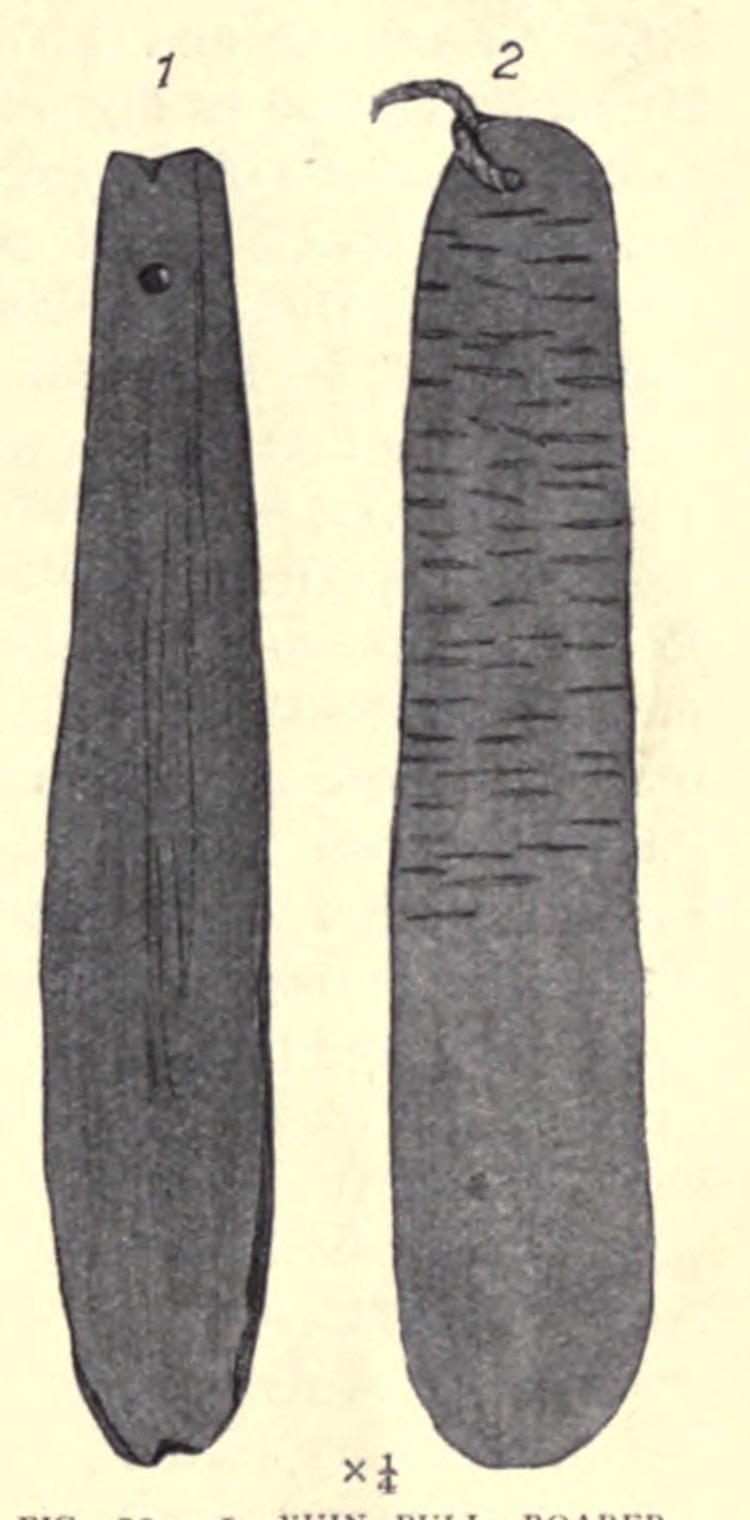
Mudji
Mudji: the Ngarigo name for the bull-roarer, whose roaring was the voice of the sky-being Daramulun, heard in thunder.
Among the Ngarigo of the Monaro tableland and Snowy Mountains, a messenger sent to summon people to the Kuringal initiation carried a bull-roarer, the mudji, together with a spear, boomerang, and shield; these were his token, the proof that the call was genuine. The mudji's roaring was the voice of Daramulun, the sky-being who had instituted the rites: the sound represents the muttering of thunder, and the thunder is the voice of Daramulun. In Ngarigo a message was Mabun and a messenger Gunumilli. A. W. Howitt — magistrate and mines warden on the Maneroo through the 1880s — collected a related coastal Yuin bull-roarer labelled the voice of Daramulun, and it passed through E. B. Tylor to the Pitt Rivers Museum in Oxford.
The consensus of opinion was that if a woman found a Mudthi and showed it to a man, he would kill her. If a man showed a Mudthi to a woman or a child, he would be killed, and not unlikely those belonging to him also.
Howitt, The Native Tribes of South-East Australia (1904), p. 563
Particulars
- Object
- Whirled slat carried by Kuringal messengers with spear, boomerang, shield.
- Function
- Initiation voice; credentials for the messenger summoning the Bunan/Kuringal.
Source
Howitt, Native Tribes of South-East Australia (1904)