No. HAD1898-029
Mabuiag turtle-fishery bullroarer
Australia · Oceania · Torres Strait
Sacred / spirit
bigur / uainis
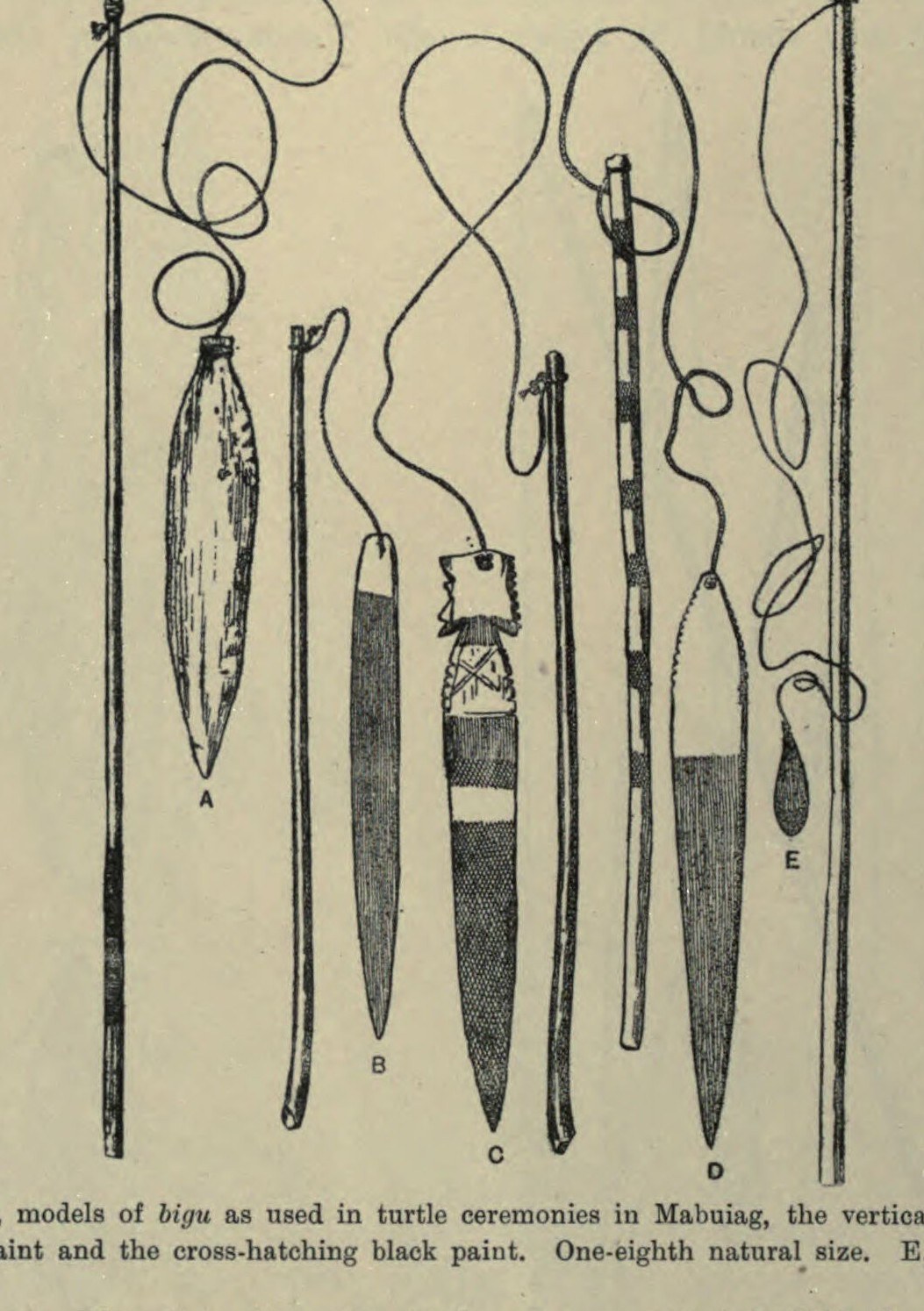
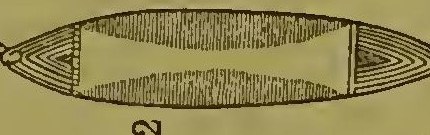
bigu and wanes — the large and small western Torres Strait bull-roarers of the Mabuiag turtle fishery. Ray's Mabuiag vocabulary defines the pair by voice — bigu, 'a bull roarer with a low and deep note'; wainis, 'a small bull-roarer with a shrill sound' — and the Eastern Islander form bigo is the same word. In the origin tale kept by the coastal Kiwai across the strait, the first bullroarer cried 'bigu, bigu' and so named itself.
Etymology. Current sources define role and contrast with bigur, but not literal etymology.
On Mabuiag, bullroarers worked the turtle fishery. Before canoes set out, men swung the large painted bigu over the vessels and whirled it with smaller wanes around the agu platform of turtle skulls and shells. A lookout later sounded one from a hill to tell women the catch had succeeded; on return, the men roared them again so the turtle would not swim away. Women could see these instruments, and islanders called the practice “half-play” — ritual power without initiation secrecy.
A performer whirled a bigu many times round his head and a wanes was at first swung in the same manner, but after a few revolutions it was lashed backwards and forwards and was thus made to produce more than one kind of noise.... When the canoes were expected to return a man would station himself on a hill to look out... then he whirled a small bull-roarer and the women knew the fishers had been lucky.
Haddon (ed.), Reports of the Cambridge Anthropological Expedition to Torres Straits, Vol. V (1904), pp. 331-332.
Particulars
- Object
- A large bull-roarer (bigu) and a small one (wanes).
- Function
- Turtle-fishery ritual: whirled over canoes, around the agu platform, and as a successful-catch signal; women were allowed to see it.
Source
A. C. Haddon (ed.), Reports of the Cambridge Anthropological Expedition to Torres Straits, vol. V: Sociology, Magic and Religion of the Western Islanders (Cambridge, 1904), pp. 330-333 and 352, fig. 52