No. FAMSF2013-001
Aimei Kiwai Kaiaimuru bullroarer
Papua New Guinea · Gulf Province · lower Era River · Oceania
Restricted
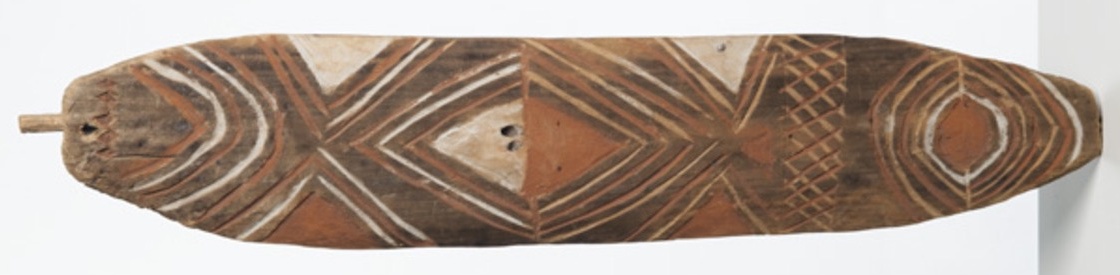
Kaiaimuru
Source term: Bull-roarer, Kaiaimuru
Kaiaimuru: the name recorded for this bullroarer at Aimei; its meaning is unrecorded.
A wood-and-lime bullroarer nearly sixty centimetres long, recorded as Kaiaimuru, from Aimei village on the lower Era River — a Kiwai-speaking, Gibaio-dialect outpost at the eastern edge of the Kiwai world. Further west, among the Kiwai whose language its makers spoke, the roarer was called madubu, and at Iasa Haddon was told that one was shown to each novice in a tabooed and fenced-in portion of the bush, where he was taught how to use it; the whirling of the madubu ensured a good crop of yams, sweet potatoes and bananas.
Bull-roarer, Kaiaimuru
Fine Arts Museums of San Francisco, Acquisitions Committee report, May 15, 2013, p. 4-1, L05.1.175.
Particulars
- Object
- Wood-and-lime slat, 58.4 x 8.9 x 0.6 cm (23 x 3 1/2 x 1/4 in.), 19th-early 20th century; cord and exact outline are not recorded.
- Function
- Among the Kiwai the madubu, or bullroarer, was shown to each novice inside a tabooed and fenced patch of bush and he was taught to use it; its whirling was held to secure the crops of yams, sweet potatoes and bananas.
Source
Fine Arts Museums of San Francisco, First Step Deaccessioning (Africa Oceania Americas), Acquisitions Committee report, May 15, 2013, item L05.1.175: 'Bull-roarer, Kaiaimuru', wood and lime, 58.4 x 8.9 x 0.6 cm, 'Aimei village; northeastern Kiwai language speakers (Gibaio dialect)', lower Era River; A. C. Haddon (ed.), Reports of the Cambridge Anthropological Expedition to Torres Straits, vol. V (1904), p. 218