No. ZFE1888-001
Gadfly at rest and in flight
Papua New Guinea · Kaiser-Wilhelmsland (German New Guinea), locality unrecorded · Oceania · Sahul
Function not recorded
Source term: Brumm- oder Schwirrholz
Brumm- oder Schwirrholz = German, humming-wood or whirring-wood, the standard nineteenth-century German terms for the bull-roarer.
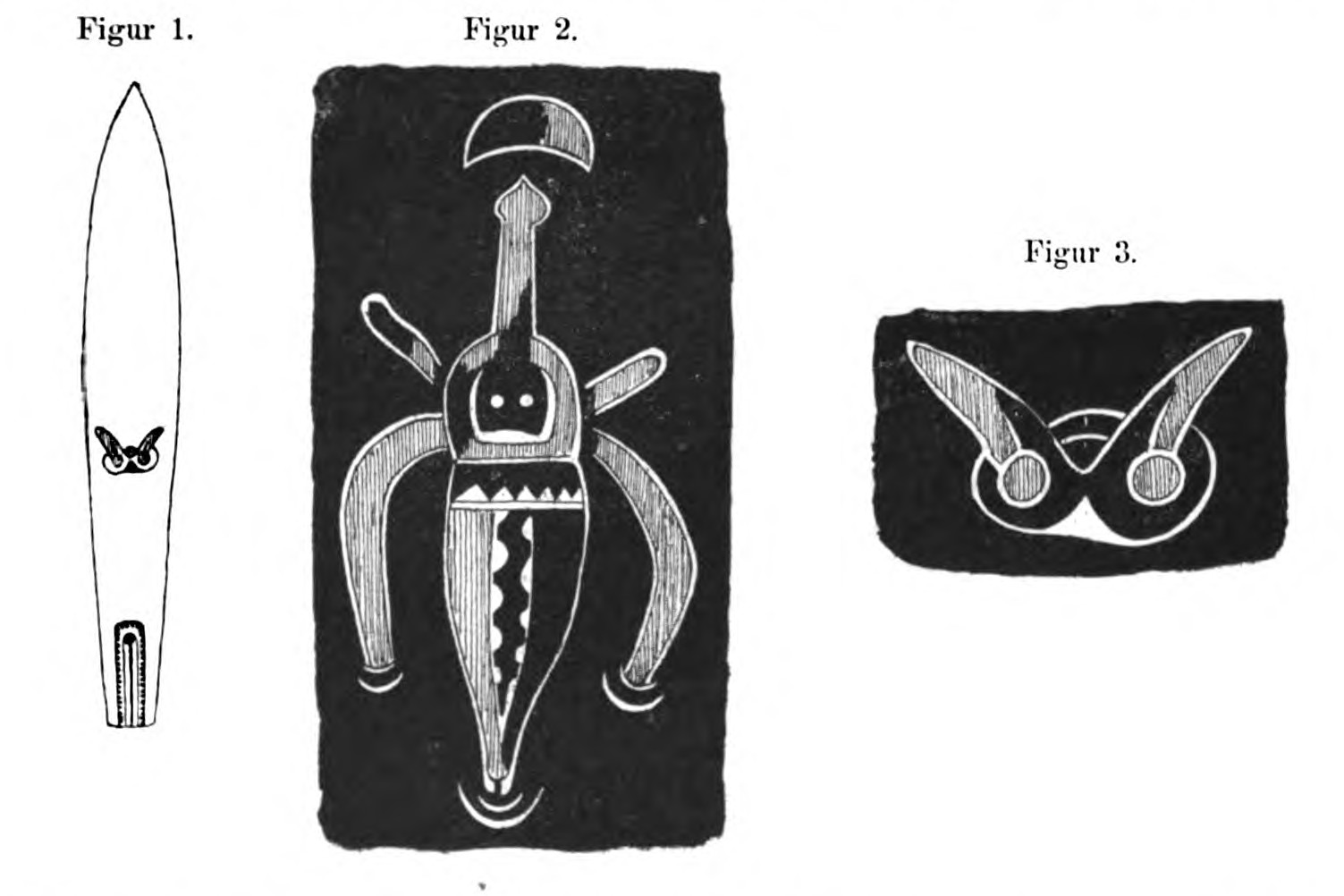
In 1888 Berlin published an extraordinary New Guinea bullroarer of dark palm wood: a 47-centimetre blade whose deep carving was filled white and hatched red. One face shows a gadfly at rest; the other confronts it head-on, wings spread. Swung from a metre of cord, the blade gave a humming, dully howling tone—the insect passing from stillness into sound. Krause’s three zincographs preserve its portrait.
Hr. E. Krause reicht Zeichnungen dieses interessanten Gegenstandes, des ersten derartigen von Neu-Guinea, herum.
Mr. E. Krause passes around drawings of this interesting object — the first of its kind from New Guinea.
Verhandlungen der Berliner Gesellschaft für Anthropologie, Ethnologie und Urgeschichte, Sitzung vom 26. Mai 1888, in Zeitschrift für Ethnologie 20 (1888), p. (267)
Particulars
- Object
- Blade of dark palm wood, 47 cm long, 6.8 cm wide, 1 cm thick, running out flat and pointed at the upper end; pierced 6.3 cm from the lower end for a cord of about 1 m, swung around the head to give a humming or dully howling tone. One face carries a deeply incised gadfly (Bremse or Dase) at rest, the other the same insect head-on in flight; contours white-infilled, hatched areas painted red. Königliches Museum für Völkerkunde Berlin, Cat. Nr. VI 10 342, acquired from the collections of the Neu-Guinea-Compagnie; presented by A. Bastian and figured in three zincographs by conservator E. Krause, session of 26 May 1888.
- Function
- Whirled around the head to produce a humming or dully howling tone; the carved gadfly appears at rest on one face and in flight on the other.
Source
E. Krause (presented by A. Bastian), Verhandlungen der Berliner Gesellschaft für Anthropologie, Ethnologie und Urgeschichte, session of 26 May 1888, pp. (266)-(267), figs. 1-3, in Zeitschrift für Ethnologie 20 (1888)