No. AUSMAIN-032
Mularatara (Matuntara)
Southern Western Desert: Palmer River country south of the Levi Range, east to Erldunda and west to Curtin Springs, extending across the Northern Territory border into northern South Australia · Central Australia
Restricted
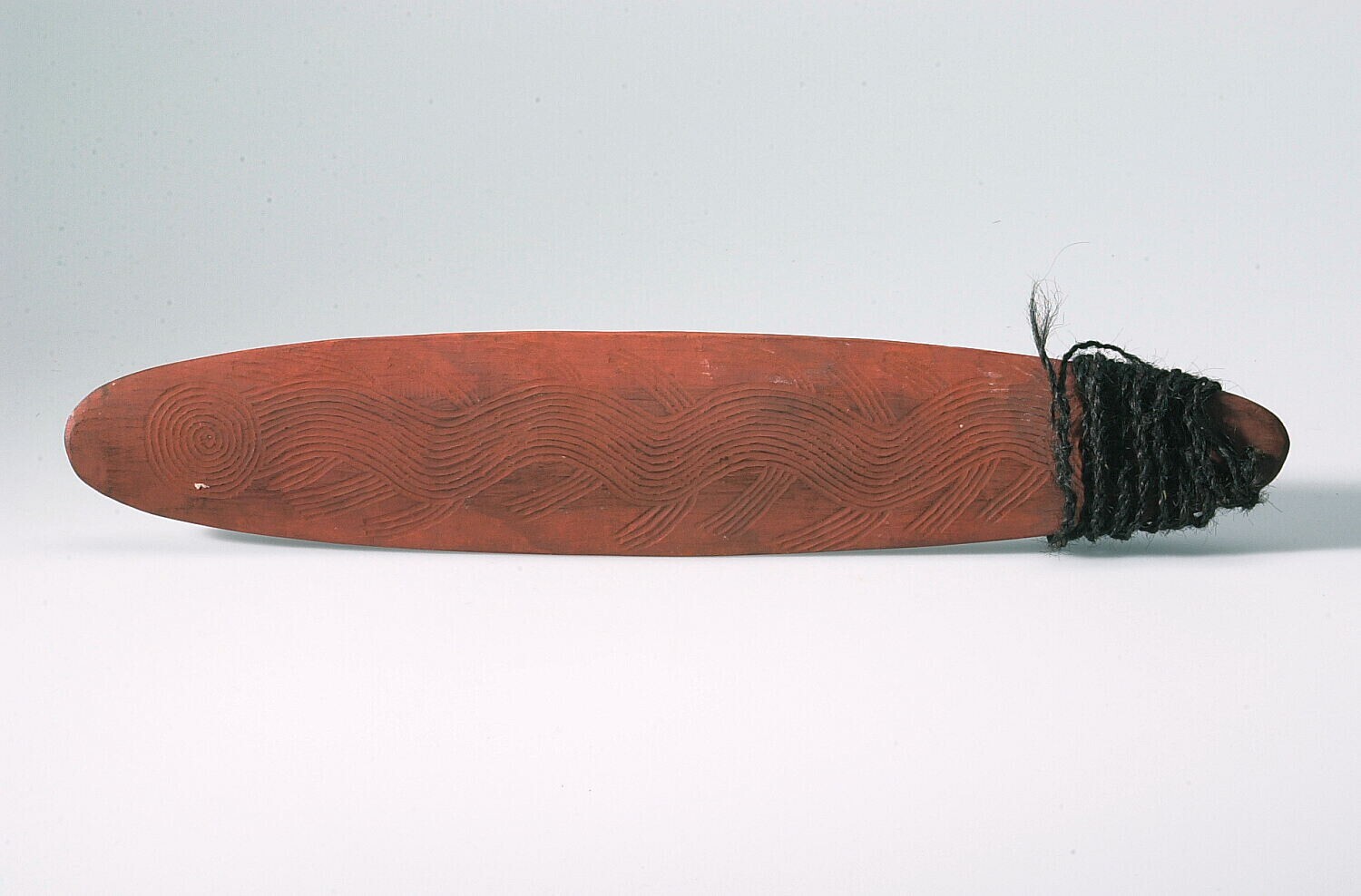
namatuna
namatuna: the Western Desert term for the bull-roarer in Roheim's southern Central Australian tribes - a flat slat whirled on a cord, sounded at initiation and forbidden to women.
Etymology. namatuna, the small whirled bull-roarer of Roheim's southern Central Australian tribes, carries no recorded literal meaning, but its roar is explained to Mularatara women and children as the one-legged demon Apuju, and Roheim classes Apuju and Maiutu among the lame 'bull-roarer beings' who are at once person and object. The instrument's name and the demons' names remain distinct words.
Among the Mularatara — a southern Western Desert people of the Palmer River country, also recorded as the Matuntara — the bull-roarer (namatuna) was sounded at boys' circumcision and kept hidden from women and children. Its roar was the voice of a being: children at the circumcision ground were told that the one-legged demon Apuju had chased them, and Apuju and Maiutu, the "bull-roarer beings," were imagined as lame or one-footed. Men showed their Adam's apples as the mark where Apuju had cut off their heads and put them back again, though the initiated knew that by "head" they meant the penis; the novice himself was said to lie with Apuju's woman, Milpati. Across the neighbouring southern tribes the instrument's hum announced the spirit to whom a boy was being given.
Thus when the boy is being circumcised the Pitjentara and the Mularatara tell the children that the one-legged Apuju has chased them. ... Maiutu, Apuju, and other bull-roarer beings are lame or they have only one foot.
Geza Roheim, The Eternal Ones of the Dream (New York: International Universities Press, 1945), pp. 83, 89.
Particulars
- Object
- A flat wooden slat (namatuna) swung on a cord to produce a roaring hum, sounded at male initiation; in Roheim's southern Western Desert tribes the namatuna's roar is held to be the voice of a being, and at circumcision children are told the one-legged Apuju has chased them.
Source
Geza Roheim, The Eternal Ones of the Dream: A Psychoanalytic Interpretation of Australian Myth and Ritual (New York: International Universities Press, 1945), pp. 83, 89