No. PNG57
Huon Gulf (General)
Papua New Guinea · Morobe · Oceania · Sahul
Restricted
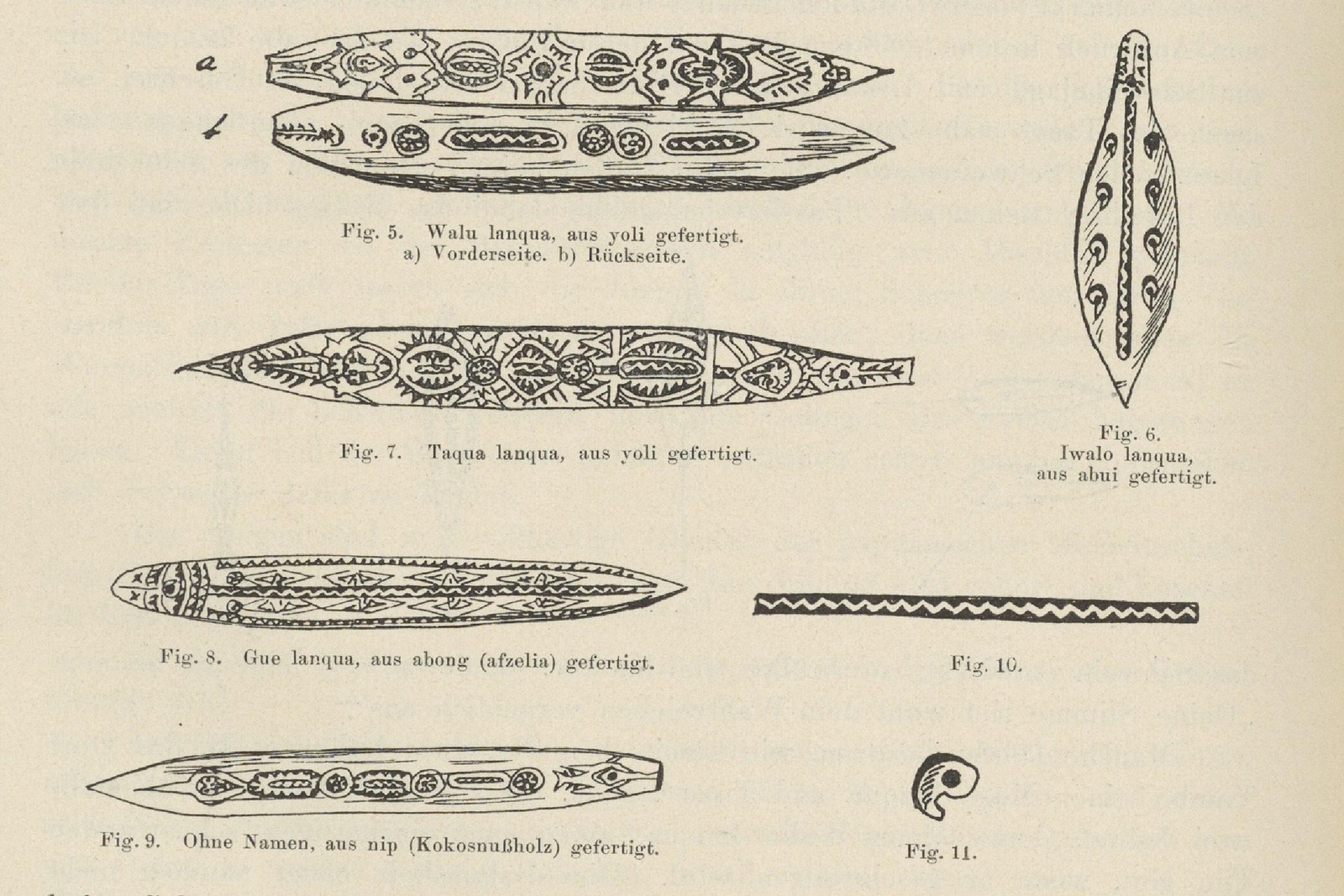
balum
ghost / spirit of the dead; the same word names the bullroarer and the swallowing initiation-monster
Etymology. In Yabim and Bukaua a single word, balum, means at once the whirled bullroarer, the monster that swallows the novices at circumcision, and the ghost or spirit of the dead. The Kai cognate ngosa means 'grandfather.'
Around the Huon Gulf the bullroarer was the voice of a monster that ate boys. Among the Yabim and Bukaua a single word, balum, named three things at once: the swinging wooden slat, the spirit of the dead, and the mythical being said to swallow the novices at circumcision and then disgorge them as grown men. For the rites a hut about a hundred feet long was built in the shape of that monster, high at the end that stood for its head and tapering away at the other. Women and the uninitiated were told the creature had eaten the boys, and it could be made to give them up only by a tribute of pigs. The droning hum that carried out of the men's enclosure was the monster's roar. The Kai of the same coast called the being ngosa, the Tami kani; in three of the four languages the word for the bullroarer also meant a ghost. Gourlay's 1975 study of esoteric instruments and their role in keeping men and women apart records the same Huon Gulf instruments kept hidden from female eyes. The balum spirit often took the form of a sea-snake, and the Bukaua’s small, high-voiced wives’ instruments formed a class distinct from the serving roarers. Around the gulf, origin stories give the first instrument to a woman. In the Kai and Bukaua tellings she discovers a whirring chip while chopping wood; Bamler’s Tami account begins with a ready-corded blade washed ashore. The men obtain the instrument and the woman dies so that its secret can be kept.
It is highly significant that all these tribes of New Guinea apply the same word to the bull-roarer and to the monster, who is supposed to swallow the novices at circumcision, and whose fearful roar is represented by the hum of the harmless wooden instruments. … The word in the speech of the Yabim and Bukaua is balum; in that of the Kai it is ngosa; and in that of the Tami it is kani.
Frazer, Balder the Beautiful (The Golden Bough, Part VII), Vol. II (1913), on the Yabim, Bukaua, Kai and Tami of New Guinea
Particulars
- Object
- Bullroarer, sacred flute and slit-gong are all in use here.
- Function
- Whirled in the circumcision rites as the roar of the swallowing monster, its secret guarded from women on pain of death.
Sources
- K. A. Gourlay, Sound-Producing Instruments in Traditional Society: A Study of Esoteric Instruments and Their Role in Male-Female Relations, New Guinea Research Bulletin 60 (1975), table 1, entry 57 View
- S. Lehner, 'Bukaua,' in R. Neuhauss (ed.), Deutsch Neu-Guinea, vol. III (Berlin: Reimer, 1911), pp. 411-412, 414
- Ch. Keysser, 'Aus dem Leben der Kaileute,' in R. Neuhauss (ed.), Deutsch Neu-Guinea, vol. III (1911), pp. 34-36
- G. Bamler, 'Tami,' in R. Neuhauss (ed.), Deutsch Neu-Guinea, vol. III (1911), p. 495
- J. G. Frazer, Balder the Beautiful, The Golden Bough, Part VII, vol. II (1913), Yabim, Bukaua, Kai and Tami discussion