No. SAMA2026-004
Sacred motif on a pale cloth
Central Australia · Oceania · Sahul
Sacred / spirit
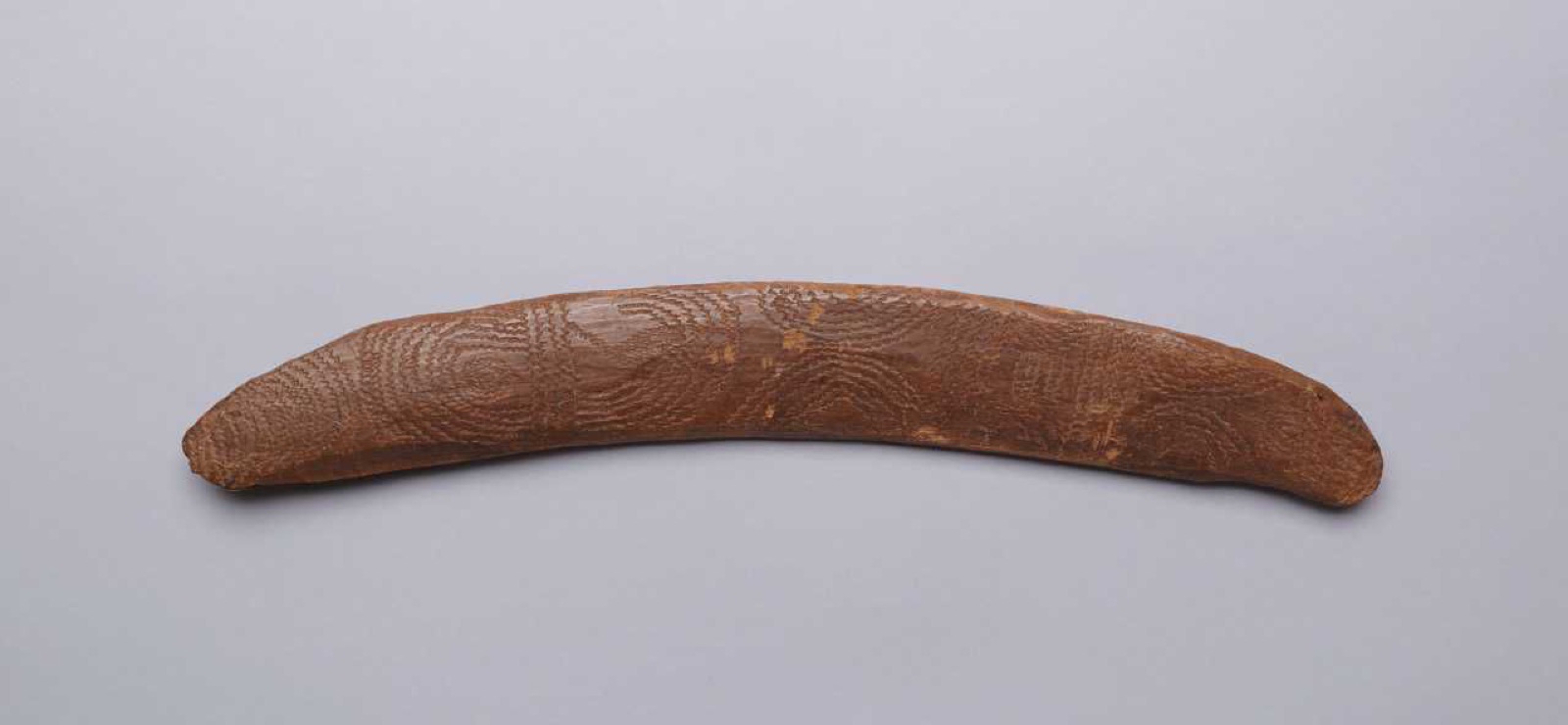
Source term: bull roarer
No local term recorded.
Sometime between 1890 and 1912, Francis Gillen — the Alice Springs telegraph-station manager who became Baldwin Spencer's partner in recording Central Australian ceremony, and who as special magistrate and sub-protector was effectively the administrator of the region — laid a bullroarer on a light-coloured cloth and photographed it by itself. The archive can still read the carving off the print: two semicircles, a circle, and lines at either end, described as a sacred motif. The label on the back gives one piece of geography, and only one: 'C.Aus.'
A bull roarer laid out on a light coloured cloth, it has a sacred motif craved [sic] into the wood (two semi-circles, a circle and lines on either end).
SA Museum, Gillen AA108/48/2/16, formerly AP6245
Particulars
- Object
- An early photograph of a bullroarer laid on pale cloth, carved with two semicircles, a circle and lines at both ends, described in the archive as a sacred motif.
- Function
- Not recorded; only the archive's description of the carving as a sacred motif.
Source
South Australian Museum, Francis James Gillen AA108/48/2/16, formerly AP6245