No. MUS2026-024
Kuraba snake blades cached in cave
Australia · Northern Territory · Top End
Function not recorded
Kuraba
Source term: bull-roarer
Kuraba: the Wardaman native name recorded by Davidson (1931) for these bull-roarers, labelled with a "Snake Totem" association.
Etymology. Kuraba is the Wardaman name recorded for these bull-roarers by Daniel Davidson on his 1931 Australian Expedition. The Penn Museum register marks each specimen as a 'Snake Totem' object, so the bull-roarer belongs to a Snake Dreaming, but the word itself is not glossed as 'snake,' and the association is totemic rather than a shared lexeme.
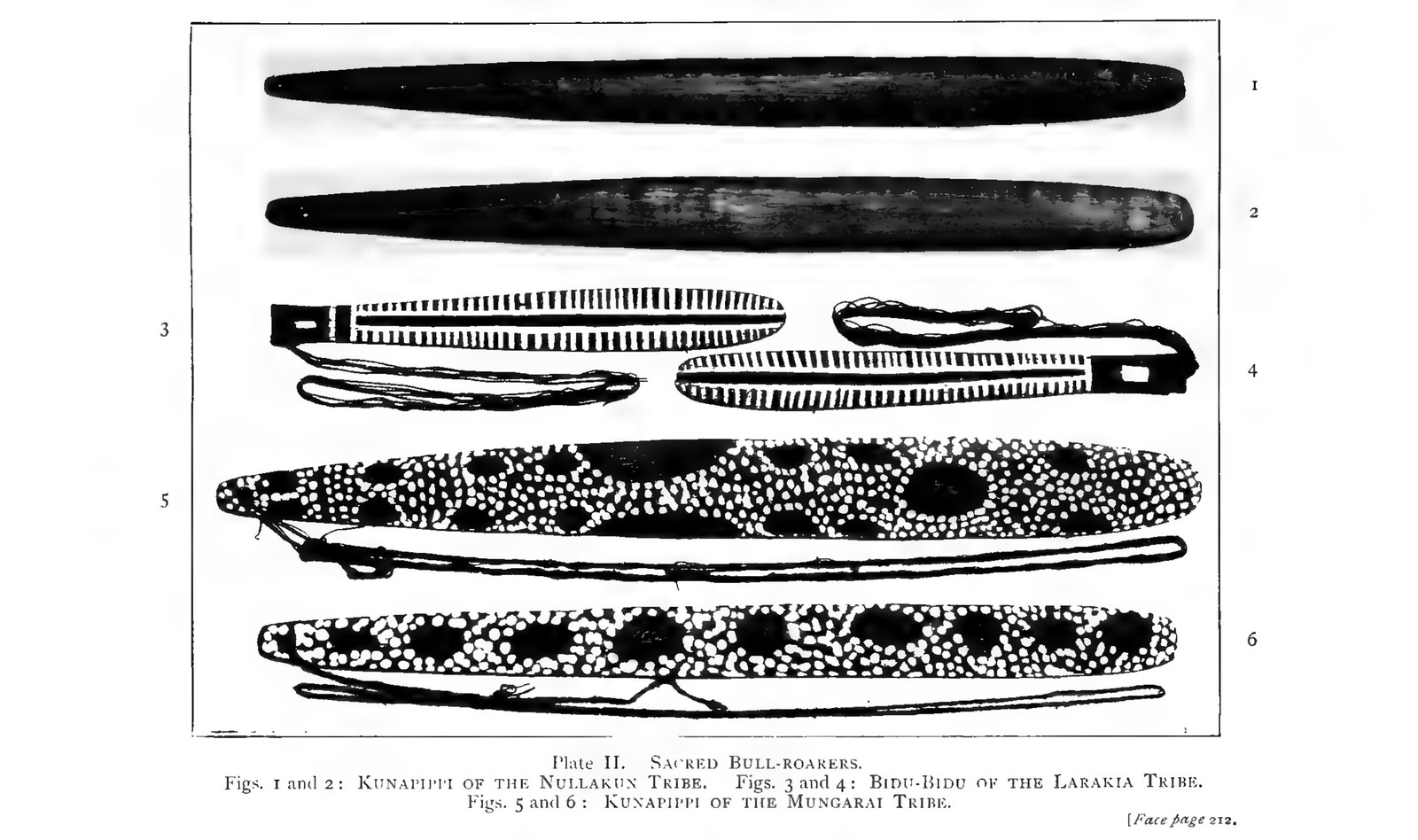
A cluster of large wooden bull-roarers from Wardaman country in the Northern Territory, collected by the American anthropologist Daniel Sutherland Davidson on his 1931 Australian expedition and now held by the Penn Museum. The objects are sizeable, roughly 77 to 80 centimetres long, and the field labels record a native name, Kuraba, and a snake-totem identity; one note reports that they were "Buried in cave No. 6," cached rather than carried.
Particulars
- Object
- Three large wooden bull-roarers of the Wardaman, 76.6 to 79.5 centimetres long, in the Penn Museum collection. The museum has a fourth blade from the same 1931 expedition, shorter at 45.8 by 7.5 centimetres and still carrying ochre, traces of white paint, and incised concentric circles and spirals — though its Wardaman attribution is marked uncertain.
- Function
- Not recorded.
Source
Penn Museum, 31-34-115, 31-34-116 and 31-34-117 (objects 318436, 223463, 261493; collected by D. S. Davidson, Australian Expedition, 1931)