No. PNG100
Moripi
Papua New Guinea · Gulf · Oceania · Sahul
Restricted
tiparu
Source term: tiparu (Tiparu)
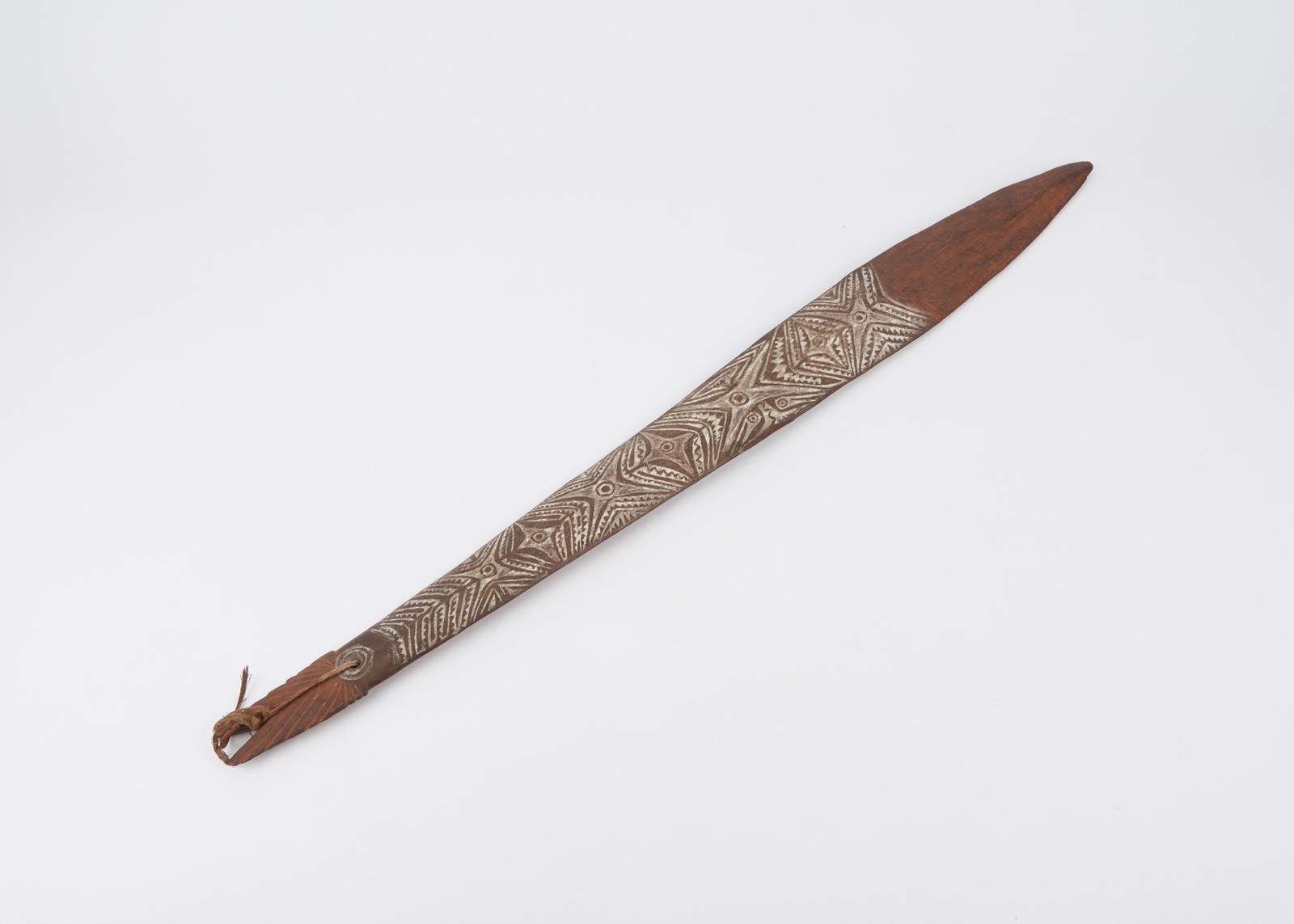
tiparu (Toaripi/Moripi): the bullroarer, Chalmers's 'Roaring Bull'.
Its voice was fatal to overhear. When the tiparu - the 'roaring bull,' as the missionary James Chalmers called it - was about to sound, the women and children of these eastern Papuan Gulf villages fled the settlement, for anyone who heard it was said to die. Only a youth who had come down from the Eramo, the men's long house - where he had stayed months with his head shaved until the hair grew long again, under a tabu on certain foods - was permitted to see the whirling blade, or to wear a mask, or to join the dances and the drum-beating. The boards themselves were carved on both sides with scrolls painted red, black and white, the larger of a pair Chalmers obtained some twenty inches long. He set the rule down plainly: no one sees the tiparu until after he has been made a man.
"Not until after they have left the Eramo is the Roaring Bull [bull-roarer, tiparu] seen" ... "Tiparu, only seen by a young man after initiation into manhood ... All women and young people leave the village lest they should hear it and die."
A. C. Haddon, The Study of Man, p. 240 in the 1898 first edition (= p. 303 in the 1908 Progressive Science Series reissue), chapter "The Bull-Roarer," quoting Rev. James Chalmers and an L.M.S. museum label (Toaripi / Motu-Motu).
Particulars
- Object
- Both the bullroarer and the sacred flute are in use here.
- Function
- Fatal to overhear: women and children fled the village when it sounded, and only youths who had come out of the Eramo after initiation might see it; associated with ancestors.
Sources
- James Chalmers and London Missionary Society museum label, via A. C. Haddon, The Study of Man (1898), p. 240 (p. 303 in the 1908 reissue)
- K. A. Gourlay, Sound-Producing Instruments in Traditional Society: A Study of Esoteric Instruments and Their Role in Male-Female Relations, New Guinea Research Bulletin 60 (1975), Table 1, entry 100; p. 71 View
- J. H. Holmes, In Primitive New Guinea (1924), p. 82, via Gourlay 1975, p. 71