MUS2026-211 - museum specimen
Gulf Province eleven-bullroarer series
Papua New Guinea - Gulf Province (no district or village recorded) - Oceania
Restricted
Source term: Bullroarer
Eleven bullroarers entered the Pitt Rivers Museum in May 1902 from somewhere on the Gulf coast of Papua, running the full range of Gulf forms: a plain notched blade, then shouldered and forked shapes, then blades serrated like teeth, and finally four carved boards — one stained black with a folded-line face in white clay, one carrying a head and zigzags, and the longest, seventy-five centimetres and fish-shaped, ridged its whole length, its fibre string still tied on. Henry Balfour is named as collector, though even that is marked uncertain, and no people is recorded for any of them.
Fish-shaped bull roarer with stylised pattern and face. Inlaid with white clay. Ridge running along the length. Fibre string.
Pitt Rivers Museum catalogue record 1902.16.24 (retrieved 2026-08-01)
- Object
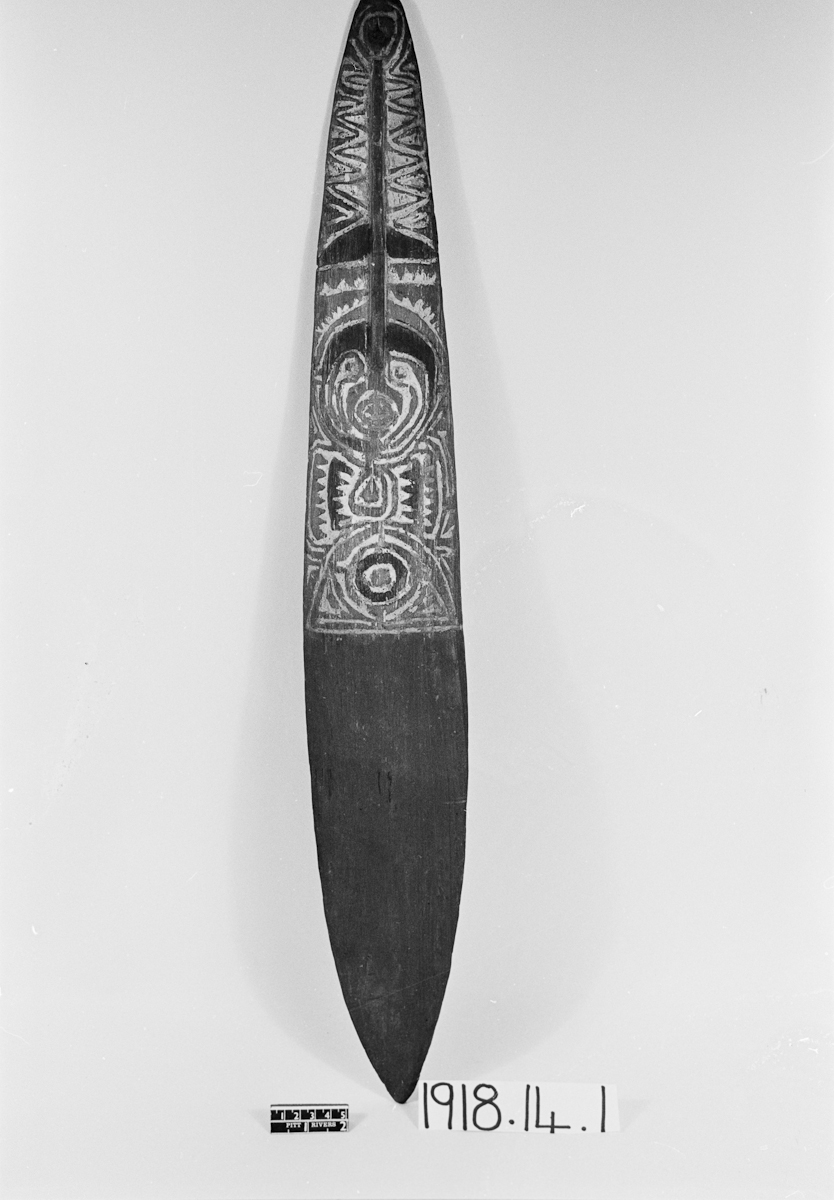
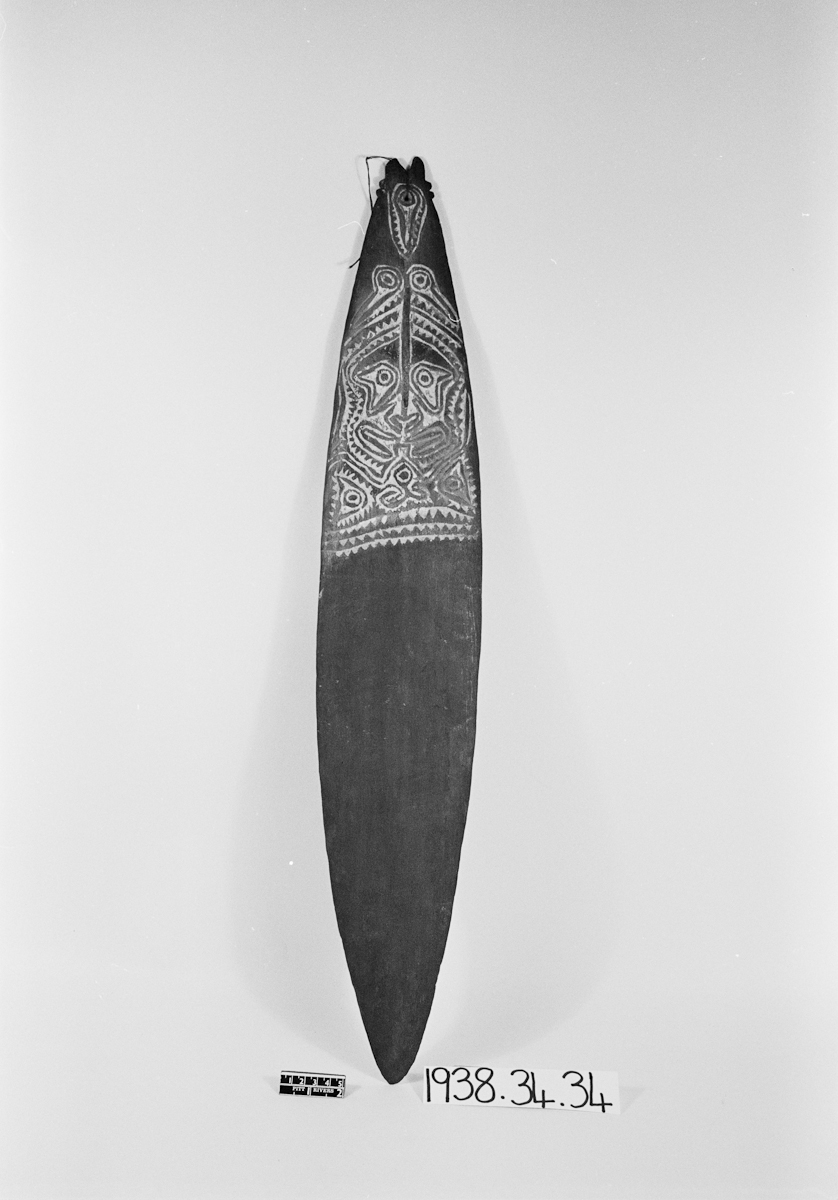
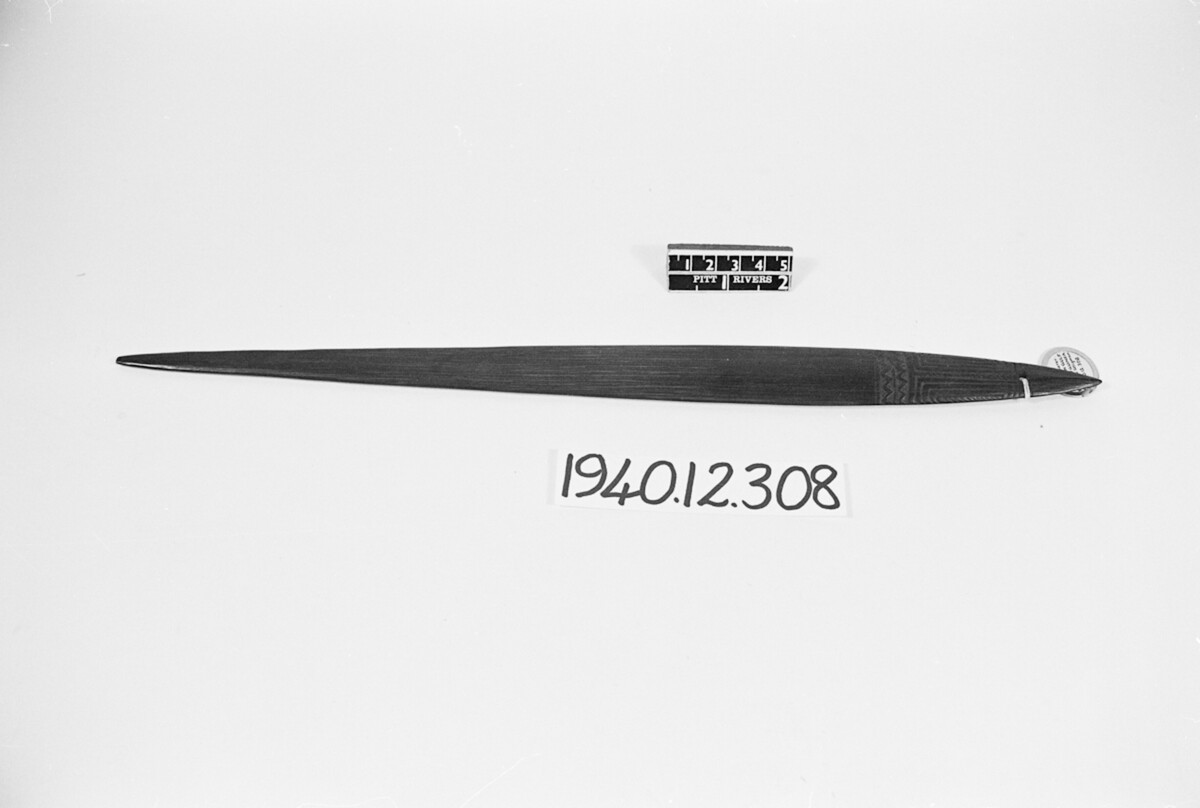
- Eleven wooden bullroarers accessioned as one series, from 310 to 750 mm long and 44 to 105 mm wide. The series runs the full range of Gulf forms: plain and lightly notched perforated blades at the small end (.16, 310 x 47 mm, notches by the perforation; .18, 418 x 58 mm, plain with a slight fork; .19, 447 x 51 mm, slim with shouldered end), then shouldered and forked blades (.17, 385 mm, pronounced shoulders and a slight ridge at the top; .20, 437 x 71 mm, forked end, shaped shoulders and a small raised oblong at the centre of one face), then serrated forms (.21, 410 x 47 mm, one forked end and one with carved serrated edges, with a length of fibre string; .22, 454 x 44 mm, serrated decoration over about two thirds of its length), and finally large carved and inlaid boards (.23, 742 x 105 mm, stained black, face and folded-line pattern inlaid with white clay, central ridge; .24, 750 x 71 mm, fish-shaped with a stylised pattern and face, white-clay inlay, a ridge running the full length and surviving fibre string; .25, 609 x 83 mm, carved head and zigzags in white-clay inlay with fibre string; .26, 535 x 70 mm, face, lines and dog-tooth shapes in white-clay inlay along a decorated ridge). Seven further Gulf blades sit nearby in the Pitt Rivers Museum, Oxford. Five, 1938.34.33–37, carry conventionalized mask faces at the head, running from a 760 by 135 mm giant stained red over whitened ground down to a 576 by 72 mm sliver; 1918.14.1 has a central ridge that ends on a carved figure's nose; 1940.12.308 is pointed palmwood, carved at one end only.
- Function
- Across the Gulf of Papua the bullroarer was sounded as the voice of a malignant deity, and the disclosure of what really made that voice was the kernel of the boys' initiation (Loeb 1929, p. 253); nothing finer is recorded for this series.
- Source
- Enumerated accessions with museum dimensions: 1902.16.16, 310 x 47 mm; .17, 385 mm long, width max 49 mm and 54 mm shoulder to end; .18, 418 x 58 mm; .19, 447 x 51 mm; .20, 437 x 71 mm; .21, 410 x 47 mm (with plant fibre); .22, 454 x 44 mm; .23, 742 x 105 mm (wood, clay, pigment); .24, 750 x 71 mm (wood, plant fibre, clay); .25, 609 x 83 mm (wood, plant…
- Source location
Page references
PRM catalogue records 1902.16.16-.26 (object irns 39746-39756) with eleven photographs (retrieved 2026-08-01)
- Source confidence
- low Gulf Province regional anchor on the Papuan Gulf coast between the Purari and Kikori deltas. The museum records the province and nothing finer - no district, river or village - so this is a province-level point and must not be read as a collecting locality.
- Spirit voice
- Initiation rite