No. CJFN15-001Australia
Bardi galaguru, flung into the Coalsack
Australia · Cape Leveque · Dampier Peninsula, Kimberley
Restricted
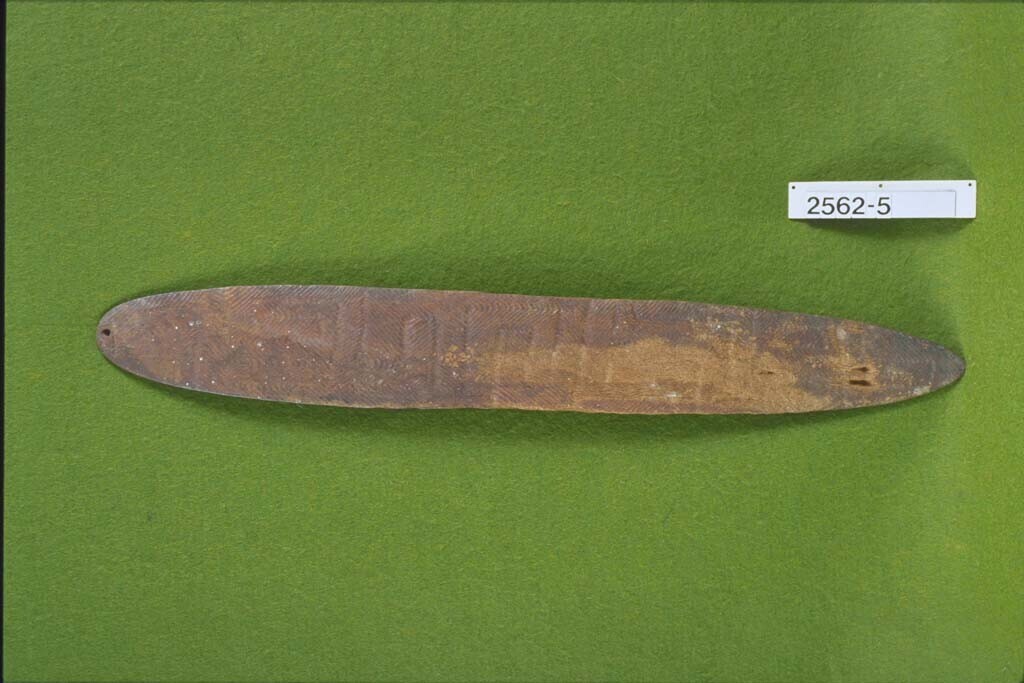
galaguru
Source term: Classification List of Bullroarers
galaguru: the Bardi sacred bullroarers, first made by the creator-hero Djamar.
Etymology. Among the Bardi (Bād) of Dampier Land the sacred bullroarers are called galaguru.
The creator-hero Djamar rose from the sea off the Dampier Peninsula and struck south whirling a bullroarer. In the bush he felled a "silver-blood" tree, split boards from it, and drove them into a creek's stone bed in a long line — the first galaguru. On the Burumar sandhill he swung one so hard the hair-string snapped and the roarer shot into the Coalsack Nebula, the black realm of the dead. Every later board brings him back. At initiation the old men search the forest for the tree under which Djamar rested and cut the new initiates' bullroarers from it; the marks incised on them show Djamar, his gear and lesser beings, and only an initiate can read them. 'We cannot carry that rock to this place,' one man said of Djamar's home at Ngamagun Creek. 'Therefore we make this djidi — and Djamar is here.' The roarer also worked out of sight: a Bardi doctor could make a man sick, though not kill him, by touching him in a dream with kalakor, an initiation bullroarer — and such a doctor carried within his own body a small snake and short sticks cut to the shape of bullroarers.
Particulars
- Object
- Sacred bullroarer boards, swung on hair-string.
- Function
- Sounded in men's initiation; in a medicine-man's hands it could also bring sickness through a dream.
Source
Laves Papers (MS2189) catalogue, Item 2.16 (D. Nash, comp.); E. A. Worms, 'Djamar, the Creator: A Myth of the Bād (West Kimberley, Australia),' Anthropos 45 (1950): 641-658, pp. 647-650; A. P. Elkin, Aboriginal Men of High Degree (1945), pp. 142-144; Mircea Eliade, Australian Religions: An Introduction (Ithaca: Cornell University Press, 1973), pp. 35-38, quoting Worms 1950, pp. 650, 657