No. MATHEWS1908-001
Birdhawal Turndun initiation bullroarer
Australia · Northeast Gippsland · Cann River · Victoria-New South Wales border
Restricted
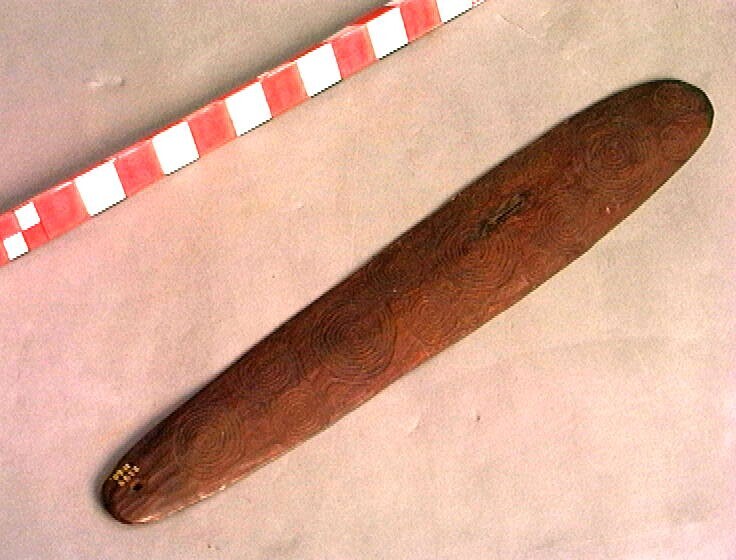
Turndun
Source term: bullroarer
Turndun: the Birdhawal name of the bullroarer heard humming at daybreak.
At daybreak in Birdhawal country, the hum of Turndun approached and every woman and child left for another camp. Later, painted men swung a larger and louder bullroarer before the novices. An elder rubbed it across each boy's chest and body as the instrument was revealed, while another man warned that betraying what he had learned meant death. Mathews distinguished three voices: the morning summoner, the larger instrument of revelation, and a much smaller roarer sounded with it at the gathering's close.
Soon after daylight next morning the humming sound of Turndun, the name of a bullroarer, was heard in the near distance.
Mathews 1908:212
Particulars
- Object
- Three sizes of bullroarer are distinguished: a morning summoner, a somewhat larger and louder instrument shown to novices, and a much smaller instrument sounded with the larger one at the close; material, dimensions, and cord construction are not recorded.
- Function
- Sounded to remove women and children from the initiation area; the larger instrument was swung before novices and rubbed across each boy's chest and body during its revelation.
Source
R. H. Mathews, 'Initiation Ceremony of the Birdhawal Tribe' (1908), pp. 212-214