No. WIRZ1925-002
Roarers that chase sickness to sea
Indonesia · Western Marind coast, Dutch South New Guinea (Merauke Regency, South Papua) · Oceania
Sacred / spirit
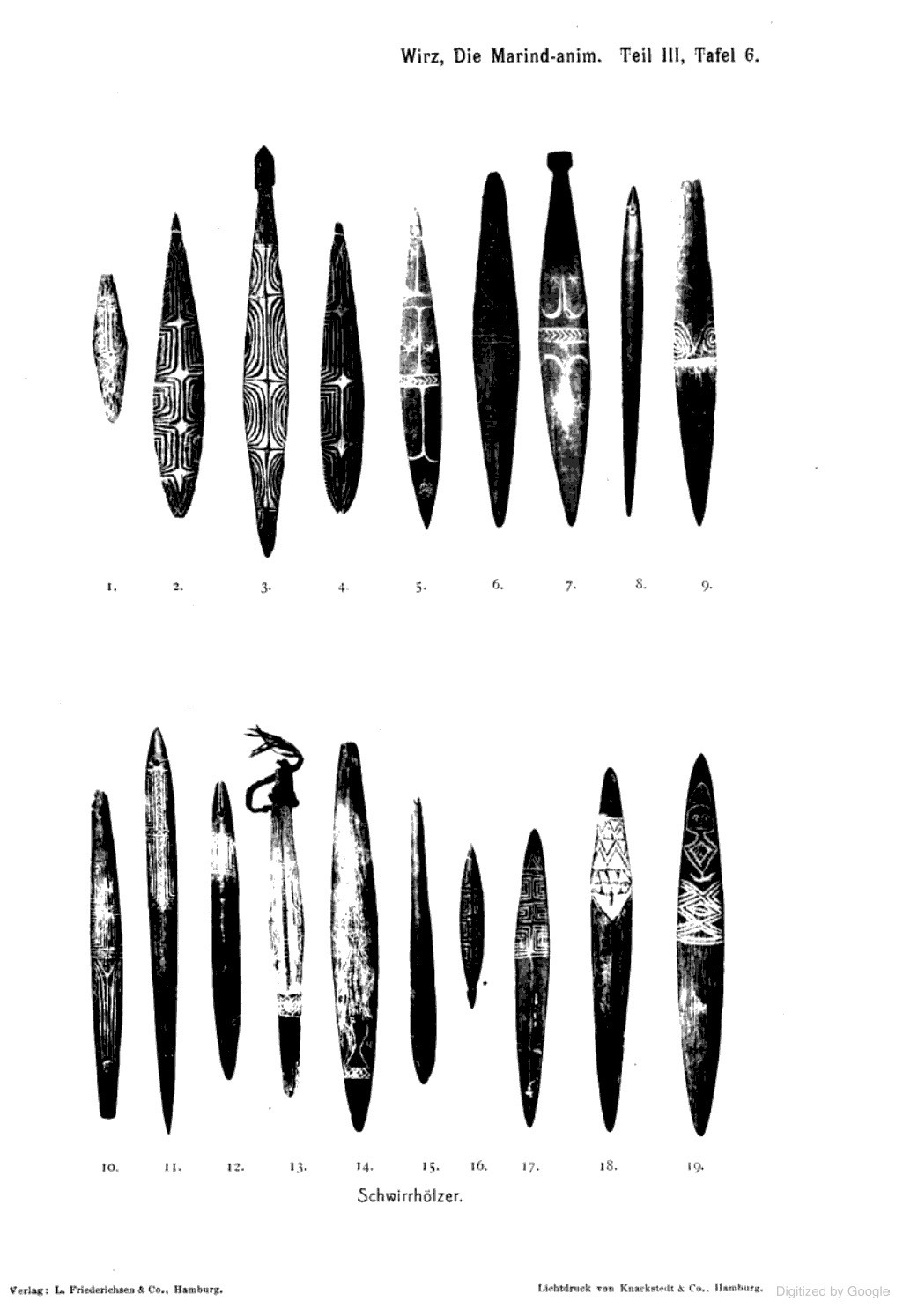
sosom (Wambi, Yamfinder)
Source term: bullroarer (Wirz via van Baal); tik (sickness); arih
tik: sickness. arih: a Marind ceremony; besides the fertility arih for crops, the western coastal people held one to drive out the tik. ébob: the ibis (Threskiornis moluccus) whose head topped the performers' arib rods. Bian: the river beyond which, to the east, the bullroarer stayed secret. sosom / soˈsom: bullroarer (western Coastal Marind, Wambi; Bruno Olsson field data, Yamfinder concept 52).
Before daybreak the roar came from far off, and soon the performers were on the beach, swinging their bullroarers in plain view: on this western stretch of the Marind coast the instrument was no longer a secret. The ceremony at Elebémë was an arih to drive out tik, sickness. The afternoon before, every villager had eaten from a great sago dish, secretly mixed with semen, a fact known only to a few old women. Six men painted black from head to foot had paced the village with long springing rods in their hair, each topped with the black head of an ibis, and the dancing went on all night. At dawn the whole crowd followed the roarers west, singing and yelling, to the Wamal river. There they threw off their decorations, dived in to wash away the sickness clinging to their bodies, and burned the ornaments to destroy its last traces. Days later the rite moved on to Wamal, Baléwil and Awehima, the last settlement on the coast, until the sickness had been chased into the sea. Along the same coast at Wambi, western Coastal Marind speakers still call the bullroarer sosom.
On this side of the Bian the bullroarer is no longer a secret implement.
Paul Wirz 1925, III, pp. 94–95, in J. van Baal, Dema (1966), p. 637
Particulars
- Object
- Bullroarers swung openly by ibis-crowned performers in a coastal sickness-expulsion procession; their form is not described.
- Function
- Sounded before dawn and swung on the beach in the arih to drive out tik, sickness: the whole village followed the performers west to the Wamal river, bathed, burned their ornaments, and the ceremony passed on to Wamal, Baléwil and Awehima to chase the sickness into the sea. On this side of the Bian the bullroarer was no longer secret.
Sources
- J. van Baal, Dema: Description and Analysis of Marind-anim Culture (1966), pp. 636–637 View · archived
- Paul Wirz, Die Marind-anim von Holländisch-Süd-Neu-Guinea, Teil III (Hamburg, 1925), pp. 94–95
- Yamfinder: The Southern New Guinea Lexical Database, concept 'bullroarer', western Coastal Marind (Wambi), field data of Bruno Olsson View