No. MUS2026-037
Boonangharry against the djuno
Pilbara coast · Western Australia
Sacred / spirit
Boonangharry
Source term: bull-roarer
Boonangharry: the collector Émile Clement's phonetic rendering of the Pilbara name for this bull-roarer, which he translated 'devil-scarer'.
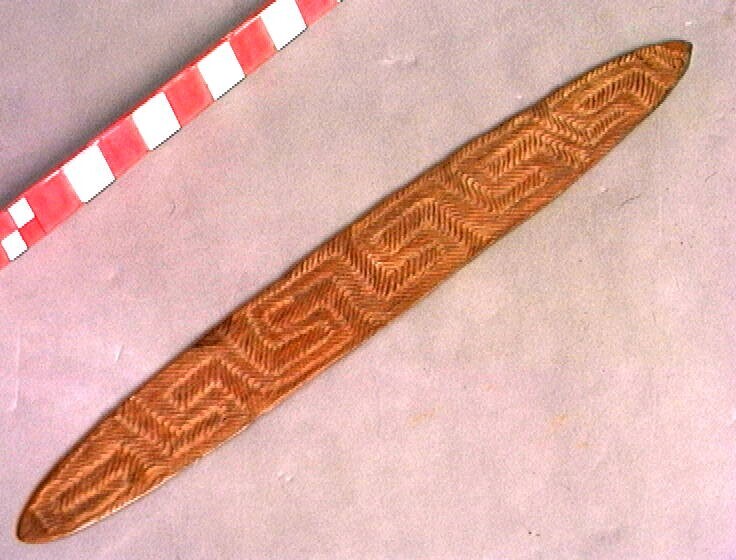
Boonangharry — the name the dealer-naturalist Émile Clement wrote down for this bull-roarer of the Martuthunira, the people of the lower Fortescue River and the Pilbara coast of Western Australia, which he sold to the Pitt Rivers Museum in Oxford, where it was accessioned in 1901 and classed as a religious and ceremonial object. Across the Pilbara Clement heard the boonangharries roaring over the sick, over the newly dead to drive off the djuno, and through the nights of dancing that lead up to circumcision. What rite this one served is no longer recoverable from the Martuthunira themselves. The linguist Alan Dench, who began work on the language in 1981, found that the Martuthunira did not practise circumcision initiation but had sent their young men east, to the Yinyjiparnti and Kurrama, to be initiated; the memory of male initiation, and of the songs and dances that went with it, was gone, and from his principal informant Algy Paterson, one of three remaining speakers and soon the last, he could record only a few secular songs of two types, jalurra and thawi.
Together with any memory of male initiation, any knowledge of the songs and dances accompanying that ritual has been lost.
Dench 1995, Martuthunira: A Language of the Pilbara Region of Western Australia (Pacific Linguistics C-125):16
Particulars
- Object
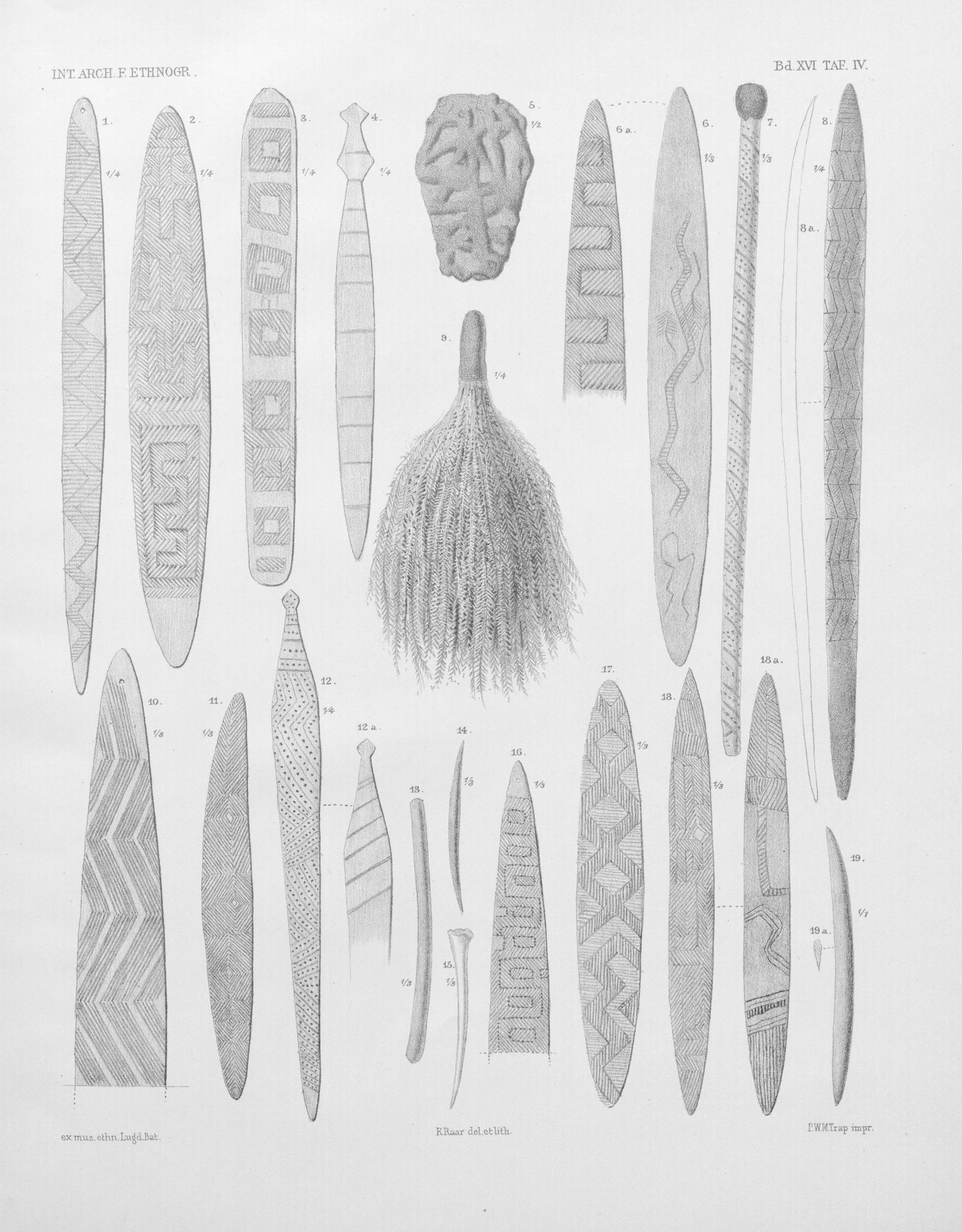
- Bull-roarer of the Martuthunira, Pitt Rivers Museum, Oxford (acc. 1901.58.22). Clement nos. 152-153, 41 x 4 cm and 44 x 3.5 cm, are shown on Plate IV as figs. 12/12a and 4.
- Function
- Set roaring over the sick and swung over the dead to drive off the djuno, the evil spirit held to cause every death.
Sources
- Pitt Rivers Museum, Oxford, accession 1901.58.22 View · archived
- E. Clement and J. D. E. Schmeltz, Ethnographical Notes on the Western-Australian Aborigines (1903), pp. 26-27, Plate IV, catalogue nos. 152-153, figs. 12/12a and 4 View · archived
- Dench, Martuthunira: A Language of the Pilbara Region of Western Australia, Pacific Linguistics C-125 (1995), p. 16