No. AUSMAIN-017
Itchumundi
Australia · Lower Darling River (Wilcannia-Menindee-Bourke arc) · New South Wales
Restricted
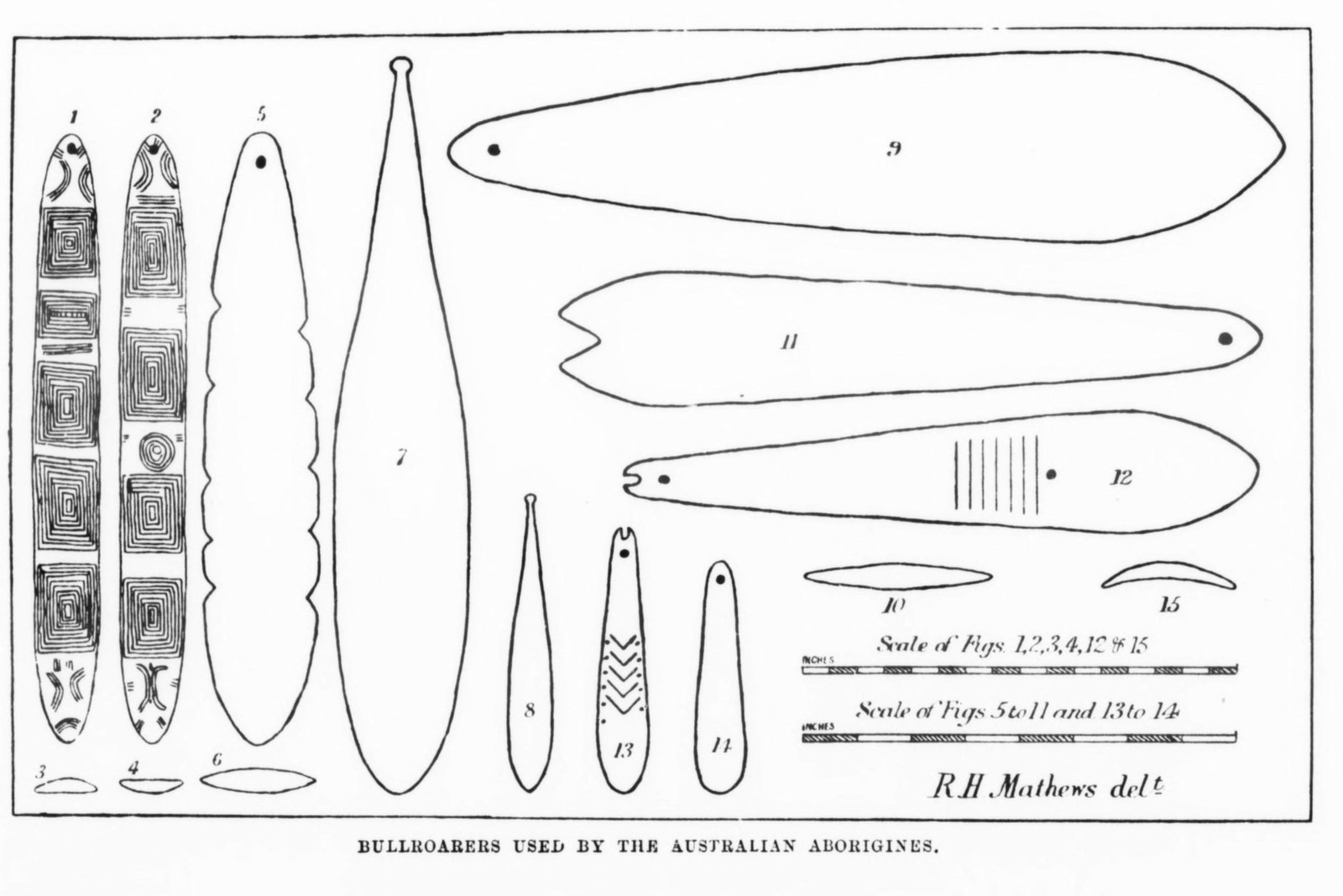
Bungumbelli (large) / Purtali (small)
Bungumbelli, the larger bull-roarer kept by the medicine-man and notched once per ceremony; Purtali, the smaller, used in both initiation and curative exorcism.
Etymology. In the Itchumundi nation of the lower Darling, the larger of the two circumcision bull-roarers was called Bungumbelli; it was kept by the tribe's medicine-man, who cut a fresh notch on it for each ceremony at which it was used. Howitt records the name only as 'large bull-roarer', with no deeper meaning supplied.
Among the Itchumundi nation of the Lower Darling — the Wilya, Kongait, Bulali, and Tongaranka tribes whose country lay back from the river toward the Grey and Barrier Ranges — two bull-roarers were sounded at the initiation ceremonies. The larger, Bungumbelli, was the charge of the tribe's medicine-man, who cut a fresh notch into it for every ceremony at which it was whirled. The smaller, Purtali, served the rites as well, but the medicine-men also used it in cases of sickness, as a kind of exorcism. During the ceremonies the novice drank blood from the arm of one of the old men, and was supposed thereby to be infused with a manly spirit.
The smaller one is called Purtali and is used not only at the ceremonies, but also in cases of sickness by the medicine-men as a sort of exorcism.
Howitt, Native Tribes of South-East Australia (1904), p.702
Particulars
- Object
- Pair of whirled wooden slats, one larger and one smaller.
- Function
- Initiation + healing-exorcism; medicine-man's two-instrument set.
Source
Howitt, Native Tribes of South-East Australia (1904)