No. MUS2026-043
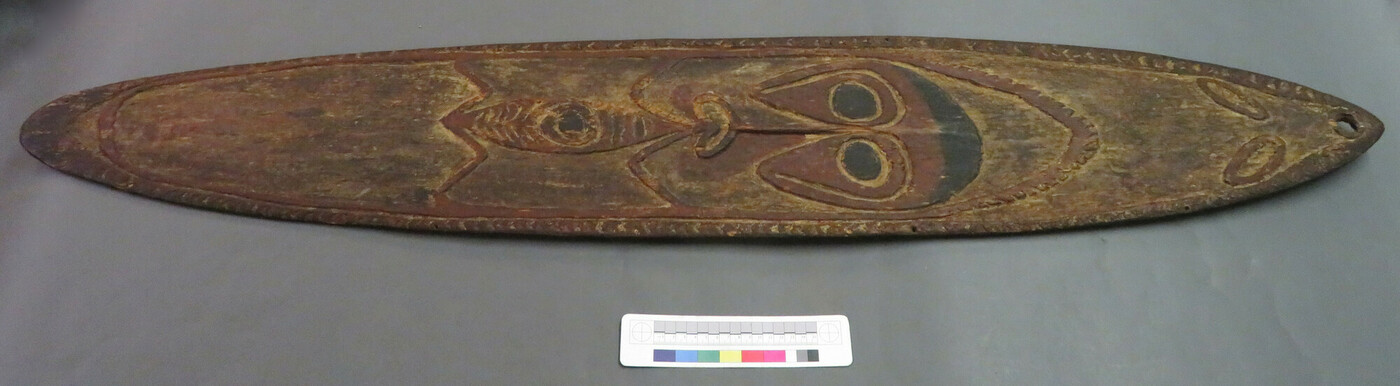
Goaribari board with a carved face
Papua New Guinea · Goaribari, Gulf Province (Kikori delta) · Oceania · Sahul
Restricted
Source term: bull-roarer
imunu viki: "weeping spirit," the Purari Delta bull-roarer whose booming voice is a lamenting spirit; the related kaiamunu are spirits embodied in monstrous wickerwork effigies kept in the men's house.
More than four and a half feet long and carved with a great-eyed face, this board came home from Goaribari Island with the 1903-04 Cooke Daniels Expedition to the Kikori delta of Papua New Guinea's Gulf Province. Oxford's Pitt Rivers Museum files it among its bull-roarers as a bull-roarer derivative, possibly an ancestor tablet. The Goaribari, a Kerewa people, were famed for their headhunters' skull racks (agiba) and painted gope spirit-boards. Further east, in the Purari Delta, the swung board is the imunu viki, the "weeping spirit": a sacred voice sounded by select society men at the death of a chief and in male initiation, when its thunder was heard as the cry of the kaiamunu, the monstrous wickerwork beasts kept hidden in the men's house and forbidden to the uninitiated.
I think, e.g., of the Bull-Roarer, the Hohao (corresponding to the Kwoi of the Purari Delta), and the tall masks called Hevehe, all belonging to the Elema people. The very shape of the material objects concerned (though their size may vary from less than 15 ins. to more than 15 ft.) is enough to suggest that the real original is the bull-roarer.
F. E. Williams, 'The Kaiamunu-Ebiha-Gi Cult in Papua,' Man 39 (1939), no. 50, p. 48
Particulars
- Object
- Oval board carved from one piece of wood, 139 cm long, 24 cm wide and 1 cm thick, tapering at both ends and pierced at one; one side bears a stylised face in low relief inside a chevron border, painted black, red and white.
- Function
- Not recorded.