No. MUS2026-154
Baramura blade, Méte’s first swing
Papua New Guinea · Lower Fly River, Western Province · Oceania
Sacred / spirit
Source term: bullroarer
bullroarer: English British Museum object type; no Baramura name is recorded.
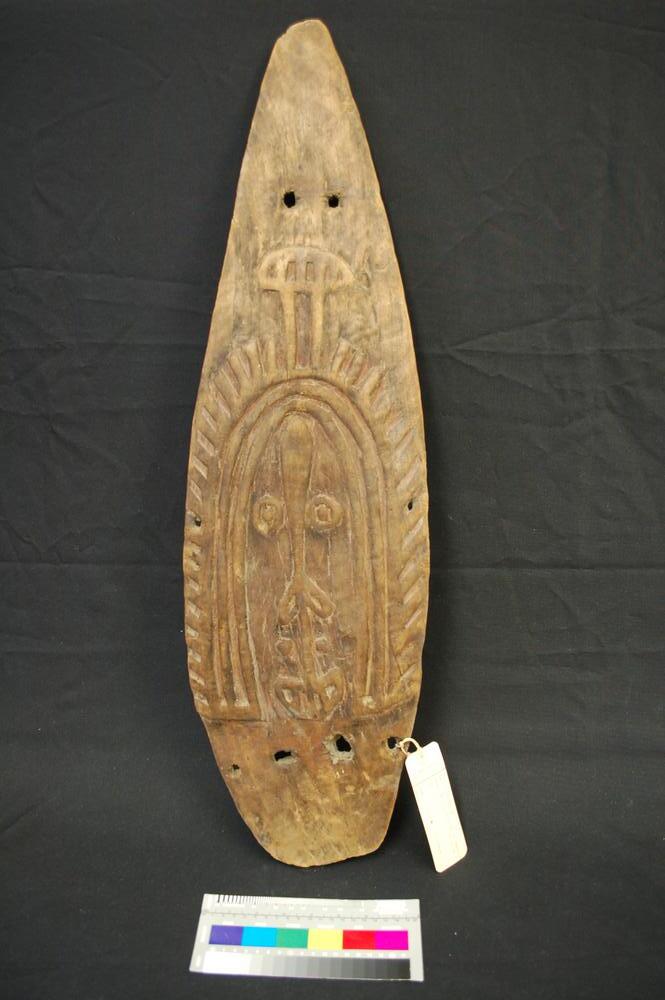
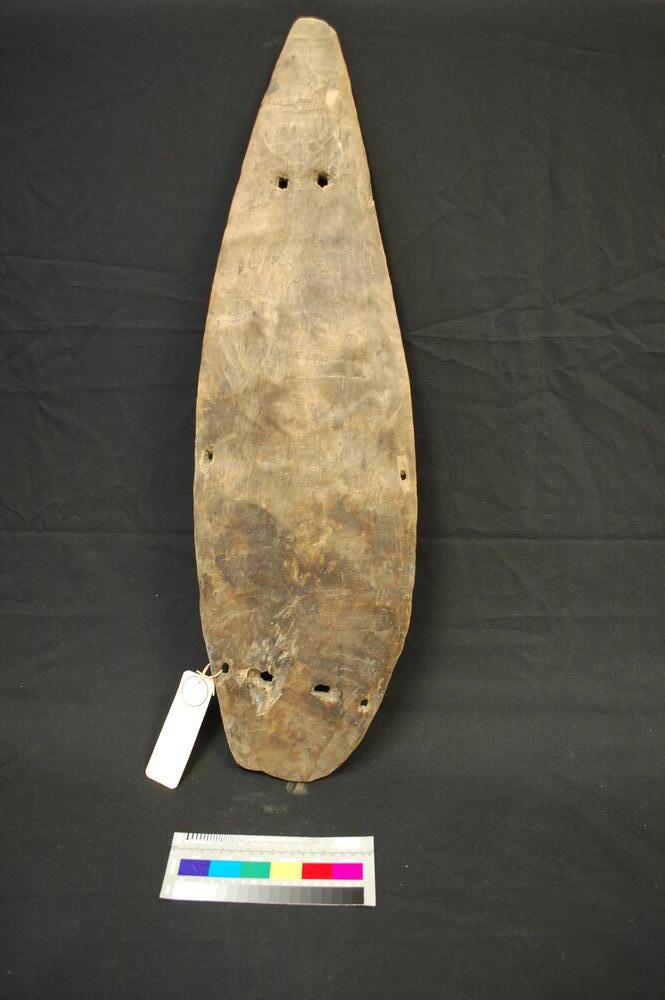
Méte was splitting otoro firewood when a splinter whirled up crying “bigu, bigu” and stuck in the ground. That night it came to her in a dream, calling her Mother: bore a hole near its nose, attach a cord, rub it with semen and vaginal fluid, and swing it over the gardens to make yams, banana, taro and sweet potato grow. Méte tried it first; her frightened husband nearly ran away. When he swung it, the ground shook and thunder ran along the island. He assembled the men, sent women and children away, and threatened any man who told a woman with his drawn bow. Méte helped the secret along by pretending to be frightened herself. Námai of Mawáta told this Kiwai story to Gunnar Landtman. In 1912 Landtman also gave the British Museum this eighty-two-centimetre blade from Baramura on the Fly River, its face carved and its reverse plain.
Ceremonial bullroarer. Baramura (on Fly River).
British Museum, Oc1912,1217.5, 1912 register.
Particulars
- Object
- 82 x 24 x 4 cm petaloid wooden board, carved on one face; the museum calls it a bullroarer.
- Function
- The 1912 register calls it ceremonial; no performance is described.