BATTARBEE1936-001 - rock art depiction
Etarratarra twin-boys bullroarers
Australia - Northern Territory - Finke Gorge National Park - Palm Valley
Sacred / spirit
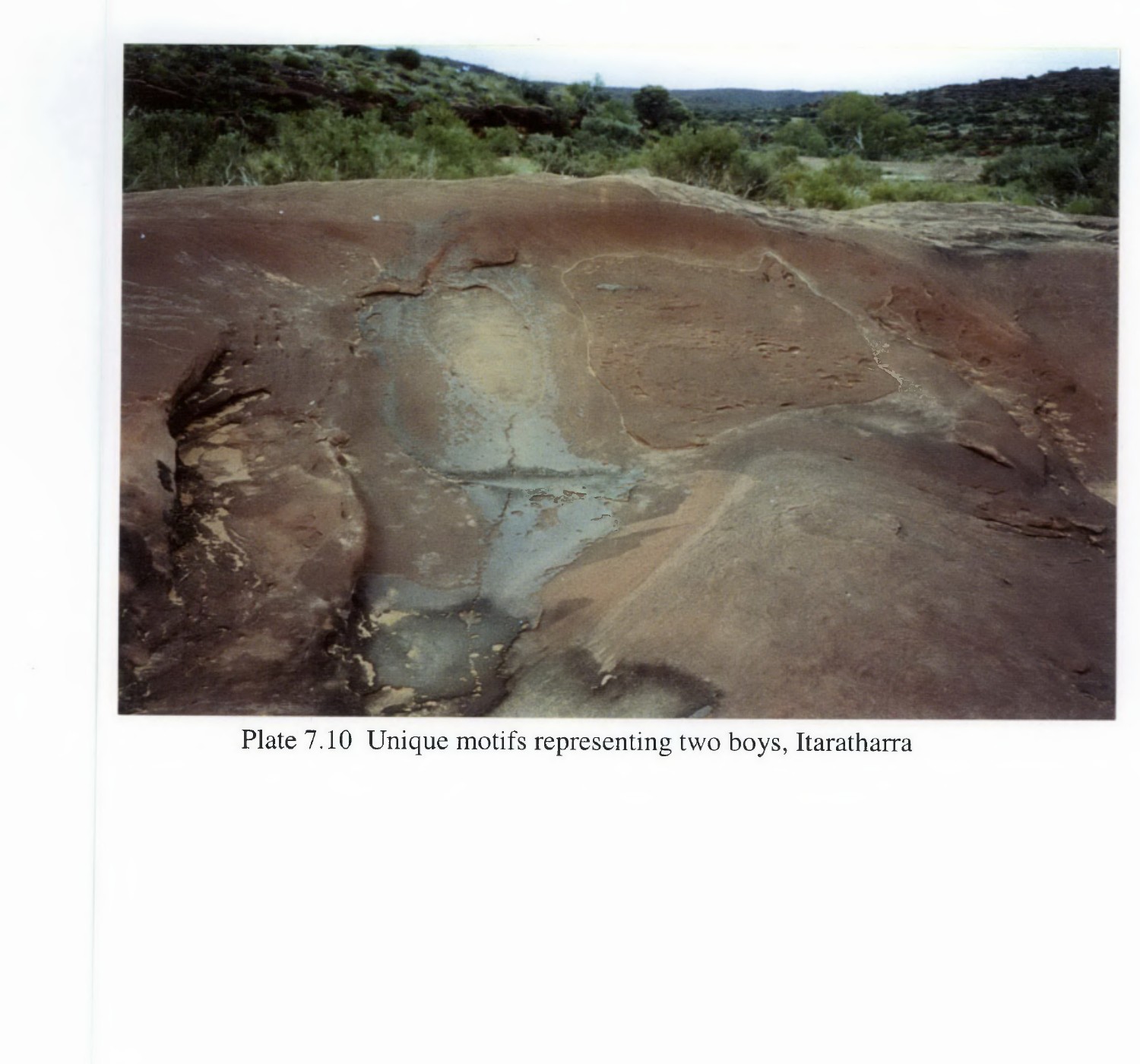
Etarratarra (Battarbee/Edmond spelling); Itaratharra (Ross 2003 plate caption)
Source term: bull roarers / unique motifs representing two boys
Etarratarra/Itaratharra: "two boys," the Western Arrarnta place-name for the carved Palm Valley outcrops, per Namatjira's own gloss recorded by Battarbee in 1936.
At Palm Valley, among the red sandstone of Finke Gorge, two carved markings sit on rock ledges beside a spring -- one large, one small. In 1936 the painter Rex Battarbee noted them in his diary as "two unusual stones... that had markings carved upon them," and his companion Albert Namatjira, on whose Western Arrarnta country they stood, explained them on the spot: Etarratarra means two boys, one big and one small, who once lived between here and Koporilya Springs, and "they are really Bull Roarers, one large and one small, and the spring is carved out of the rock too." Decades later, the archaeologist June Ross photographed the same place for her PhD thesis and captioned it "unique motifs representing two boys, Itaratharra."
They are really Bull Roarers, one large and one small and the spring is carved out of the rock too.
Albert Namatjira, quoted in Rex Battarbee's 1936 Palm Valley diary, transcribed in Martin Edmond, Battarbee and Namatjira (Giramondo, 2014), p. 162
- Object
- Two carved rock markings at Palm Valley, one large and one small, on outcrops beside a spring; described by Battarbee in 1936 as "two unusual stones... that had markings carved upon them." Ross's 2003 plate (7.10) shows a weathered, discoloured basin-like carved feature on a sandstone ledge in a bushland gorge setting; no cord, blade outline, or portable object is visible -- this is a carved place, not a recovered instrument.
- Function
- Identified by Albert Namatjira in 1936 as bullroarers, one large and one small, embedded in the story of two boys ("Etarratarra") tied to a nearby spring; Ross 2003 independently captions the same place as motifs representing two boys, without using the word bullroarer.
- Source
- Martin Edmond, Battarbee and Namatjira (Giramondo, 2014), p. 162, transcribing Rex Battarbee's 1936 Palm Valley diary: Battarbee saw "two unusual stones, one big and one small, that had markings carved upon them," and records Albert Namatjira's explanation -- "Etarratarra means two boys, one big one and one small one, who used to live between here and…
- Source location
Page references
Edmond 2014, pp. 162, 377; Ross 2003, Plate 7.10, p. 389
- Source confidence
- low Palm Valley locality centroid within Finke Gorge National Park; the exact carved outcrops are not publicly pinpointed, and the site sits on Western Arrarnta country where precise coordinates are withheld as a matter of course.