No. HAYS1986-008
Wojokeso roarer shown at septum-piercing
Papua New Guinea · Safeyoka · Ampale language orbit · Oceania · Sahul
Restricted
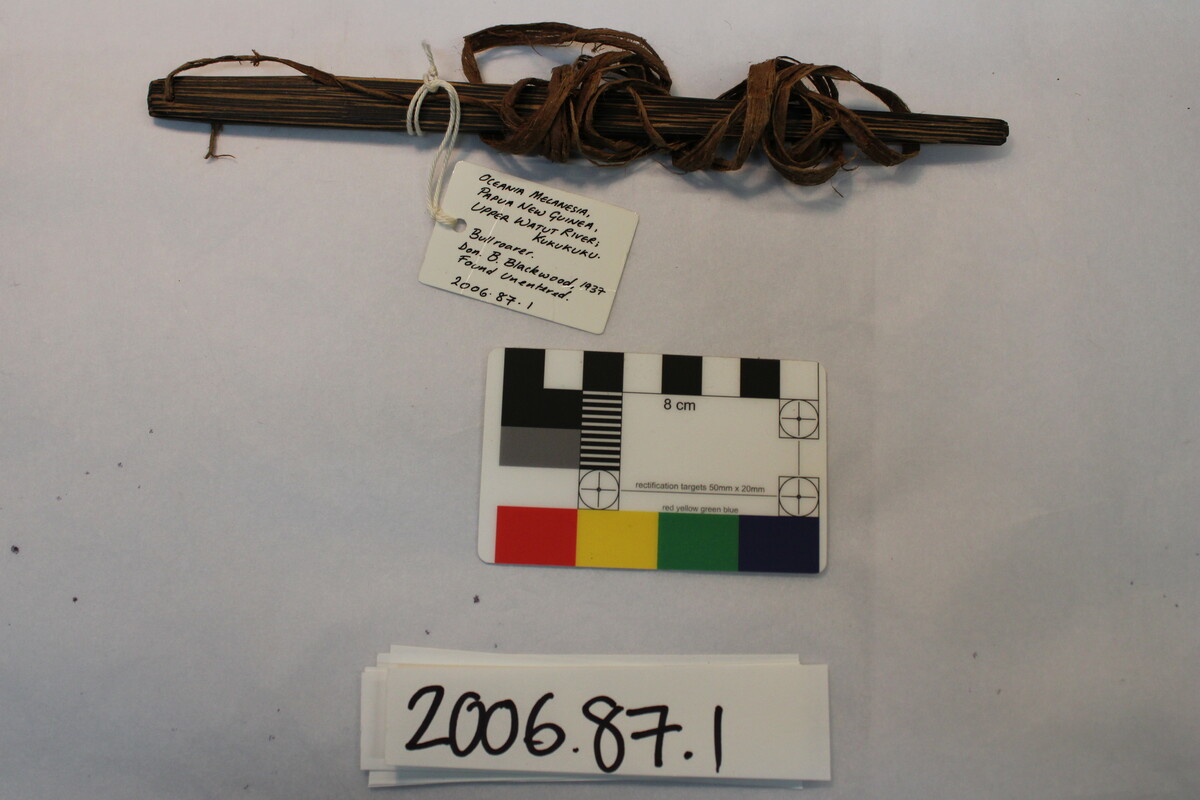
Source term: bull-roarer
Two things came open at once for a Wojokeso boy: the source of the roaring he had heard all his life, and the cartilage of his own nose. This was the southeastern corner of the Highlands, Angan-speaking country. Wojokeso men had transverse flutes as well, where several of their Angan neighbours had none — yet it was the roarer that was kept out of sight and then disclosed, at the moment the boy's face was changed for good. Hays takes the Wojokeso detail from Vida Chenoweth's survey of Papua New Guinea instruments.
bullroarers were the secret instrument revealed to young boys, in association with septum-piercing, in Kapau, Menya, and Wojokeso
Hays 1986:443 (Anthropos 81), citing Blackwood 1978:125–127; Simpson 1953:102–105; Chenoweth 1976:40, 45
Particulars
- Object
- A bullroarer kept secret from Wojokeso boys and revealed to them during initiation.
- Function
- The secret instrument revealed to young boys at initiation, in association with the piercing of the nasal septum.
Sources
- Terence E. Hays, 'Sacred Flutes, Fertility, and Growth in the Papua New Guinea Highlands,' Anthropos 81 (1986): 435-453, pp. 436, 443 View · archived
- Vida Chenoweth, Musical Instruments of Papua New Guinea (Ukarumpa: SIL, 1976), pp. 40, 45, cited in Hays (1986), p. 443
- Beatrice Blackwood, The Kukukuku of the Upper Watut (1978), pp. 125-127, cited in Hays (1986), p. 443
- Simpson (1953), pp. 102-105, cited in Hays (1986), p. 443