No. FRAZER1913-012
Binbinga Katajalina bullroarer
Australia · Western Gulf of Carpentaria
Restricted
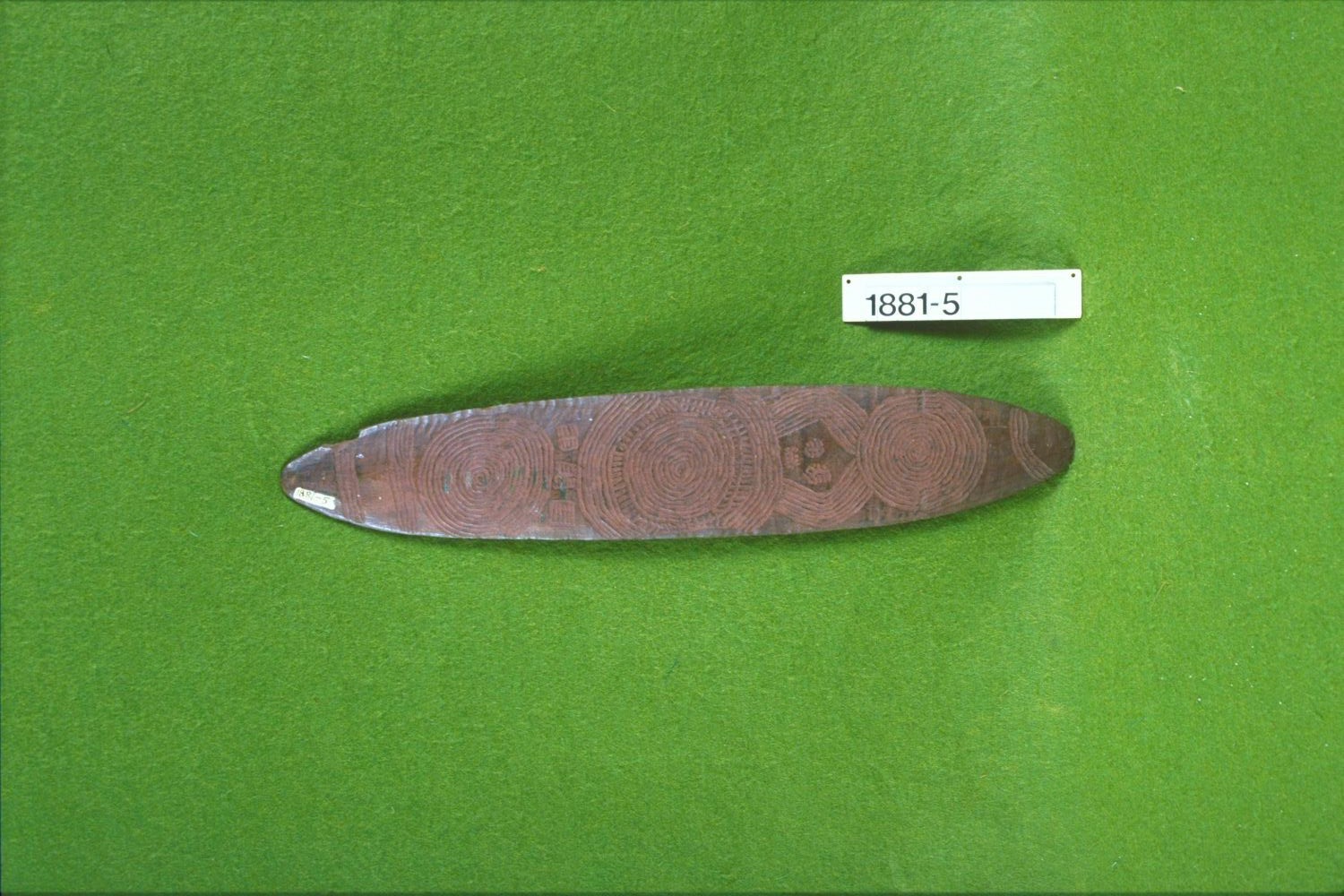
watanurra / watamura
Source term: sacred stick / bull-roarer
watanurra (also watamura): the Binbinga name for the sacred stick or bull-roarer twirled at circumcision; the Anula called the equivalent object mura-mura.
Etymology. Watanurra is the Binbinga name for the sacred stick or bullroarer twirled while a boy is circumcised. The word itself has no recorded literal meaning; the newly initiated boy carried a small watanurra, kept from the sight of women, until his wound healed.
Among the Binbinga of the western Gulf of Carpentaria, the women and children were told that the roaring at a boy's circumcision was the voice of Katajalina, a spirit who lived in an ant-hill, came out and ate the novice, and afterwards restored him to life. The sound came from a sacred stick, the watanurra, twirled steadily while the operator cut — an instrument with its own beginning, for by Binbinga tradition the watamura was first made by two men of the wild-dog totem, the same ancestors who originated the ceremony of circumcision itself. After the cutting the boy was shown one of the sticks, laid on the palms of his hands, and given a smaller one to carry into the bush until his wound healed, warned that if any woman or boy caught sight of it both he and they would die. Spencer and Gillen, who recorded the rite on their 1901-1902 expedition across the continent, set Katajalina alongside Twanyirika of the Arunta and judged both "merely bogeys to frighten the women and children"; among the neighbouring Anula the noise was the spirit Gnabaia, who swallowed the boys and afterwards disgorged them as initiated youths.
In the Binbinga tribe the origin of the Churinga is attributed to two Dingo men of the Alcheringa, who also first introduced the use of a stone knife at circumcision. They used to carry their sacred sticks, which they called watumurra, under their arms during the day, but placed them on their heads at night-time.
Spencer and Gillen 1904, The Northern Tribes of Central Australia, p. 280
Particulars
- Function
- Initiation spirit-voice bullroarer with swallowing/restoration belief.
Source
Baldwin Spencer and F. J. Gillen, The Northern Tribes of Central Australia (London: Macmillan, 1904), pp. 280, 366-367 and 501