No. FRAZER1913-010
Unmatjera Twanyirika bullroarer
Central Australia
Restricted
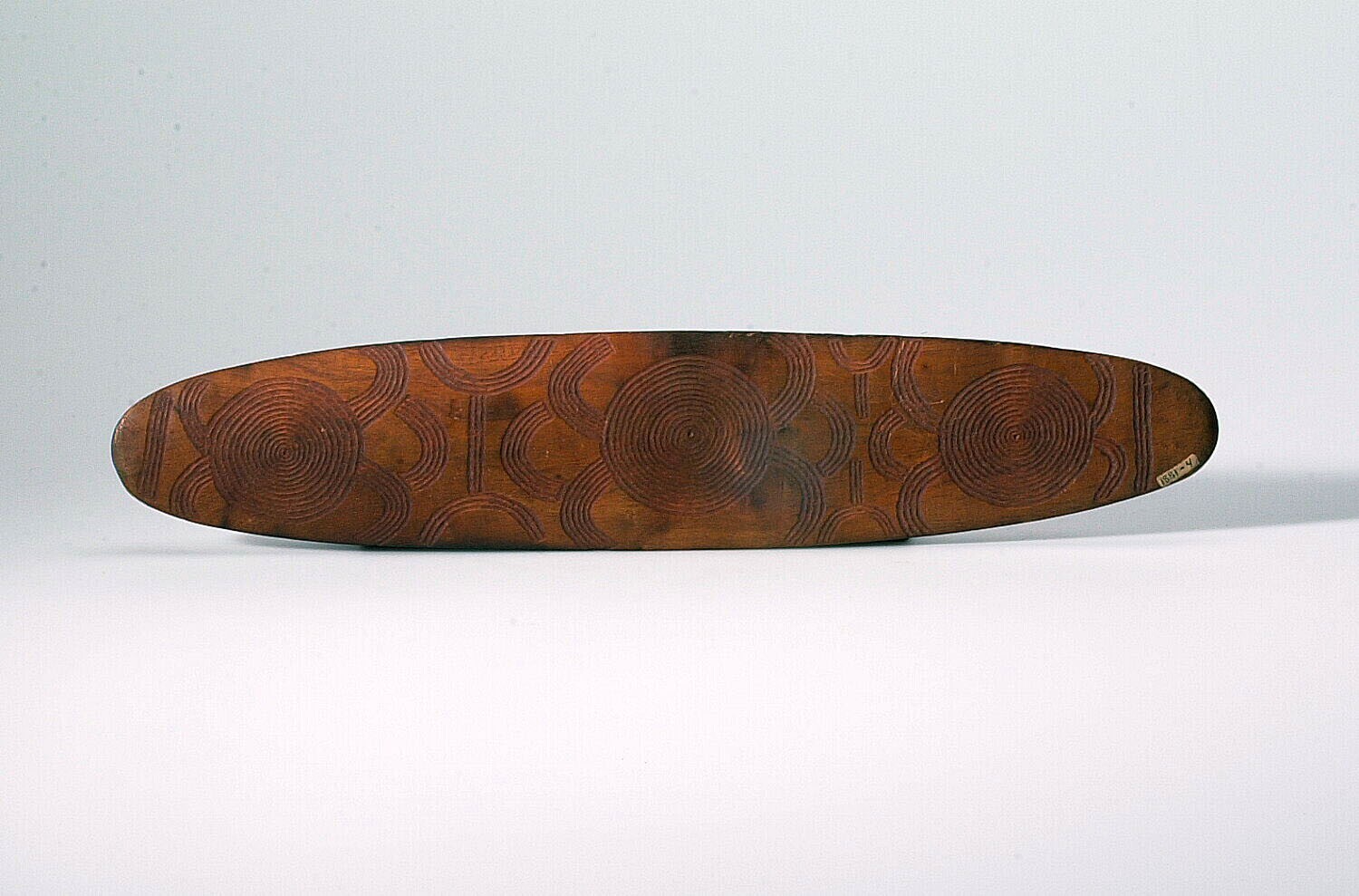
luringa
Source term: bull-roarer / luringa sound
luringa: the word, shared with the Kaitish, for the noise made by the swung bull-roarer.
Etymology. Luringa names the roar itself, not the wood: women and boys were taught that the luringa was the voice of Twanyirika.
Among the Unmatjera of central Australia, a boy recovering in the bush from circumcision had to keep the bull-roarer swinging. If he let it fall silent, another arakurta — a youth between circumcision and subincision — would come down out of the sky and carry him off. Tradition held that this sky-being had himself been initiated by the Ullakuppera men, when they first introduced the stone knife in the Alcheringa, and had then gone up into the sky at a place called Urniara. The women were taught that the spirit Twanyirika ordinarily lived in a rock, from which he came out to take possession of the initiated youth. The old men told the boys that Twanyirika had put his penis into the eyes, nose, mouth, and between the toes and fingers of the novice, and that a big black cloud rising up suddenly was Twanyirika making a smoke.
In the Unmatjera tribe the belief is very similar to that of the Arunta. The noise made by the bull-roarer is called luringa, and the boy is told that, unless he makes it, whilst he is out in the bush recovering from the operation of circumcision, another arakurta, who lives up in the sky, will come down and carry him away.
Spencer & Gillen 1904, The Northern Tribes of Central Australia, p. 498
Particulars
- Function
- Circumcision/subincision initiation instrument connected to Twanyirika death-and-restoration belief.
Source
Baldwin Spencer and F. J. Gillen, The Northern Tribes of Central Australia (London: Macmillan, 1904), pp. 343 and 498