No. PNG3
Wapei
Papua New Guinea · West Sepik · Oceania · Sahul
Function not recorded
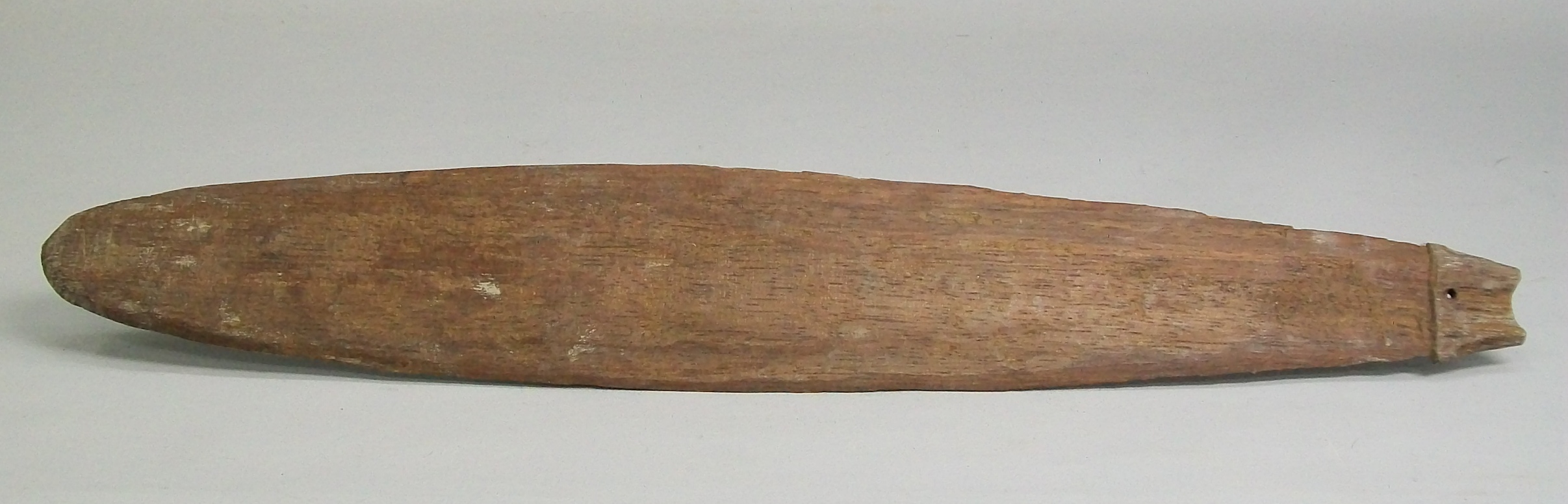
Among the Wape — Olo-speaking villagers on the inland slopes of the Torricelli Mountains in West Sepik — every child is born into a named patrilineage identified by its own slit-gong signal. At the curing festivals, dancing is restricted to women and youths, who shuffle in a circle round the dance plaza to the beat of the booming slit-gongs and hand-held dance drums. The greatest of these gatherings is the spirit fish-curing festival, which can bring together many hundreds of people from neighboring villages. The Wape hold that all things have a spirit, that the recently dead and the demons are the most dangerous, and that at death the spirit leaves the body through the anus and becomes a rapacious ghost before retiring to its lineage lands. The Wape appear as the Wapei in Gourlay's 1975 survey of New Guinea sound-producing instruments, with a bullroarer and a sacred flute listed alongside the slit-gong, though William Mitchell, the ethnographer of the Wape, documents the slit-gongs and dance drums in detail without recording either a bullroarer or a sacred flute.
Ancestral ghosts and the demons resident on one's land are perceived as being very active forces in everyday life. Since these spirits are omniscient, a person offends them at her or his peril.
William E. Mitchell, "Wape," Encyclopedia of World Cultures (1991)
Particulars
- Function
- Not recorded.
Source
K. A. Gourlay, Sound-Producing Instruments in Traditional Society: A Study of Esoteric Instruments and Their Role in Male-Female Relations (New Guinea Research Bulletin 60; Canberra and Port Moresby, 1975), Table 1, p. 5, entry 3; William E. Mitchell, 'Wape,' Encyclopedia of World Cultures (1991)