No. TORRES-003Oceania
Moa (Mua) Islanders
Australia · Moa (Mua · Banks) Island, western Torres Strait, Queensland · Oceania
Weather / fertility magic
- Rain & weather
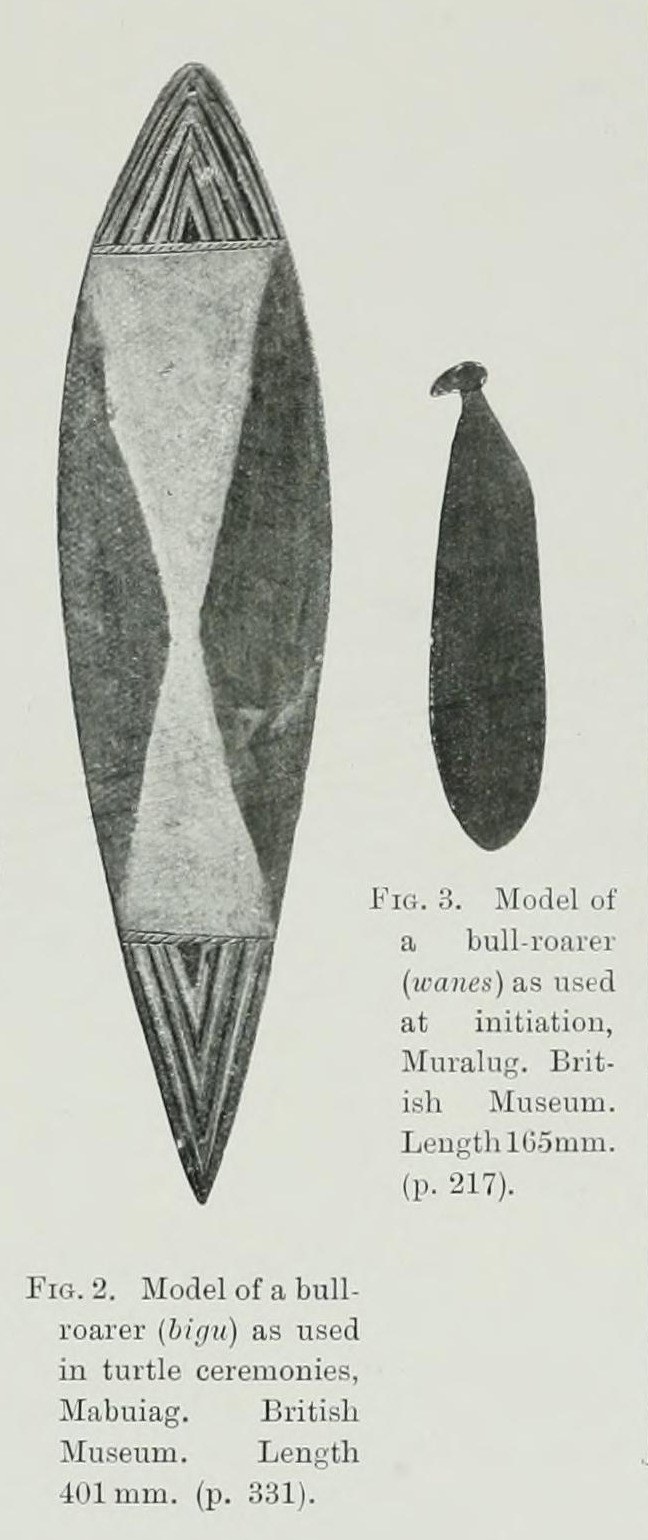
wanes
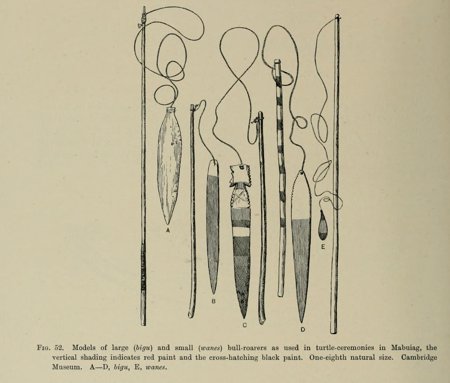
wanes: the small, thin, leaf-shaped (ellipsoidal) bull-roarer of the western Torres Strait, distinguished from the larger bigu; whirled on a yard-long cord fastened to a stick.
Etymology. In the western Torres Strait wanes named the small, thin, leaf-shaped bull-roarer, whirled on a yard of cord tied to a stick; Ray's Mabuiag vocabulary defines it as 'a small bull-roarer with a shrill sound,' the counterpart of the deep-voiced bigu. No literal etymology is recorded; on Moa the instrument served wind magic.
On Moa Island in the western Torres Strait, a wind-maker painted himself black from head to foot and whirled a wanes to call up wind — and the same man could quiet it again. The wanes was the small, leaf-shaped bull-roarer of the western islands, a thin bevelled slat swung on a long cord, the smaller companion to the larger bigu. On neighbouring Muralug a man who wanted more wind spun it fast on its long line from the top of a tree.
A "big man" in Moa could cause wind to blow by painting himself black all over and whirling a wanes, or small leaf-shaped bull-roarer (fig. 52 E). He could also "quench the wind," "usimaipa gub."
A. C. Haddon (ed.), Reports of the Cambridge Anthropological Expedition to Torres Straits, Vol. V (1904), p. 352.
Particulars
- Object
- The wanes is the smaller of two Torres Strait bull-roarers: an ellipsoidal, thin leaf-shaped wooden slat with bevelled edges and a swelling at one end where a cord about a yard long is tied. The cord is fastened to a stick and the slat is whirled over the head. On Moa it was used in a small, very thin form for weather magic.
- Function
- Whirled by a Moa "big man," painted black, to raise wind; the same man could also "quench" the wind.
Discussed in 3 essays
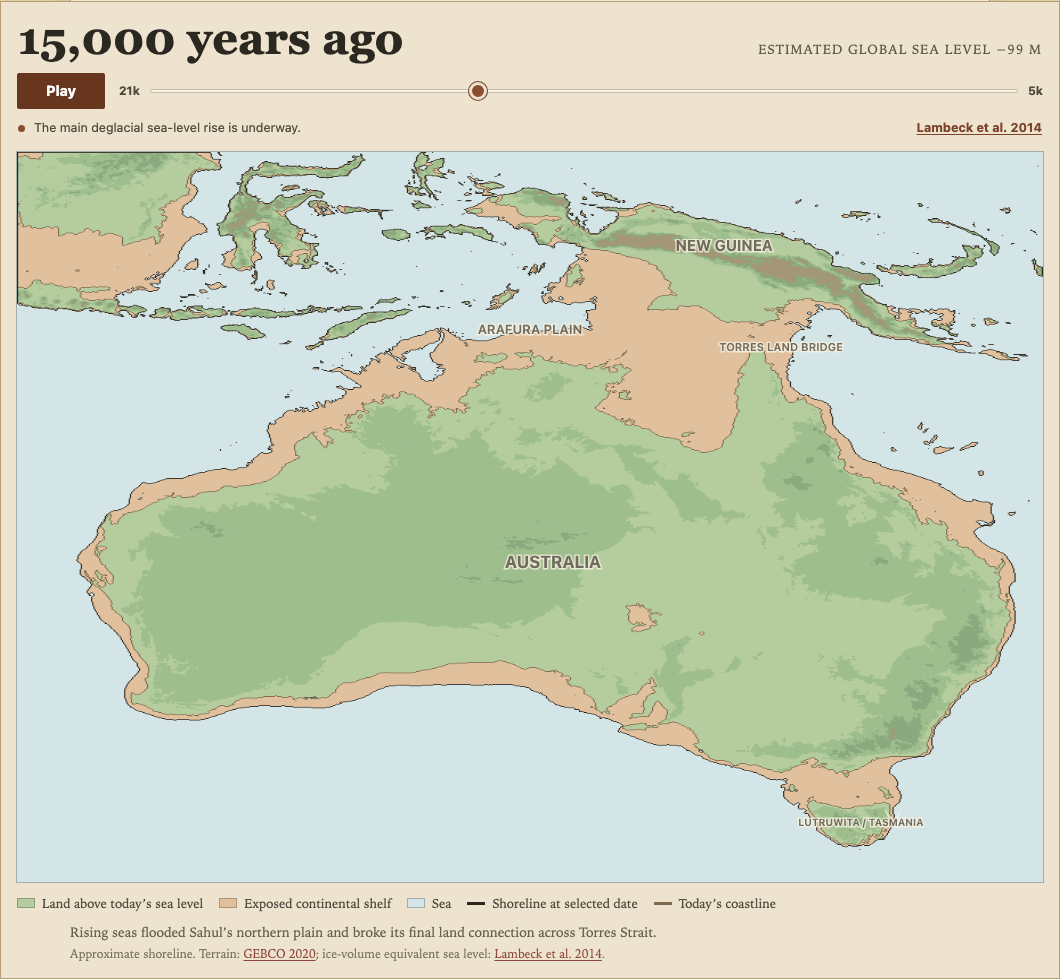 Old Sahul: When New Guinea and Australia Were One
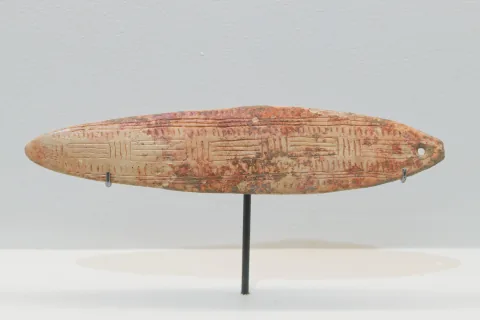 Thunder Before the Plow
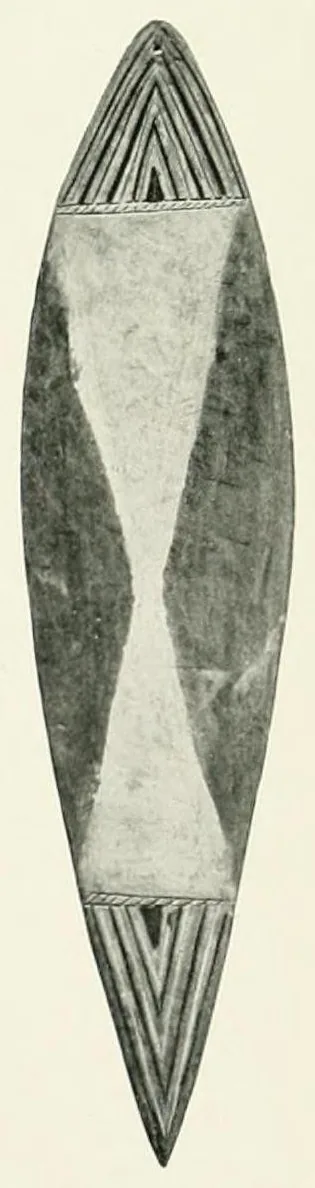 The Whirlwind
Source
A. C. Haddon (ed.), Reports of the Cambridge Anthropological Expedition to Torres Straits, Vol. V: Sociology, Magic and Religion of the Western Islanders (Cambridge University Press, 1904), pp. 217, 352 and fig. 52 E
Nearby in the atlas
 Bigu of the yams and the turtleAustralia · Yam (Iama) Island, central Torres Strait · Weather / fertility magic
 Keriri novice hidden in the bushAustralia · Keriri (Hammond Island), Prince of Wales / Muralug group, western Torres Strait, Queensland · Restricted
 Mer bigo for rain and turtleAustralia · Mer (Murray Island), Eastern Islands, Torres Strait, Queensland · Weather / fertility magic
 Kwerenaty, guardian of the initiatesAustralia · Upper Sandover River, north-east of the MacDonnell Ranges, Northern Territory · Restricted
 Mara mumuna and Mumuna's cryAustralia · Coastal country around the mouth of the Limmen Bight River, southwest Gulf of Carpentaria, between the Roper River and Maria Island, Northern Territory · Restricted
 Mardu (Mardudjara) Western Desert sacred-board bullroarerAustralia · Lake Disappointment (Kumpupintil), Western Desert, Western Australia · Restricted