MAJNEP1977-001 - ethnographic attestation
Kalam wtt, named for a parrot
Papua New Guinea - Upper Kaironk Valley, Schrader Range, Madang Province - Oceania - Sahul
Play / practical
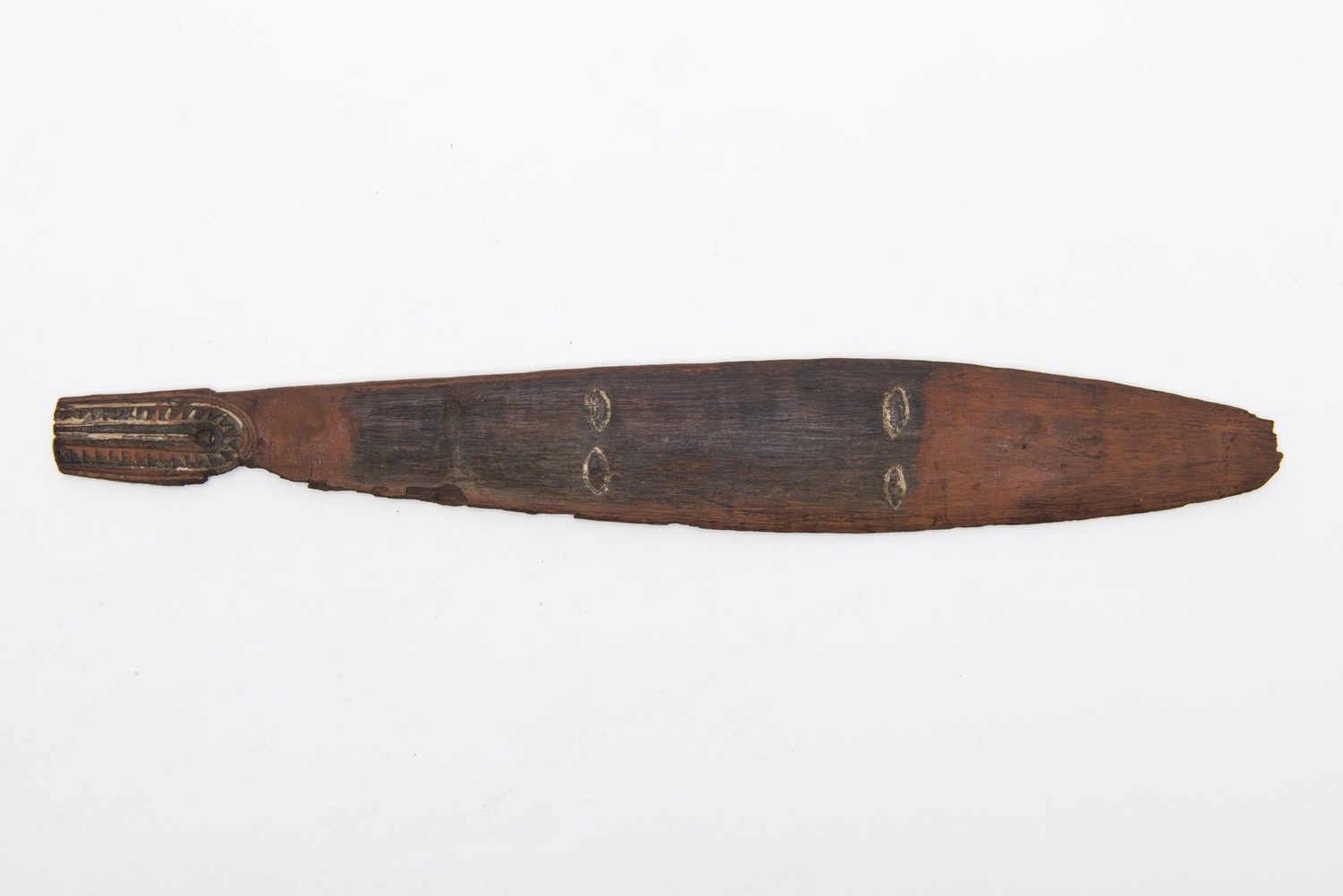
wtt
Source term: bull-roarer
wtt (also given as wurur): the name some Kalam give an unfamiliar brightly coloured parrot, probably the Eclectus Parrot and/or the Black-capped Lory; also the bullroarer. glmd: a parrot name shouted at uninitiated boys.
Kalam men have a parrot's name for small boys. When uninitiated boys are noisy and disobedient, the men shout glmd at them, reminding them that one day their noses will be pierced; the first initiates were called glmd because their noses were like parrots' beaks. When boys come out of initiation they wear the plumage of the tabal and the jbog, the little red lory. The bullroarer, though, belongs to the children. The Kalam know it only as a toy and call it wtt, the name some Kalam give a brightly coloured parrot they hardly know, probably the Eclectus or the Black-capped Lory.
Wtt is also used for the bull-roarer, which is familiar to Kalam, but only as a children's toy.
Majnep and Bulmer, Birds of My Kalam Country (1977), p. 133
- Object
- Children's bullroarer; its form is not described.
- Function
- A children's toy.
- Source
- Ian Saem Majnep and Ralph Bulmer, Birds of My Kalam Country (Auckland: Auckland University Press / Oxford University Press, 1977), pp. 50, 55, 133, 206
- Source location
Page references
p. 133; index p. 206; context pp. 50, 55
- Source confidence
- medium to high
- Location note
- Upper Kaironk Valley, between Kaironk village (OSM -5.2396, 144.4804) and Simbai station (OSM -5.2737, 144.5438), the home area of Majnep and the fieldwork base; valley anchor, not a village record.
Regions: New Guinea · Sahul · Melanesia
- Toy / secular survival