No. GODDARD1941-001
Carnarvon string stencils
Australia · Carnarvon Gorge, Carnarvon Range, Central Queensland
Function not recorded
Source term: bullroarers with string attached
womerah (woomera): spearthrower; Goddard's platypus is a woomera stencil laid over two boomerangs, with a bullroarer as the tail.
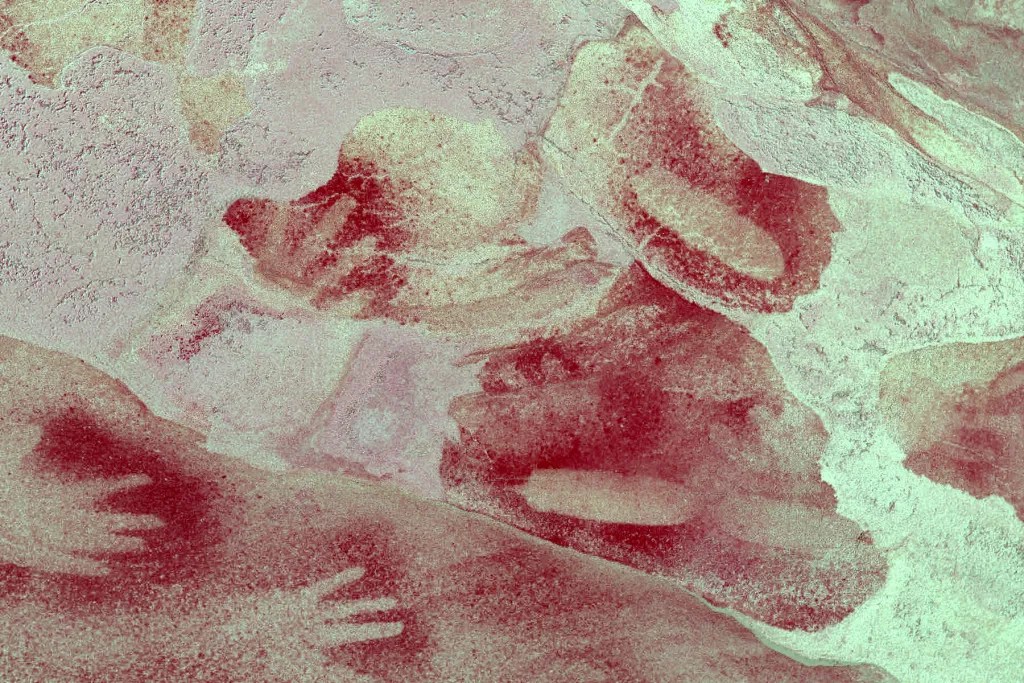
Nine miles up Carnarvon Gorge, where the pale sandstone walls close in, a rock shelter 270 feet long opens in the southern cliff. Nearly every surface within reach is worked: red hands, boomerangs and axes, the scaled cones of the zamia palm whose nuts people pounded and baked, and a burial niche twelve feet up, ringed with stencilled hands. On a boulder near the centre, and on the wall behind it, fifteen red bullroarers hang with their strings still attached. Downstream at Moolyamber Junction the same shape became an animal: a spearthrower stencilled over two boomerangs, with a bullroarer for a tail, makes a platypus.
These figures seem to represent bullroarers with string attached.
R. H. Goddard, Oceania 11 (1941), p. 369
Particulars
- Object
- Fifteen red stencilled figures read as bullroarers with strings attached: four on a large central boulder and eleven on the shelter wall behind it, about five feet above the floor, in an enormous rock shelter on the southern side of Carnarvon Gorge. At Moolyamber Junction a stencilled platypus uses a bullroarer for its tail.
- Function
- Not recorded.
Source
R. H. Goddard, “Aboriginal Rock Sculpture and Stencilling in the Carnarvon Ranges,” Oceania 11(4) (1941), pp. 368–372, pls I–II