No. AUSMAIN-019
Pitjantjatjara
Anangu lands, NW South Australia · SW Northern Territory near Uluru · Western Desert
Restricted
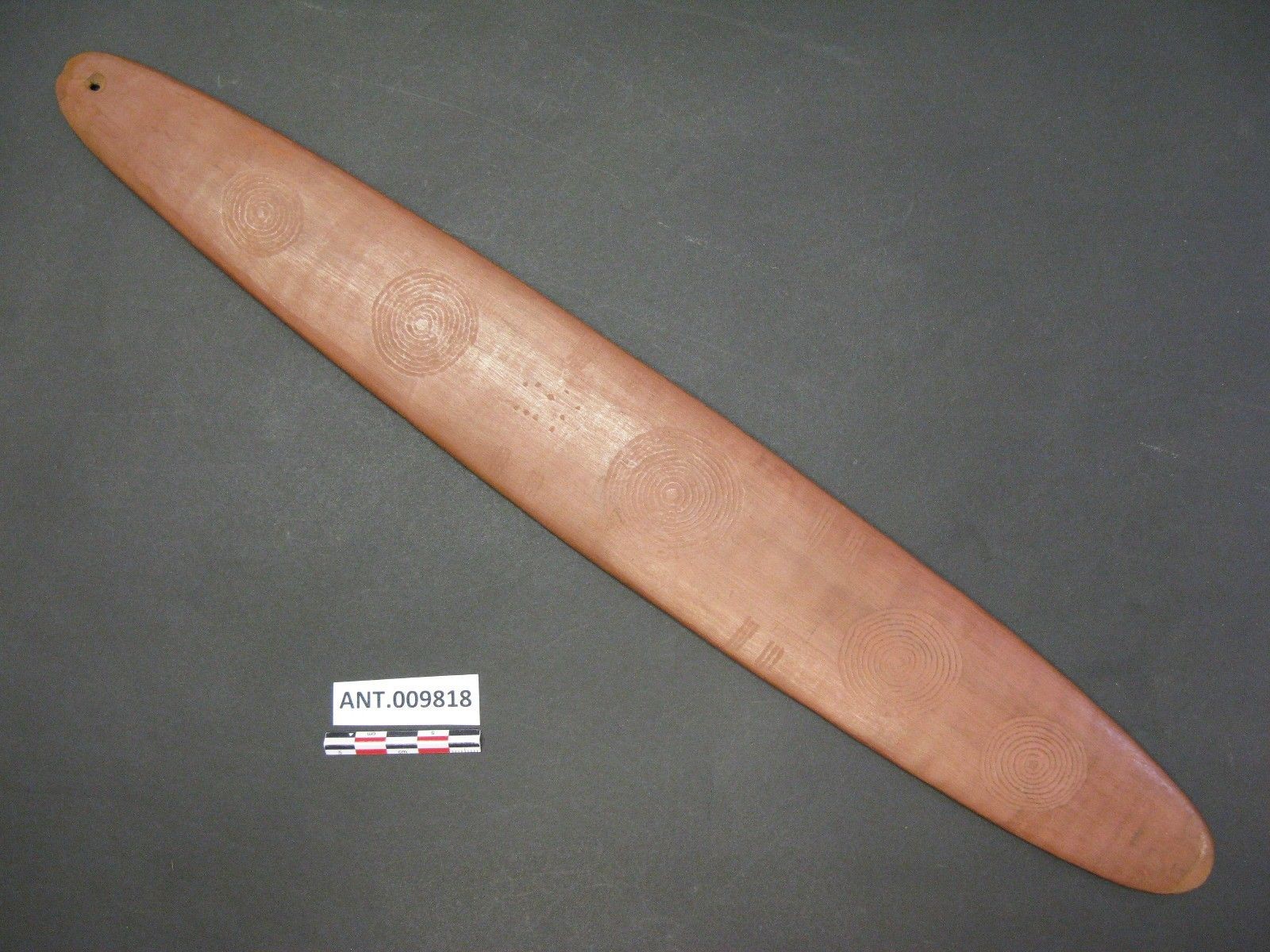
tjurunga
namatuna / mandagi / windirpiri / kuntanka (Pitjantjatjara, "bull-roarer"; kuntanka = the Pitjantjatjara equivalent of the Aranda churinga/tjurunga); pupi-pupi is the onomatopoeic name imitating its sound; Apuju is the one-legged bull-roarer demon whose voice the uninitiated take the roar to be
Etymology. Roheim's informant Tnyetika ("Erldunda Bob") decomposed the Aranda word tjurunga as "own shame" or taboo: tju (bora, shame) plus runga (own, proper one), "to stop people from talking too loudly about the tjurunga"; runga (own) doubles for knanindja (totem, literally origin).
Among the Pitjantjatjara and their Western Desert neighbours, the bull-roarer belongs to men's secret-sacred initiation. At the close of circumcision the youth is handed the instrument — namatuna, mandagi or windirpiri — smeared with blood and warned to keep it off the women's road and whirl it only in the thick scrub. On the long post-circumcision bush journey the new men swing it as they travel, and at the great ceremony they whirl it through the night to frighten the women and children, who dare not rise until dawn. The roar is given out as the one-legged demon Apuju come to carry the boys off, and the tale runs deeper than a bogey: children are shown the Adam's apple as the scar where Apuju cut off their heads and set them back on, while the initiated know that by "head" the story means the penis, and that the novice is given to the Apuju-woman Milpati — a demoness whose genital hangs from her navel, and who tears the member from any man not a novice who approaches her. Only at initiation does the youth learn that there is no Apuju, and that men make the sound. Geza Roheim recorded all of this on his 1929 expedition into the country around the Tomkinson and Musgrave Ranges.
Before being brought back into the camp, the boys are handed the bull-roarer (namatuna) and told "For the woman's road don't take it." "When you whirl it, you keep to the thick scrub only."
Geza Roheim, The Eternal Ones of the Dream (1945), pp. 13-14
Particulars
- Object
- Western Desert bull-roarer: namatuna / mandagi / windirpiri, the Pitjantjatjara kuntanka, equivalent of the Aranda churinga.
Source
Geza Roheim, The Eternal Ones of the Dream: A Psychoanalytic Interpretation of Australian Myth and Ritual (New York: International Universities Press, 1945), based on Roheim's own 1929 Western Desert expedition among the Pitjentara (Pitjantjatjara), Yumu, Pindupi, Nambutji and Luritja; Initiation and women-taboo: at the close of circumcision the Pitjentara boy is handed the bull-roarer (namatuna) and told "For the woman's road don't take it" / "When you whirl it, you keep to the thick scrub only," and the Nambutji are warned "don't let women and children see it" (pp. 13-14); the Pitjentara kuntanka is "the Pitjentara equivalent of the Aranda tjurunga" and "no woman may come near it" (p. 18); Tindale's eyewitness Pitjentara initiation has the youths "swinging bull-roarers as they went" while the womenfolk "kept their faces down beside their fires lest they should see the secret visitors" (pp. 14-15); "Maiutu, Apuju, and other bull-roarer beings are lame" (p. 91-area). Supporting Western Desert myth: in the Njirana-Julana story (Musgrave Ranges, Anangu country, after R. & C. Berndt) the ancestral being's penis "frightens the Minmara group of women by throwing a bull-roarer" (Appendix, pp. 258-259), and Roheim records the Central Australian belief that "women are impregnated by a bull-roarer thrown at them by an ancestor" (Ch. V, p. 90). Local Pitjentara names for the instrument: namatuna, mandagi, windirpiri, kuntanka, pupi-pupi; AIATSIS Wallace finding aid, WALLACE_NP02-001811B and -001812A, W69-4/W69-5, Ernabella 1969