Atlas Essay — 30 September 2026
The Bullroarer and the Flood
Children find a wooden instrument, take it home and show it to the women. The ground falls away. Where the people lived, there is now water. This is a Kurnai story from southeastern Australia, and it is not alone: four more peoples across Australia and New Guinea tell strikingly similar stories of a sacred voice, a guarded secret and a world taken by water.
Across Australia and New Guinea, closely similar flood myths and rituals bind sacred sound to the making and keeping of the world.
In brief
- Across Australia and New Guinea, closely similar flood myths and rituals bind sacred sound to the making and keeping of the world.
- Five peoples tell versions of one story: the Kurnai of Gippsland, the peoples of the Morehead region, the Tor peoples of northern New Guinea, the Muyu of western New Guinea and the Yolngu of Arnhem Land.
- In Gippsland, the Morehead region and Tor country, disclosure of the sacred instrument or its knowledge brings a deluge that can kill everyone.
- Among the Muyu, people sound bullroarers and flutes against the water that makes their rivers. In Arnhem Land, the ceremonial bullroarer embodies the serpent who calls the first wet-season rain.
- Gippsland’s drowned country has a place on the map: scholars have compared it with the flooding of the Bassian plain after the Ice Age.
Five peoples, one flood
From the southern coast of Australia to the northern coast of New Guinea, five peoples keep returning to the same three things. A sacred instrument speaks with an ancestor’s voice. The instrument, or the knowledge that goes with it, is a guarded secret. And water, once loosed, destroys the world or remakes it.
The instrument is usually the bullroarer: a wooden blade swung on a cord. It turns in the air and makes a low, pulsing roar. In many ceremonies that noise is an ancestor speaking, and the right to see its wooden body is closely guarded. In Tor country the voice comes from bamboo flutes, kept under the same rule.
The Kurnai live in Gippsland, in southeastern Australia; the Yolngu in northeastern Arnhem Land, on Australia’s northern coast. Across the Arafura Sea, Muyu country lies in the upper river country of western New Guinea, in today’s Indonesian Papua. The Morehead region lies just east of it, across the border in Papua New Guinea. The Tor peoples live on New Guinea’s northern coast, also in Indonesian Papua.
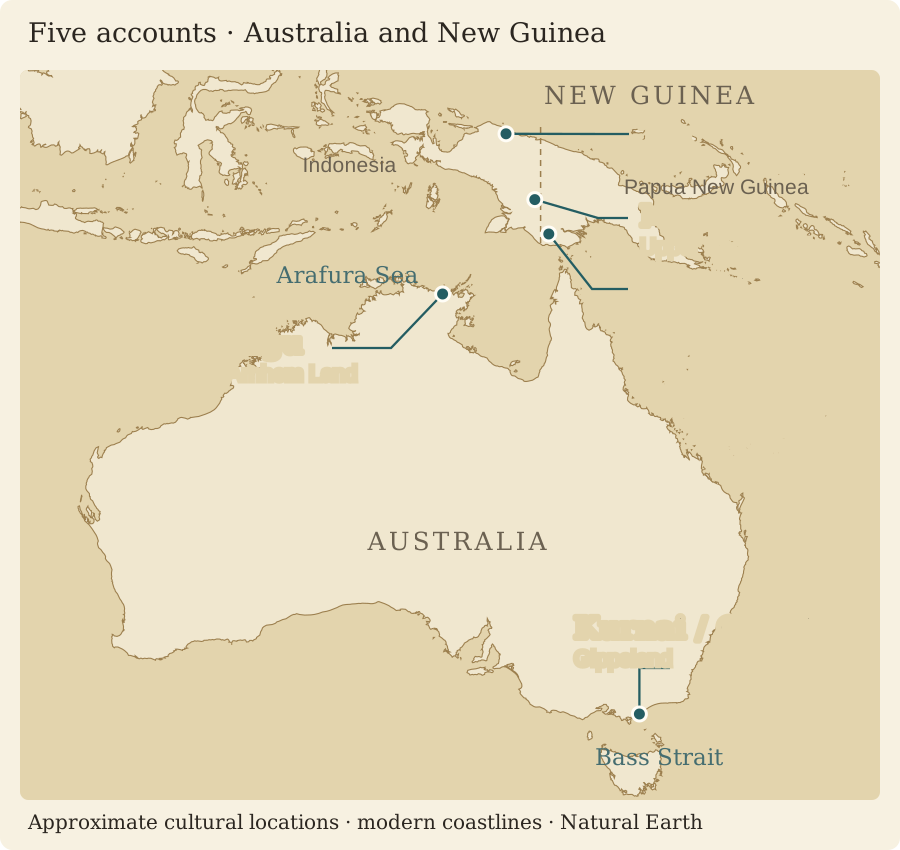
The five fall into two groups that answer each other. In Gippsland, the Morehead region and Tor country, revealing what is hidden brings the flood: disclosure is the act that drowns the world. Among the Muyu and the Yolngu, the sacred voice stands at the water’s making. The ancestors sound it against the flood that makes the rivers, or it becomes the body of the serpent who calls the rain. The first group tells what happens when the secret fails. The second tells how the sacred voice came to belong with the water.
Tundun: the secret that drowned Gippsland
Gippsland lies on the northern side of Bass Strait. In the short Kurnai account published by Fison and Howitt in 1880, children find a turndun, carry it into camp and show it to women. The country south of Gippsland crumbles into water. People who had lived there drown.
Howitt’s fuller telling gives the catastrophe a family. Mungan-ngaua, “our father,” teaches the ancestral Kurnai to make their implements, canoes and weapons. His son Tundun conducts the Jeraeil initiation and makes the instruments that bear his own name and his wife’s. When the ceremonial secrets are revealed to women, Mungan-ngaua sends his fire—the southern lights—to fill the space between earth and sky. People turn violently on one another. Then the sea rushes over the land and drowns almost everyone. The survivors become the Muk-kurnai, the ancestral Kurnai. Tundun and his wife become porpoises.
The two tellings put revelation at the hinge of the world. A hidden wooden object becomes visible; the land becomes water. The married pair who give the instruments their names enter the sea themselves. The flood changes the people, their country and the form of the ancestors whose voices are heard in ceremony.
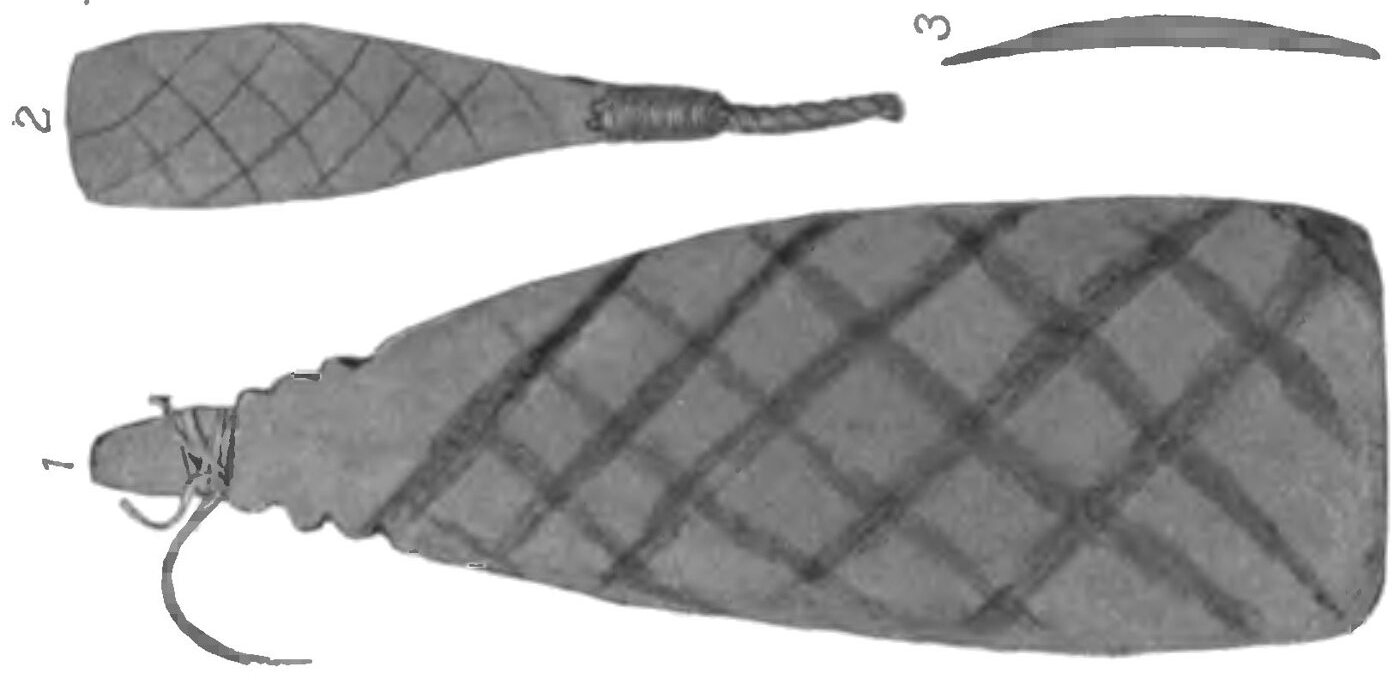
At the Jeraeil Howitt witnessed, men emerged from the scrub sounding the paired blades around covered novices. Boys were shown the instruments, warned to keep the secret and taught to whirl them. Women could hear the concealed roar, understood as Tundun’s voice; the guarded revelation concerned what lay behind it. Initiation therefore put the young men at the dangerous boundary dramatized by the flood. They could now see and handle the power whose disclosure had once destroyed the ancestral world.
Morehead: tell the stories, release the deluge
In southern Papua New Guinea, in the Morehead region near the Indonesian border, initiation gives secrecy the same stakes as in Gippsland. The region’s initiation stories include the origin of the Keraki bullroarer, the first death and ancestral relationships. They are taught to boys and withheld from women and children. Williams recorded that exposing the secrets would bring tremendous rain and a ruinous deluge.
Decades later, Kevin Murphy heard a particularly vivid form at Arufi and Serki. If women discovered the men’s stories, a snake would come from the sky, drill a hole in the earth and release a flood that killed everyone. The dangerous disclosure concerns the stories taught in initiation. Knowledge itself opens the ground.
The resemblance to Gippsland is close: a guarded ancestral teaching, women learning what is withheld, and water destroying the human world. The bullroarer belongs to the initiation complex whose secrecy keeps that catastrophe at bay. The rule learned by a boy consequently reaches far beyond his own conduct. The continued existence of everyone around him depends on keeping it.
Tor: the flutes must eat first
On New Guinea’s northern coast, the Tor-region ceremonies place the same rule on another sacred voice: bamboo flutes. At the inauguration of the faareh, the men’s ceremonial house, they arrive wrapped in banana leaves. Women leave before the flutes are uncovered. Two older women ritually remain behind and are chased out, reenacting the ancestral men’s capture of a house and instruments first owned by women.
Then the men roast a pig and prepare sago jelly. Pieces of both are pressed into the flute openings: the instruments must eat before they can sound. The players form two groups and blow, beginning quietly and growing louder as each group answers the other.
Oosterwal records the prohibition in its starkest form. A woman seeing a flute or hearing its tone would bring heavy rain, overflowing rivers and water over the whole earth. Plants would die; no person would survive. It is the Gippsland and Morehead flood again, with the flute in the bullroarer’s place. Neglecting the rites invites the same end: clouds blot out the sun, rain continues and the world goes under.
Tor makes explicit what the other accounts repeatedly place around sacred sound: the world needs a relationship to be maintained. The flutes must be fed, played and kept by the proper custodians. Then rain comes in its season, sago grows and children are born. The difference between life-giving rain and the final deluge rests with the ceremonial voice.
Muyu: the voices raised against the water
Three peoples tell what happens when the secret fails. The Muyu tell what happened when the water first came. In the upper river country of western New Guinea, just west of the Morehead region, the Muyu bullroarer enters the flood itself. In Schoorl’s account, the ancestors hold a pig feast but have no water. A dog discovers it beneath a great taro plant and keeps the discovery to himself. Water on his chin betrays him; a watching lizard tells the others. They gather to drink and clear the source. The water wells up, and their efforts to dam it fail.
Fish emerge, including the giant Tònkíruk. The people spear him. He flees north carrying all the water, then returns with a thundering rush. The ancestors whirl bullroarers and blow flutes to stop him. The water passes them anyway, making islands in the Kao River. All rivers originate in this event. Some guests are swept away; those who stand firm become the ancestors of the Muyu.
The instruments already belong to this ancestral feast. In the preceding part of the same telling, Kamberap has taught people the sacred pig rites and named the bullroarers and flutes to be hidden from women and children. They are the same guarded voices whose disclosure drowns Gippsland and Tor country. When the water comes, the ancestors answer it with the sounds he gave them.
Here the flood makes a lasting geography: rivers, islands and the people who remain to inhabit them. Its age is unknown, but its scale is the birth of the inhabited world. The scene also makes the instruments’ intended power unmistakable. Faced with water about to remake their country, the ancestors reach for a whirling blade and a flute. Their failure leaves the landscape in which their descendants live.
Yurlunggur: the rain has a voice
On the Australian side of the Arafura Sea, in northeastern Arnhem Land, the Wawaluk sisters travel through Country naming its plants, animals and heavenly bodies. Each has a child. They stop beside the waterhole of Mirramina. When the younger sister approaches for drinking water, she enrages Yurlunggur, the great snake who lives there.
In the telling associated with the Yolngu artist Mathaman Marika, Yurlunggur coils around their camp and sings the first wet-season rain. The sisters clap their singing sticks and sing to stop it. The rain continues. A stick hurled into the sky becomes the snake’s first lightning. He swallows the sisters, casts them out, then swallows them again. Other great snakes reproach him for eating people of his own moiety, one of the two great kinship divisions. He falls in shame, making the triangular ceremonial ground.
At Kunapipi ceremony, the bullroarer embodies Yurlunggur. The blade is his body, the human-hair cord his fangs, and the roar his voice. The being who sings the rains can be sounded again by people who inherit his ceremony.
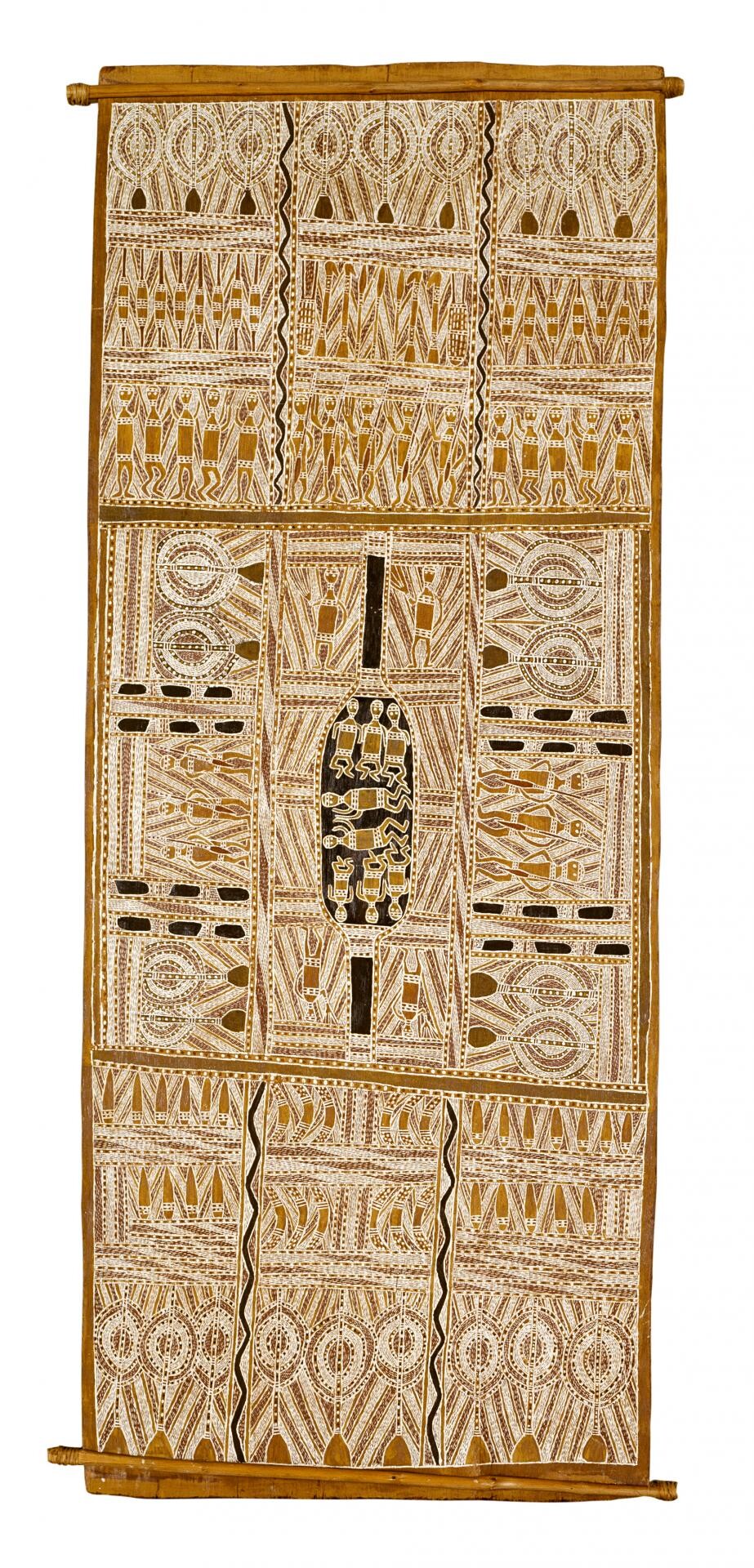
The Yolngu account concerns the arrival of seasonal rain and ancestral law. Its force comes from giving water, song and ceremony a common author. The sisters name the world; the snake changes it; the instrument carries his voice. The roaring blade is a body through which people meet the power that once overwhelmed their ancestors.
Set beside the Kao River, this is a remarkable recurrence. In both, the instrument that now sounds at a feast or initiation belongs to a story about the making of country, its people or its seasons. In all five, the ancestral catastrophe remains present in an object that descendants can hold.
Sahul: the drowned country behind the stories
The five peoples live on the shores of what was once a single continent. Australia and New Guinea face one another across the Arafura Sea and Torres Strait. During the last Ice Age, much of that water was inhabited land. Lower seas joined them into Sahul, one continent, with Tasmania attached at its southern end. As the ice melted, the sea took the northern plain, opened the straits and drowned the country between Tasmania and the Australian mainland.

Gippsland lies on the northern edge of that last southern drowning. Patrick Nunn and Nicholas Reid compare the Kurnai account’s lost land with the Bassian plain, the country that once joined Victoria to Tasmania. Their shoreline reconstruction places the relevant inundation between about 9,240 and 12,460 years ago.
That is the most concrete Ice Age connection among the five: the instrument stands inside a story about land that became sea, and the land can be found on the map. The date comes from the reconstructed landscape. It gives the drowning a possible physical setting; the ceremony and every detail of the story need not be the same age.
The region’s memories of vanished land include crossings that became channels, plains that became gulfs and places people could reach on foot before the water came. Among those accounts, the five told here stand apart for the place they give a sacred instrument.
The sacred voice keeps meeting the flood
Floods are familiar in this part of the world. The repeated presence of a sacred instrument is the striking detail. A wooden blade and a bamboo pipe are small enough to carry in the hand, yet their stories give them a place beside the powers that drown country, make rivers and establish the rains. Their keepers inherit that relationship.
Kurnai, Morehead and Tor tell one warning from three directions. In Gippsland, country becomes sea in a story whose decisive act is showing the bullroarer. Morehead and Tor make the relationship a continuing obligation: keep the ancestral knowledge and sound in their proper hands, or the deluge can come again. Muyu and Yolngu tell the other half. Muyu places the same class of instrument in the ancestors’ attempt to stop the water that makes their rivers. Yolngu ceremony gives the rain-making serpent his wooden body and roaring voice. And Gippsland offers the clearest bridge to the end of the Ice Age, where the Bassian plain went under.
Across Australia and New Guinea, closely similar flood myths and rituals bind sacred sound to the making and keeping of the world. The similarity lies in this unusually specific conjunction: overwhelming water, ancestral power, a guarded voice and rules inherited from the beginning. The world has already been changed by water. Those who sound the ancestors are charged with living on its terms.
Key sources
Gippsland. Lorimer Fison and A. W. Howitt, Kamilaroi and Kurnai (1880), p. 269, the children and turndun account. Patrick D. Nunn and Nicholas J. Reid, “Aboriginal Memories of Inundation of the Australian Coast Dating from More than 7000 Years Ago”, Australian Geographer 47 (2016), p. 20 and table 2, p. 40, for the Bassian comparison and shoreline interval.
Tundun and the Jeraeil. A. W. Howitt, The Native Tribes of South-East Australia (1904), p. 493, for Mungan-ngaua, auroral fire, the sea and the porpoise transformation; pp. 628–632 and fig. 37 for the paired instruments, witnessed initiation and guarded revelation.
Morehead. Kevin Michael Murphy, The Cultural Organisation of Social Difference and Relatedness at the Border between Australia and Papua New Guinea (ANU PhD thesis, 2013), pp. 184–185, including his Arufi and Serki accounts and his quotation of F. E. Williams, Papuans of the Trans-Fly (1936), p. 293.
Tor. Gottfried Oosterwal, Die Papua: Von der Kultur eines Naturvolkes (1963), printed pp. 119–123, for the inauguration, flute feeding, sight-and-sound prohibition and rites maintaining the natural order.
Muyu. J. W. Schoorl, Kebudayaan dan Perubahan Suku Muyu dalam Arus Modernisasi Irian Jaya (1997), printed pp. 170–171, for Kamberap’s instruments, the pig feast, Tònkíruk, the unsuccessful attempt to stop the water and the Kao islands and rivers.
Yolngu. James A. Davidson, “Mathaman: warrior, artist, songman”, Art Bulletin of Victoria 29, for Marika’s ceremonial testimony, the anatomy of the Kunapipi bullroarer and the Wawaluk sisters’ encounter with Yurlunggur. The narrative here follows that telling.
Sahul’s coastline. Geoscience Australia, “Australian Landforms and their History”. The shoreline player uses the GEBCO 2020 Grid and Kurt Lambeck and colleagues, “Sea level and global ice volumes from the Last Glacial Maximum to the Holocene”, PNAS 111 (2014); each event on its timeline links its own source.