No. HAD1898-032
Kurnai Tundun bullroarer
Australia · Southeast
Restricted
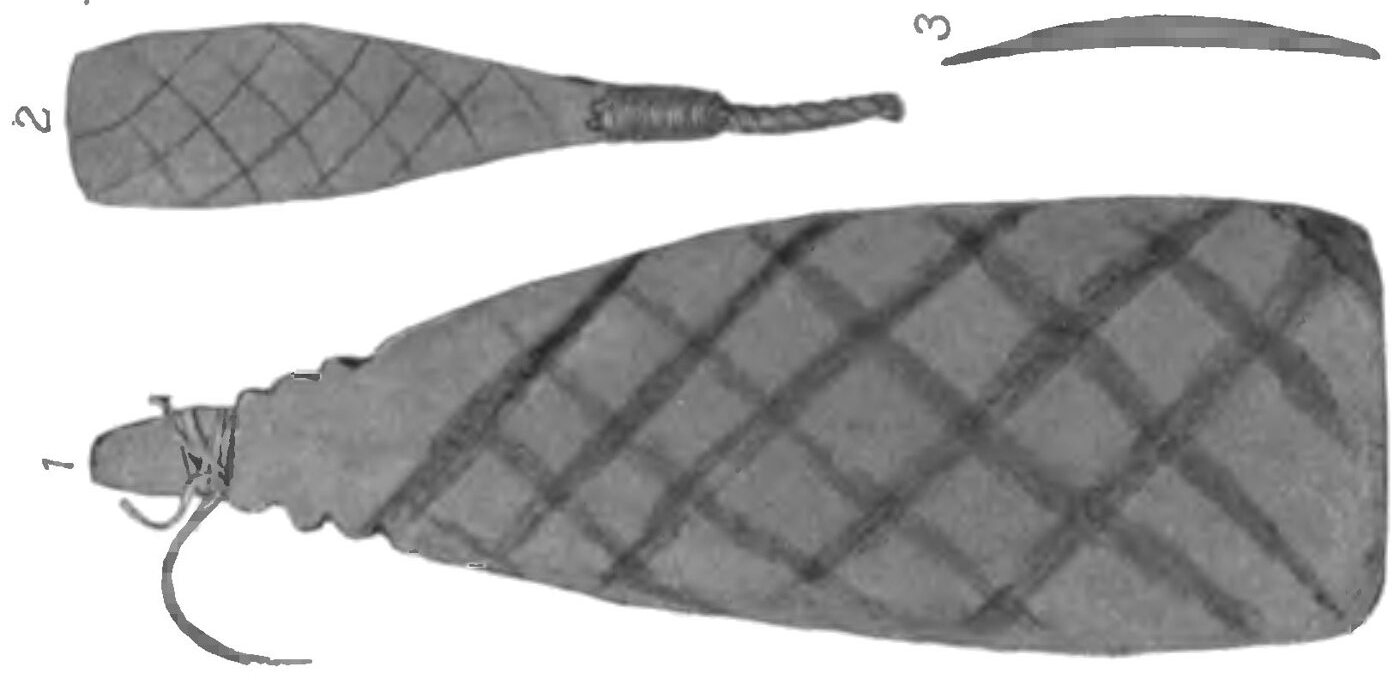
Tundun / Rukut Tundun
Tundun: the larger Kurnai bull-roarer, "the man," named for the son of the All-Father Mungan-ngaua. Rukut-Tundun: the smaller, "the woman," his wife. Jeraeil: the male initiation in which they are revealed.
Etymology. "The man," the larger of the two Kurnai bull-roarers; also called "Grandfather" (Wehntwin) or Muk-brogan, "Arch-Companion." Named for Tundun, son of the All-Father Mungan-ngaua, who made the instruments bearing his own and his wife's names.
Among the Kurnai of Gippsland, the men in charge of the boys at the Jeraeil told them that in the afternoon they would be shown their grandfather. What they were shown was the Tundun, the larger of two bull-roarers, "the man"; the smaller blade was the Rukut-Tundun, "the woman," his wife. Both are shaped like the little bark paddle a Kurnai uses when sitting in his canoe. At the Jeraeil of 1884 a headman came out of the scrub whirling a man Tundun to a dull roar, the man behind him a woman Tundun with its high screech, and sixteen men filed into the open until the din closed in a half-circle round the kneeling novices. Two old men then ran from boy to boy: never tell your mother, never your sister, never anyone who is not Jeraeil. The secret was kept from women on pain of death. Last of all the novices were handed the Tundun and told to sound it, which they did "with evident reluctance and apprehension." Behind it lay a myth: Mungan-ngaua, "Our Father," had a son named Tundun who made the instruments bearing his own and his wife's names, and Mungan instituted the Jeraeil. When a traitor revealed its secrets to women, Mungan sent his fire, the Aurora Australis, across the whole sky; men went mad and speared one another, the sea rushed over the land, and nearly all mankind was drowned. Of the survivors, Tundun and his wife became porpoises, and Mungan withdrew to the sky. The women were told that Tundun himself came down to make the boys into men, and that the hideous sounds they heard at night were his voice as he walked round the camp; a blade that flew off its string and was found by a woman or child was a paddle Tundun had dropped on his way home. An older telling, set down by Fison and Howitt in 1880, gave the danger in miniature: some Kurnai children found a turndun, took it home and showed it to the women, "and immediately the earth crumbled away, and it was all water, and the Kurnai were drowned." Two such bull-roarers, collected by Howitt himself, are now in Oxford.
At the Jeraeil I am describing the novices thoroughly entered into the fun of frightening the women; and, having got over their awe of the bull-roarers, they made an outrageous noise with them. The moment the roaring and screeching sounds were heard there was a terrible clamour of cries and screams from the women and children, to the delight of the novices, who now in their turn aided in mystifying the uninitiated.
A. W. Howitt, The Native Tribes of South-East Australia (1904), p. 632
Particulars
- Object
- Flat wooden blades whirled on a cord, shaped like a small bark canoe paddle, at the Pitt Rivers Museum in Oxford: the large Tundun, 330 by 75 mm, cross-hatched and hung on sinew (1911.32.10), and the smaller Rukut-Tundun, 150 by 38 mm (1911.32.12). A third Rukut-Tundun is a 153 mm blade mounted on a 625 mm stick (1911.32.11.1).
- Function
- Two bullroarers revealed in Jeraeil initiation; Tundun's voice frightens women and children and is tied to a deluge warning myth.
Source
A. W. Howitt, The Native Tribes of South-East Australia (London: Macmillan, 1904), pp. 493-494, 628-632; L. Fison and A. W. Howitt, Kamilaroi and Kurnai (1880), p. 268, quoted in Andrew Lang, Custom and Myth, "The Bull-Roarer"; Pitt Rivers Museum 1911.32.10-12 (field collector A. W. Howitt)