Named ancestral blades, shared rites and the making of men
Around the Huon Gulf, the roarer speaks as an ancestor and a being that swallows boys at circumcision. Bukaua balum, Kai ngosa and Tami kani join instrument, spirit and initiation. Named blades remember particular dead people; related firewood-discovery stories explain how men came to guard the voice.
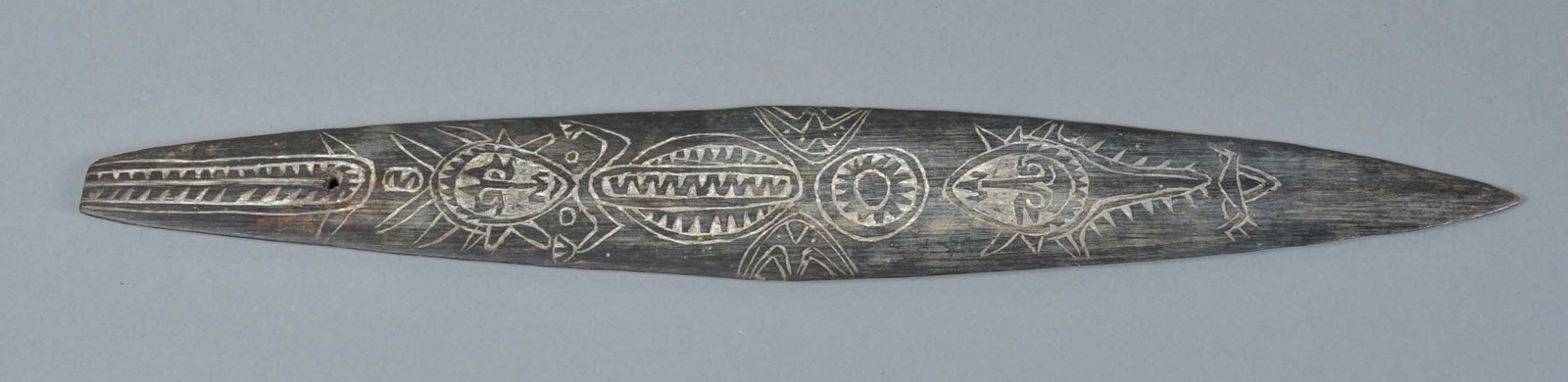
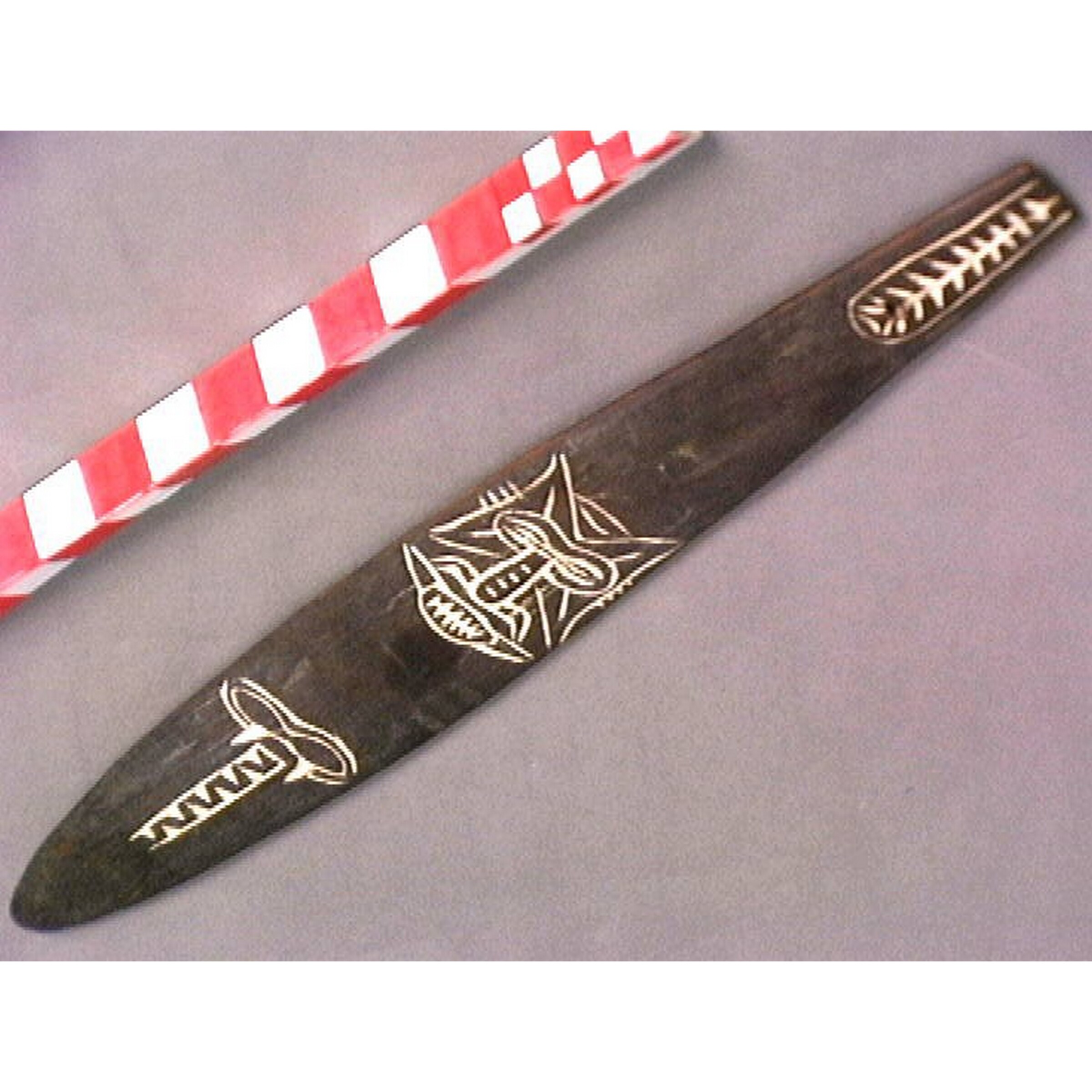
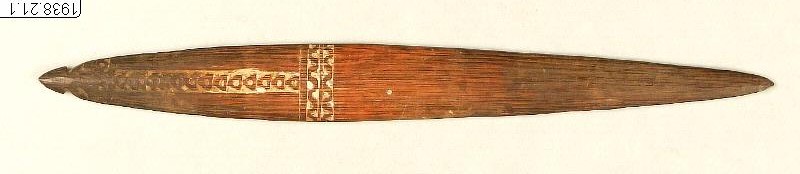
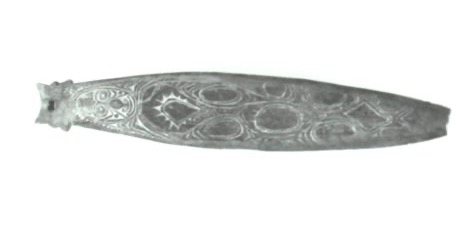
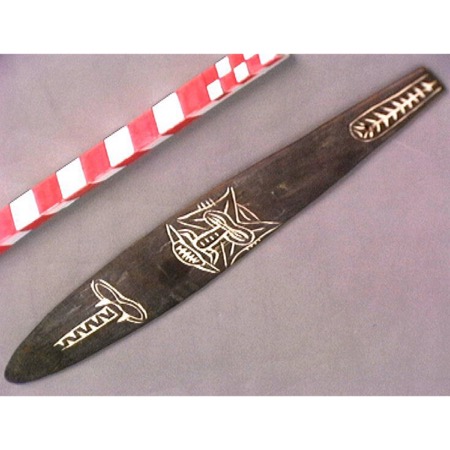
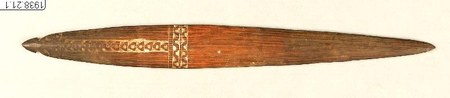
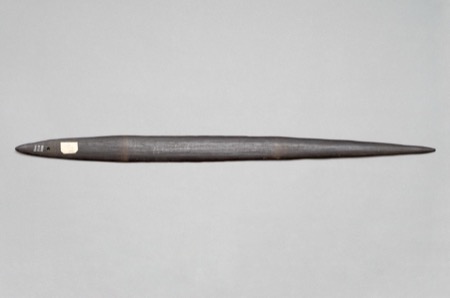
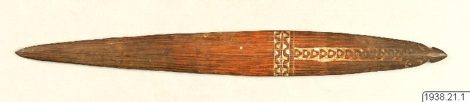
Bukaua (Bukawa), Huon GulfA long, dark, finely tapered wooden blade incised along its length.Ethnologisches Museum, Staatliche Museen zu Berlin (VI 29955); photo Anika Niemeck · CC BY-NC-SA 4.0TamiNarrow carved Tami bullroarer, Wereldmuseum RV-746-38.Wereldmuseum / NMVW (RV-746-38) · CC BY-SA 4.0Bukawa / YabimSchwirrholz from a magic bundle for the Barlum (balum) festival.Världskulturmuseet, Göteborg (1938.21.0001) · CC BY 4.0
The boys go into the being’s belly and come out as men. Around the Huon Gulf, hidden bullroarers give that being a voice; circumcision is the wound left by its swallowing and return. Among the Bukaua and Yabim, balum names the instrument, the being and the dead. Kai ngosa and Tami kani give neighboring forms to a ceremonial pattern built from ancestors, food, fear and revelation. 1, 5, 6, 7
The swallowing is made tangible. A long initiation lodge can become the creature’s body, high at the head and tapering toward the back, with great eyes above the entrance. Women are told it has eaten their sons, and pigs must be supplied to secure their release. The bullroarers sounding out of sight make its presence audible. Circumcision and seclusion occupy the time inside the body; the returning novices carry the wound that is explained as the creature’s bite. 5, 1
The same passage admits different enactments. Kai boys file beneath a scaffold where a man imitates swallowing and spurts water over each novice. Tami candidates pass a row of men swinging bullroarers above their heads. Inland among the Burum-Mindik, esöŋ names an ancestral cult, circumcision, the ancestral spirit and the instrument; the dictionary’s example has the spirit swallowing the boys. The shared action survives changes of language, apparatus and setting. 5, 6, 7, 8
On Umboi, related masked rites drew the boundary differently. Bamler’s Tami informants described the bullroarer there as the spirit’s “tongue,” still honoured as a master but no longer hidden from women. The closest female relatives of boys undergoing circumcision were said to attend the operation and see the instrument. The wooden mask represented kani. A spirit’s voice and an initiation setting could persist while the rule about who saw the blade changed. 7
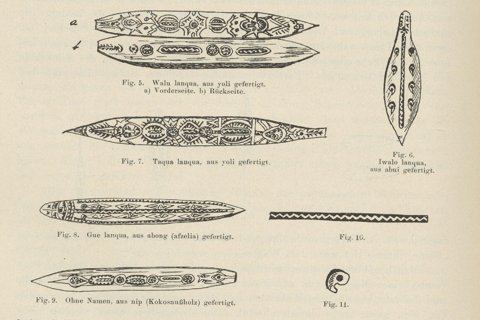
A Bukaua ruling blade remembers an individual. Its name joins the dead man’s name to lanqua, “the Old One.” At Uwaung, Wabo lanqua hangs askew on its cord and gives a rasping sound, because Wabo’s mutilated nose had made his speech indistinct. Gumba lanqua has two humps cut into its sides for Gumba’s prominent hipbones. These are portraits made to move and speak, preserving peculiarities people knew in life. 1
The ancestral company has ranks. Below the ruling instruments are ngasengomi, the serving ones, also named for dead people but important chiefly to their descendants. A separate small class, auwi lanqua, speaks for the ruling ancestors’ wives. Its brighter pitch answers their brighter voices. The wood gives audible form to a community of the dead with its own relations and distinctions. 1
Bukaua carvers could read a program of secrecy in the ornament. A small sea-snake and a beetle grub warned against eating those foods. A butterfly carried the balum’s message landward and seaward; a scorpion threatened the unseen sting. A spirit holding fire exposed whoever betrayed the secret, while a spiny pandanus leaf warned people to keep their distance. Lehner understood the recurring eye of the abo fruit as a sign of growth: once broken from its stalk the fruit becomes strong and seed-bearing, as circumcision separates the boys from their former condition. 1
The first instrument repeatedly begins with a woman splitting firewood. In Lehner’s Bukaua telling, a lance-shaped chip flies off humming. The woman tells her husband; he ties wood to a cord and reproduces the sound. The men decide to keep it by killing her, and compensate him with another wife. In the Kai account, a woman near Laugube shares the discovery with her brother. He wants a great pig feast at the women’s expense; she herself tells him to kill her so the men can keep their secret. 1, 6
Bamler records two entrances to the Tami story. The mainland telling places the whirring splinter on the Boang islands by Nassau Bay. On Tami, the woman finds the instrument already finished, its string attached, among washed-up driftwood. She brings it to her husband; the men agree to spell her to death and replace her. The versions converge on the present ownership rule, while preserving a revealing difference: one discovers a sound, the other receives an instrument from elsewhere. 7
The ruling Bukaua ancestor’s name is also a cry the living use: in war, pig-netting, pig markets and girls’ consecration. It marks allegiance as well as memory. Among the Yabim, men name the dead while twirling the instruments so that taro grows. A voice that orders the initiation ground can order other parts of community life, calling an ancestor into food production or a living group into common action. 1, 3
On the gulf’s southern coast, Siboma gives that public force another institutional form. Bolomana is both the Numbami bullroarer and the ritual through which community sanctions are enforced. It has an enclosure, dagalawa, a word, kuma, for offence and offender, and four instrument groups in fixed precedence: wosa, bamo, yagowi and asoli. This is a locally named arrangement of the same central resources—guarded sound, ranked custodians and collective authority—without making every Huon community tell the same monster’s story. 4
Banko lanqua - "Banko the Old." Among the Bukaua of the Huon Gulf each clan's ruling bull-roarer bore a dead man's name joined to lanqua, "the Old One," and the name doubled as the clan's war-cry, shouted in war, at pig-netting, at the pig market and at the girls' consecration; a man whose roarer…
Museum of Archaeology & Anthropology, University of Cambridge, 1930.429 · CC BY-NC-ND 4.0
Among the Kai, a tribe of mountaineers inland from Finsch Harbour, the bull-roarer was the voice of Ngosa, the monster who swallowed boys at circumcision. The Kai conceived male initiation as being gulped down and disgorged by this being, and one word, Ngosa, named the monster, the swinging…
Representative — not this record’s object · Iatmul bullroarer from Korigo Hill, collected by Gregory Bateson
On the Tami Islands of the Huon Gulf, the hum of the bullroarer was the voice of a monster that swallowed boys at their initiation and disgorged them as men, and the women wept for joy and strewed boiled field-fruits along the returning boys' path. The Tami were one of four neighbouring peoples of…
Världskulturmuseet, Göteborg (1938.21.0001) · CC BY 4.0
Among the Bukaua and Yabim of the Morobe coast, boys taken for circumcision were said to be swallowed by a ferocious monster called balum, who released them from his belly only after enough pigs had been sacrificed to make him vomit them up; in spewing them out he bit or scratched them, and that…
esöŋ (cult, spirit, and bullroarer; Siawari asa); köwawöŋ / muwum-muwum
One word carried the whole institution among the Burum-Mindik of the inland Huon Peninsula: esöŋ was the ancestral cult, the circumcision it enacted, and the ancestral spirit — 'the ancestral spirit swallowed up the boys,' runs the dictionary's own example sentence — and esöŋ was also the…
Representative — not this record’s object · Daniels-expedition palmwood blade marked ‘Bensbach’.
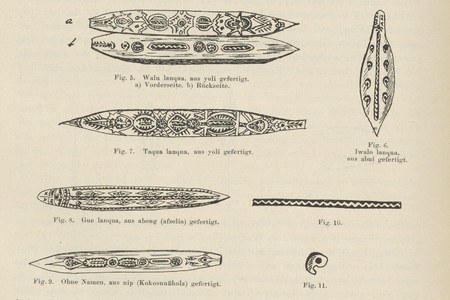
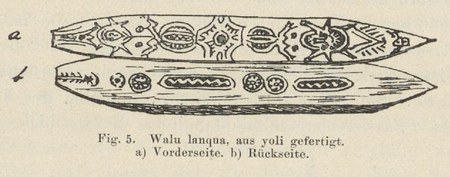
R. Neuhauss, Deutsch-Neu-Guinea, Bd. III (1911), p. 412, figs. 5–11 (S. Lehner, 'Bukaua') — Universitätsbibliothek Frankfurt, DSDK · Public domain
At Siboma, on the south coast of the Huon Gulf, wrongdoers answered to the bullroarer. Among the Numbami, bolomana named both the instrument and the rite through which the village enforced its sanctions. It was held inside its own enclosure, the dagalawa, and it had its own word for the accused:…
Representative — not this record’s object · Named balum bullroarers of the Bukaua, across the Huon Gulf from Siboma.
In Richard Neuhauss, Deutsch Neu-Guinea III, pp. 402–418; named ancestral blades and their classes pp. 410–413; origin story p. 414. Primary missionary field account. Wabo and Gumba checked directly on p. 411; wives distinguished from serving instruments directly on p. 412.
New Guinea Research Bulletin 60. Distribution tables distinguish occurrence from documented ritual use. Origin accounts pp. 79–85 reproduce named field witnesses; these are source chains, not additional independent witnesses.
Deutsch Neu-Guinea III, p. 333: Yabim men twirl the instruments naming the dead for taro growth. Transmitted in Frazer, Balder the Beautiful II (1913), p. 232 and note 615; the taro rite is Yabim-specific.
1976 Siboma fieldwork, deposited Kaipuleohone JB1-006: bolomana and its four ranked groups p. 12; dagalawa p. 15; kuma p. 38. Written record read; PARADISEC audio not heard.
The Golden Bough XI, pp. 227–243: Huon swallowing and return sequence and the local lexical comparison; transmitted from Vetter, Schellong and the Neuhauss III missionary accounts, not independent fieldwork.
Neuhauss, Deutsch Neu-Guinea III: p. 495. Mainland Boang/Solitary islands by Nassau Bay firewood variant; Tami ready-made driftwood variant; both end in killing by spell and replacement wife. Bamler’s circa-150-year introduction estimate is an interpretation from his inquiries. P.512: Tami informants’ related Rook/Umboi masked kani institution; bullroarer as spirit’s tongue; female relatives reportedly attend circumcision and see it. Direct page inspected; no Rook swallowing story inferred.