No. AUSMAIN-026
Nambutji
Northern Western Desert, Luritja-speaking country north of the Pitjantjatjara and west of the Aranda, around the Mount Liebig–Haasts Bluff–Lake Macdonald corridor on the Northern Territory side near the Western Australia border
Restricted
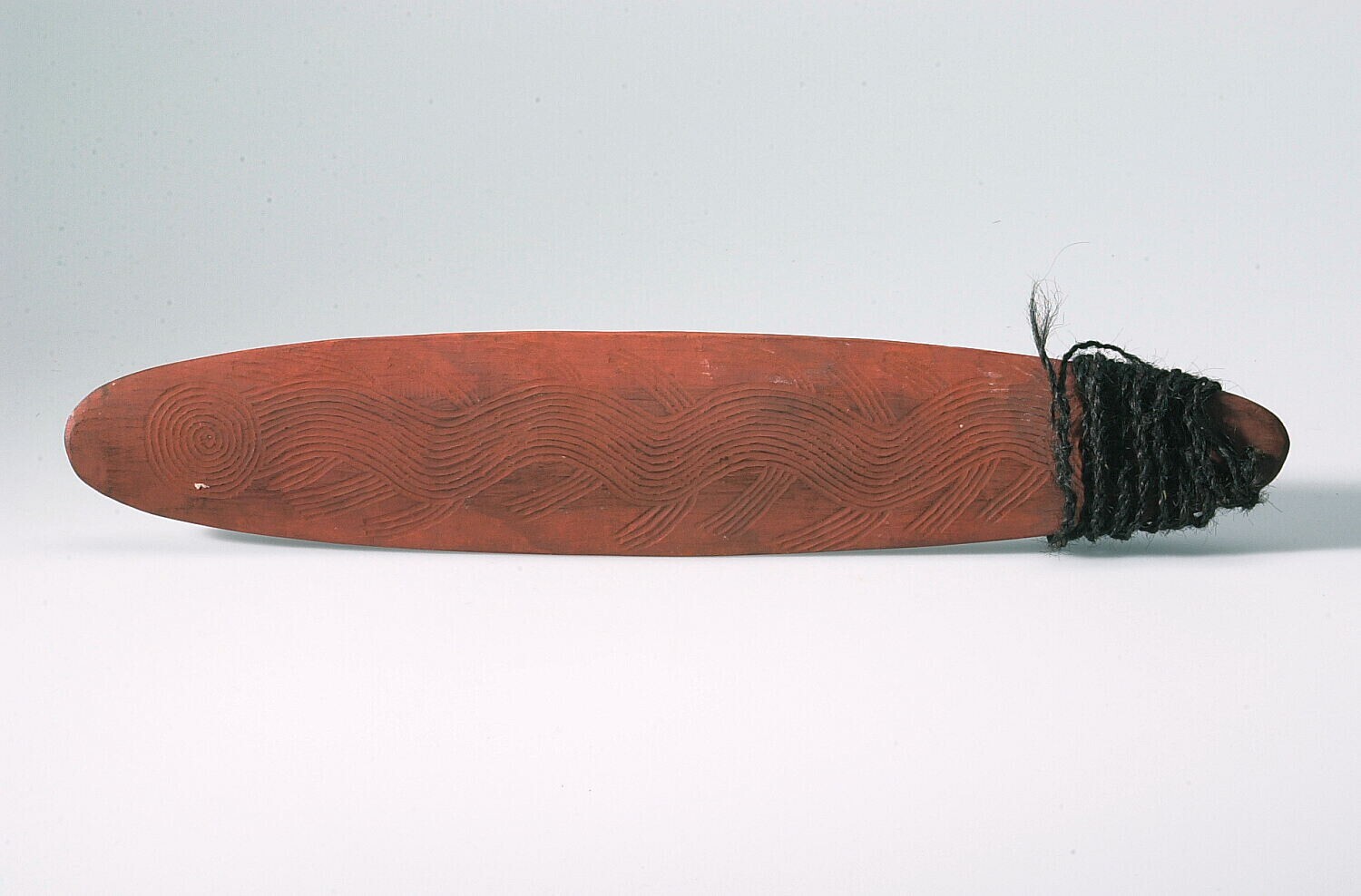
windirpiri
Source term: windirpiri (= namatuna, bull-roarer)
windirpiri: the Nambutji name for the bull-roarer, equated by Roheim with the Aranda namatuna.
Etymology. Roheim gives windirpiri as the Nambutji word for the bull-roarer, equating it outright with the Aranda namatuna; he records no literal meaning for the word itself. The Nambutji slat he collected is captioned ninti-windirpiri, 'penis tjurunga,' of the ancestor of Kuna-tari, in keeping with his report that the Nambutji cult hero is the phallus itself.
Among the Nambutji, a Luritja-speaking people of the northern Western Desert, the bull-roarer was the windirpiri, and behind it stood the myth of Witanygula — the penis of an old man who sat forever at the place called Kuna-tari. The organ travelled under the earth of its own accord, seeking the women, until a woman named Iniwara found it hidden beneath her tomahawk and chopped it to pieces; the chips turned to stone, becoming the tjurunga stones that are marked underneath with a penis. The carved windirpiri Geza Roheim collected at Kuna-tari — now in the Hungarian Ethnographical Museum in Budapest — was identified to him as exactly such a penis-tjurunga. Roheim, who worked here in 1929, recorded that the instrument was handed to a boy only after circumcision and subincision: the novice took it into the bush, kept to a separate waterhole so that women would not cross his track, and carried it hidden in his spear-thrower. Whirled in the thick scrub all night through initiation, its roar frightened the women's camp; charged with blood drawn from the subincision wound, the same slat served as an instrument of love magic.
When they give him the windirpiri (= namatuna, bull-roarer) they say, "Take care of it, carry it in womera (spear-thrower) with spear, don't leave it about, don't let women and children see it."
Geza Roheim, The Eternal Ones of the Dream (1945), p. 13.
Particulars
- Object
- A flat wooden slat whirled on a single cord to produce a roaring, whirring voice. The Nambutji windirpiri is a small perforated tjurunga-type bull-roarer; Roheim's collected specimen, a phallic 'ninti-windirpiri' form, is in the Hungarian Ethnographical Museum (Neprajzi Muzeum, Budapest), no. 132,129.
- Function
- Whirled in male initiation: handed to novices after circumcision and subincision, kept hidden from women and children, and swung to frighten the women's camp; its whirred voice belongs to the phallic totemic ancestor and the same slat doubles as an instrument of love magic charged with subincision blood.
Source
Geza Roheim, The Eternal Ones of the Dream: A Psychoanalytic Interpretation of Australian Myth and Ritual (New York: International Universities Press, 1945), pp. 13 (windirpiri handed to the Nambutji novice; namatuna whirled "in the thick scrub"), 33 (the Nambutji "in the north," cult hero is Phallos itself), 35 (museum object caption, ninti-windirpiri of the Nambutji, Hungarian Ethnographical Museum 132,129), 83 (the small perforated bull-roarer used in love magic), 109 (namatuna "whirled all night to frighten the women and children")