No. NGUINEA-006
Biliva, swung over the gardens
Papua New Guinea · Central Province · Kairuku Hiri District · Lala (Nara) area · Oceania · Sahul
Weather / fertility magic
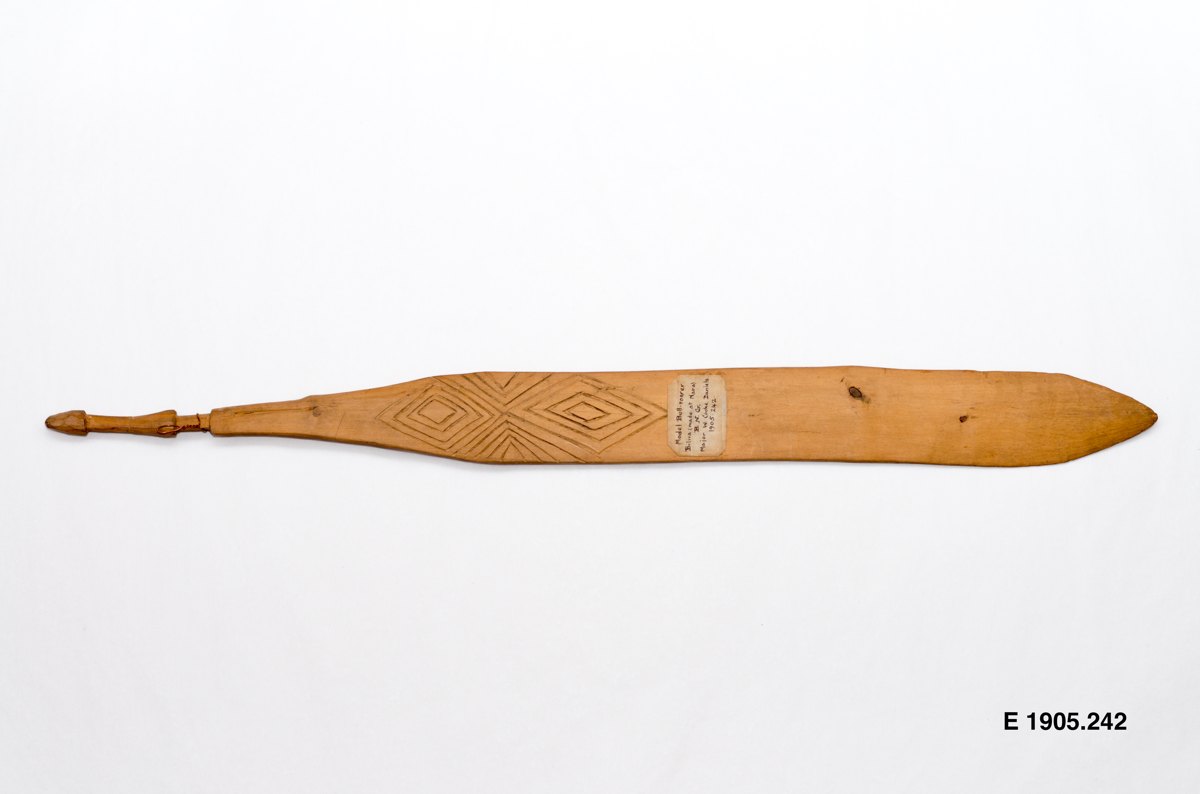
Biliva
Source term: Model Bullroarer
biliva: Seligman records the Nara (Lala) bullroarer as beriwa, swung to make crops grow — among the neighbouring Roro the same word means spirits, both ghosts of the dead and never-human malicious agencies (Lala/Nara, Central Province); Seligman 1910, pp. 304, 748.
Etymology. Seligman, ethnographer of the expedition that collected this model, records the Nara district name of the bullroarer as beriwa — evidently the same word as the museum's biliva. Among the neighbouring Roro the identical word beriwa means spirits: ghosts of the dead but also malicious agencies that were never human, and Seligman suggests the Roro took the bullroarer sense from the Nara, who swing the instrument to make their crops grow.
Swung over the gardens of the Nara (Lala) of Papua's south coast, this whirling board was meant to make the crops grow. Its name gives away whose voice it carried: beriwa, the same word that among their Roro neighbours means spirits, both the ghosts of the dead and malicious powers that had never been human. Charles Seligman recorded the custom when the Daniels expedition visited the Nara in May 1904. This sword-shaped example, carved from one length of wood and incised with opposed diamonds near the grip, is a scale model of the roarer that fed the fields.
Wooden model bullroarer carved from the whole; sword shaped with two opposing concentric diamond patterns incised either side near handle. Finial rounded and handle roughly finished.
Cambridge Museum of Archaeology and Anthropology, object record E 1905.242 (Model Bullroarer)
Particulars
- Object
- Sword- or spear-shaped model bullroarer, 480 x 44 mm; a second Nara example at the Pitt Rivers Museum is a carved and incised 402 x 48 mm wooden blade with string tied around the shaped end.